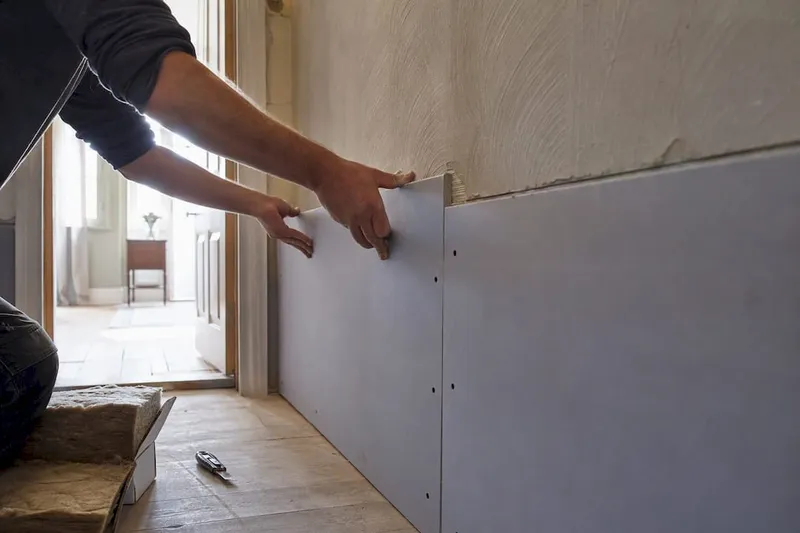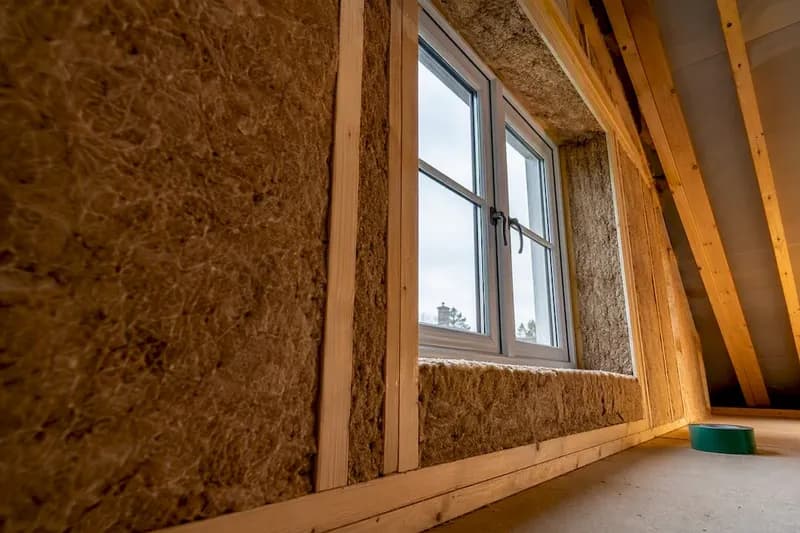
For most retrofit and renovation projects, recycled cellulose, wood fibre, and recycled PET or denim are the most practical low-impact insulation choices. Sheep's wool and cork suit moisture-managed builds and higher-budget eco projects, while hemp and aerogel fit specialist applications. Each carries different costs, installation demands, and thermal performance, so the right pick depends on your climate, budget, and how much detailing precision your build can handle.
TL;DR:
- Recycled cellulose is the most affordable and widely used natural insulation with low embodied energy, best suited for loft and dense wall retrofits.
- Proper installation and moisture management are critical, as gaps or thermal bridges can significantly reduce insulation performance regardless of the material's datasheet ratings.
- Natural fibers like sheep's wool and cork excel in moisture regulation and durability but come at a higher cost and require careful detailing for optimal performance.
- Recycled denim and PET insulations offer eco-friendly options with easily available environmental declarations, while hemp and aerogel are more specialized, with hemp sequestering carbon and aerogel providing high performance in tight spaces.
- Selecting the ideal insulation depends on climate, budget, and build complexity, with quality installation and comprehensive planning crucial to avoiding costly mistakes.
Table of Contents
- Sustainable insulation options compared by material
- What actually matters when choosing between them
- Budgeting for cost and installation complexity
- Embodied carbon, reuse, and end-of-life reality
- House A-Z's take on avoiding costly insulation mistakes
- Why the "best" material question misses the point
- Plan your sustainable insulation project properly
- Sources
- FAQ
Sustainable insulation options compared by material
Sustainability in insulation comes down to a handful of measurable things: recycled content, embodied energy, indoor air quality, and what happens to the material at the end of its working life. The EPA's guidance on greener insulation frames it exactly this way, pointing buyers towards thermal performance, reduced toxics and VOCs, and recyclability as the core criteria worth checking on any datasheet.
Here's how the main sustainable insulation materials stack up against each other.
- Cellulose (recycled newsprint): made largely from recycled paper treated with borate for fire and pest resistance. Manufacturer figures put thermal conductivity around 0.038 to 0.039 W/m·K, with notably lower embodied energy than polystyrene or glass wool. Best for loft retrofits and dense-packed wall cavities. Downside: it settles over time and needs careful blowing to avoid gaps.
- Wood fibre: pressed timber offcuts and forestry residue, sold as rigid boards or loose fill. It handles moisture well, buffering humidity rather than trapping it, which makes it a strong fit for older solid-wall homes. It's bulkier than mineral wool for the same R-value, so wall thickness needs planning.
- Sheep's wool: naturally moisture-wicking and self-regulating in humidity, with no need for chemical fire treatment in most cases because wool is inherently flame-resistant. It costs more than cellulose and is harder to source in volume outside specialist suppliers. Best for period properties and anyone prioritising a fully natural build.
- Cork: expanded cork granules or boards offer good acoustic and thermal performance and are entirely renewable, harvested without felling the tree. It's rot-proof and pest-resistant but sits at the premium end of the market.
- Hemp / hempcrete: hemp fibre batts insulate walls and roofs, while hempcrete (hemp shiv mixed with lime) forms a breathable, load-bearing wall system. Hemp sequesters carbon as it grows, but hempcrete construction is slower and needs specialist contractors familiar with lime-based builds.
- Recycled PET and denim: PET insulation is made from plastic bottles, and denim insulation is made from post-consumer cotton offcuts, with one major denim brand diverting around 19.5 million pounds of textile waste annually. A single home's worth of PET fibre insulation can use thousands of bottles. Both come with published EPDs and HPDs, and denim in particular is non-irritant enough to handle without a respirator.
- Aerogel: the highest performer per millimetre of thickness, aerogel insulates far better than any material on this list, but it's expensive and typically reserved for space-constrained retrofits where wall thickness is the deciding factor rather than budget.
- Straw and rice-husk boards: agricultural byproduct composites are still emerging in the mainstream market. Trials on cellulose and rice-husk blends report thermal conductivities between 0.0409 and 0.04607 W/m·K, with rice husk improving resistance to rot compared with some other natural fibres, though fire and mechanical testing data remain limited for some products.
What actually matters when choosing between them
R-value tells you how much a specific thickness resists heat flow; thermal conductivity (measured in W/m·K) tells you how the raw material performs regardless of thickness, and U-value tells you how the whole assembly, insulation plus wall plus air gaps, performs together. A brilliant k-value on a datasheet means little if the installation leaves gaps or the wall build-up creates a thermal bridge, a point sustainable design specialists at ASLA stress repeatedly: judge insulation as part of a system, not in isolation.
Embodied carbon is the other half of the equation. A product with a published Environmental Product Declaration lets you compare manufacturing impact on a like-for-like basis, and a Health Product Declaration flags any VOC or toxicity concerns before installation starts. Natural fibre materials also need careful vapour and moisture detailing; get it wrong and you risk trapped damp rather than the breathable performance you paid for.
Run through this before committing to a material:
- Confirm the k-value or R-value against your climate zone's building guidance, not just the marketing headline.
- Check for an EPD or HPD on the product page or ask the supplier directly.
- Map out moisture and vapour control detailing before ordering, especially around windows and junctions.
- Confirm fire rating suitability for the specific application (loft, wall cavity, or exposed ceiling).
- Get written confirmation the installer has handled this specific material before.
Pro Tip: Ask any supplier for their EPD reference number, not just a sustainability claim in a brochure. If they can't produce one, treat the green marketing with caution.
Budgeting for cost and installation complexity
Costs vary widely by material and by how much labour the job demands; for an independent comparison of cellulose and fiberglass covering installation complexity and performance, see Cellulose vs fiberglass insulation: which suits your home?. Loose-fill cellulose and recycled denim batts sit at the lower end and are largely DIY-friendly, since denim in particular needs no special respirator or gloves. Wood fibre boards and hemp batts sit in the middle, needing more precise cutting and fitting. Hempcrete and spray-applied systems sit highest, both in material cost and because they demand specialist contractors, hempcrete for its lime-based curing process, and castor-oil spray foams for the ventilation adjustments they often require alongside installation.
- Loose-fill cellulose and denim batts: low to medium cost, straightforward for a confident DIYer.
- Wood fibre and cork boards: medium cost, moderate skill needed for tight, gap-free fitting.
- Hemp batts: medium cost, DIY-possible with care around vapour detailing.
- Hempcrete and spray systems: high cost, professional installation essential.
When getting quotes, ask installers directly how many jobs they've completed with the specific material you're choosing, not just insulation generally. A fitter experienced with fibreglass won't automatically know the density settings for dense-pack cellulose, and that gap in experience is where callbacks happen.
Embodied carbon, reuse, and end-of-life reality
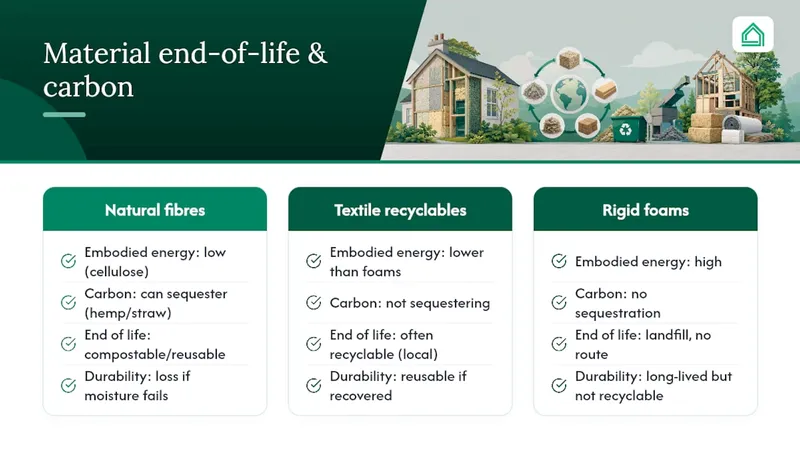
Cellulose carries markedly lower embodied energy than polystyrene or mineral wool, largely because it is made from recycled paper rather than energy-intensive raw processing. Hemp and straw-based materials go further still, sequestering carbon while growing, though that benefit only holds if the finished assembly lasts. Natural fibres that fail early because of poor moisture detailing lose that carbon advantage fast, since replacement means re-manufacturing and re-installing.
At end of life, cellulose and wood fibre are generally compostable or reusable in other low-grade applications, while PET and denim insulation can often be recycled again depending on local waste facilities. Rigid foams and most spray-applied products, by contrast, typically go to landfill with no practical recycling route.
House A-Z's take on avoiding costly insulation mistakes
Three things separate a smooth sustainable insulation job from an expensive one: a genuine budget contingency for detailing surprises, a written moisture-control checklist for every junction, and a formal check of the installer's experience with your chosen material.
Track these three items in a planning tool from day one, not once the walls are already open.
Why the "best" material question misses the point
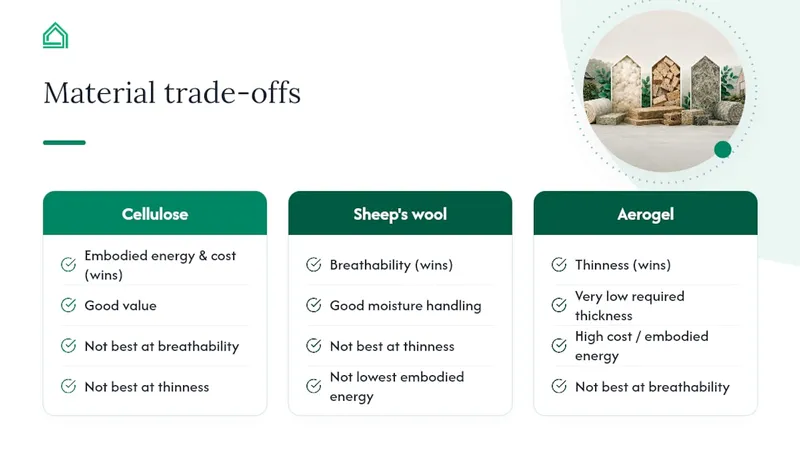
The most common mistake homeowners make is asking which sustainable insulation is objectively best, when the honest answer is that it depends entirely on your wall build-up, climate, and tolerance for installation risk. Cellulose wins on embodied energy and cost; sheep's wool wins on breathability; aerogel wins on thinness. None of them wins on everything.
Conventional advice fixates on R-value comparisons and largely ignores installation quality, yet a mediocre material fitted perfectly will usually outperform a brilliant material fitted badly. That's not a popular message because it doesn't fit neatly into a comparison table, but it's what the thermal bridging evidence consistently shows.
Prioritise the datasheet over the marketing claim, the installer's track record over the lowest quote, and the moisture detailing over the headline k-value. Get those three right and the material choice becomes far less high-stakes than it first appears.
— Azai
Plan your sustainable insulation project properly
House A-Z isn't a material supplier, so it won't sell you cellulose or wood fibre. What it does is stop the planning chaos that turns a straightforward insulation upgrade into a budget disaster: tracking contingency funds against your actual spend, building a detailed checklist for moisture and vapour detailing so nothing gets missed at the framing stage, and coordinating with contractors and installers so everyone's working from the same plan rather than three different spreadsheets.
If you're weighing up cellulose against wood fibre, or trying to work out whether your installer has actually handled hempcrete before, a structured plan catches the gaps before they become expensive. Start mapping your project with House A-Z's planning agents and see where the budget risks actually sit.
Sources
- 7 eco-friendly insulation alternatives for a green home
- Identifying Greener Insulation
- ISOCELL — natural, sustainable thermal insulation made from cellulose fibre
- Henry UltraTouch recycled denim insulation
- Experimental evaluation of cellulose and rice husk-based insulation materials
FAQ
What is the most environmentally friendly insulation?
Cellulose made from recycled newsprint generally has the lowest embodied energy of the mainstream options, with manufacturer figures showing conductivity around 0.038 to 0.039 W/m·K. Hemp and sheep's wool are strong alternatives where budget allows, since both come from renewable, low-processing sources.
What are some affordable alternatives to standard insulation?
Recycled denim and PET insulation are among the more affordable sustainable options, often priced close to standard fibreglass while offering recycled content and published EPDs. Loose-fill cellulose is typically the cheapest natural option for loft retrofits.
What is the healthiest and safest type of insulation?
Recycled denim insulation is non-irritant and can be handled without a respirator or special gloves, making it one of the safer materials for DIY installers. Sheep's wool is similarly low-irritant and needs no chemical fire treatment in most applications.
What are some eco-friendly alternatives to polystyrene foam?
Wood fibre boards, cork, and cellulose all replace polystyrene in wall and roof applications with far lower embodied energy and better end-of-life recyclability. Rice-husk composites are an emerging option, with lab tests showing comparable thermal conductivity to some established natural materials.
Is sheep's wool insulation worth the extra cost?
For period properties or fully natural builds, yes. Wool's self-regulating moisture handling and natural fire resistance suit damp or older solid-wall homes better than synthetic alternatives, though it costs more than cellulose or recycled denim.