Spray foam seals air leaks better and packs more R-value into each inch. Blown-in insulation (cellulose or fibreglass) costs less, suits retrofits and is generally considered the gentler choice for indoor air quality. Neither wins everywhere. The right pick depends on the part of the house, the depth available, your budget and how well the building is air sealed first.
This guide walks through how each material works, where each shines, what the numbers look like and how to decide room by room. Most of the hard data comes from US government and industry bodies, so we flag where figures are American. UK prices and building regulations differ, so use the figures to compare the two options and get local quotes in pounds before you commit.
TL;DR
- Spray foam is sprayed on site, expands to fill gaps and gives the best air sealing. Closed-cell foam has the highest R-value per inch.
- Blown-in insulation is loose cellulose or fibreglass blown by machine into lofts and cavities. It is usually cheaper and well suited to retrofits.
- Per the Insulation Institute, material matters less than correct installation, air sealing and R-value per pound spent.
- Fire protection and ventilation after application matter more with foam. Cellulose and fibreglass rank highly on health in one NRDC review.
- Plan the whole job, with budget and quotes in one place, before anyone books an installer.
Table of Contents
- How the two materials are made and installed
- Open-cell and closed-cell foam: a quick guide
- Performance: R-value, air sealing and moisture
- Cost: what the numbers say
- Health, fire and the environment
- Spray foam vs blown-in cellulose vs batts
- Which one for which part of the house?
- Our perspective
- Plan your insulation choice with House A-Z
- Questions readers ask
- Sources
How the two materials are made and installed
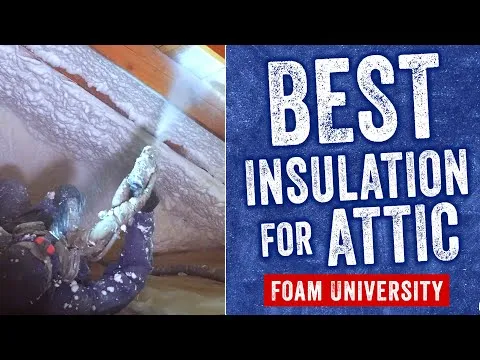
Spray polyurethane foam is made on site from two components that meet at the nozzle. It lands as liquid, expands and cures in place. Proper formation depends on following the manufacturer's instructions for air temperature, humidity and the temperature of the surface being sprayed, and a short wait is needed before anyone re-enters.
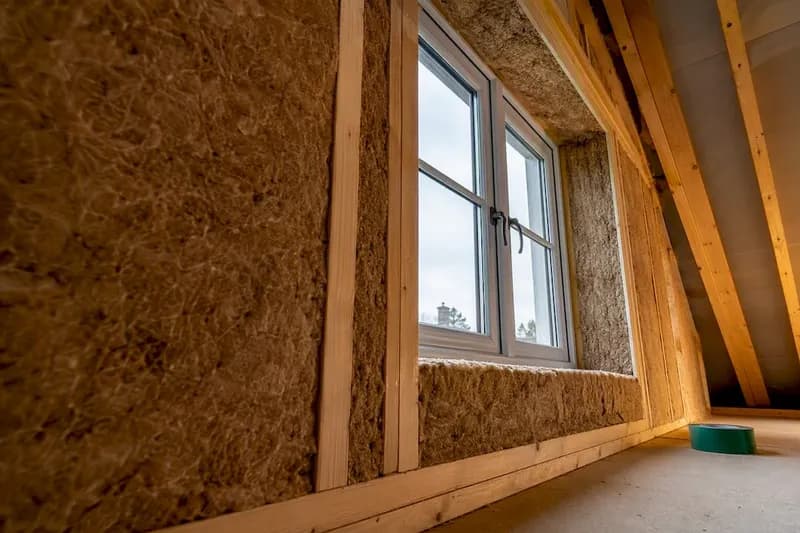
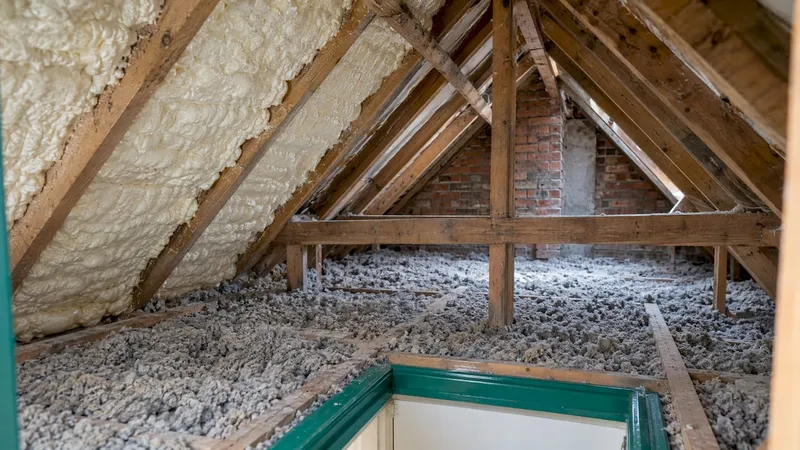
Blown-in insulation is a dry, loose material. Fibreglass or cellulose is fed through a machine and blown onto a loft floor or into wall cavities, where it sits behind netting. According to the US Department of Energy, loose-fill fibre insulation is inexpensive, conforms to the space it is blown into and is well suited to retrofits. It also fills spaces around electrical boxes, wiring and pipes. The same guide notes it typically needs a professional installer and a blowing machine.
In practice, that gives you a simple split:
- Spray foam: a liquid that becomes a solid, bonded layer. It works as insulation and as an air barrier in one go.
- Blown-in: a fluffy blanket of fibres. It is excellent at covering awkward shapes and at adding depth to a loft, but it relies on a separate air-sealing step.
Open-cell and closed-cell foam: a quick guide
Spray foam comes in two flavours, and the difference changes both price and performance.
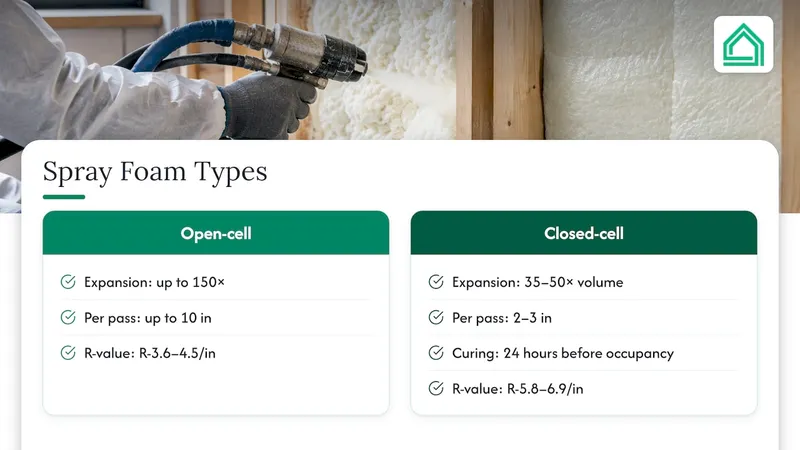
Closed-cell foam keeps over 90% of its cells closed, with insulating gas trapped inside, which makes it rigid and hard to compress. The US Department of Energy's spray foam guide adds that closed-cell foam expands roughly 35 to 50 times its original volume and is typically applied in layers of 2 to 3 inches per pass. Natural Resources Canada says it needs a 24-hour curing and off-gassing period before occupancy resumes and should not be used in enclosed cavities.
Open-cell foam is softer and expands far more, up to 150 times. It can go on to full thickness in a single pass, generally up to 10 inches, and it has a lower installed cost because of that higher expansion ratio.
The Spray Polyurethane Foam Alliance gives typical R-values per inch (US units) of R-3.6 to R-4.5 for open-cell and R-5.8 to R-6.9 for closed-cell. Closed-cell foam is the choice when depth is tight and you want the most insulation in the least space.
Performance: R-value, air sealing and moisture
Air sealing is where foam stands out
Air leakage through gaps, cracks and voids wastes heat. The US Department of Energy says both foam types are excellent at air sealing, because the expanding foam fills the gaps, which makes it better at blocking airflow than fibreglass or cellulose. That is the strongest argument for foam in rim joists, awkward roof slopes and anywhere the building is draughty.
Thermal performance: closer than the marketing suggests
Per inch, closed-cell foam wins clearly. But a thick layer of blown-in material can match it. The Insulation Institute makes the point that the material has little impact on energy savings. Three things drive efficiency: correct installation, proper air sealing and the most R-value per pound spent. Any material of the same R-value insulates equally well when installed and sealed correctly.
The same page adds that no insulation product is proven to give a continuous whole-home air barrier. Fibreglass, mineral wool, spray foam and loose-fill cellulose all need air sealing to work properly. So with blown-in, budget for sealing the gaps first. It is a small job with a large payoff.
Walls and uneven cavities
US Department of Energy research on high-R walls notes that because installation is more uniform, a spray or blown-in product is recommended to reach the highest overall wall R-value. Of those options, cellulose has the lowest embodied energy and offers increased fire resistance.
Strength and durability
Closed-cell foam adds a bonus: the US Department of Energy says racking strength of frame walls increases substantially when it is used in the cavities, which matters for seismic and hurricane zones. That is less relevant for most British homes, but it shows foam acts as more than insulation.
Cost: what the numbers say
Prices vary by region, access, thickness and the installer's order book. All the figures below are US dollar figures from US sources, so treat them as a way to compare materials, not as a UK quote.
| Option | Typical US installed cost | Source |
|---|---|---|
| Loose-fill (8 to 23 inches) | $0.45 to $2.25 per sq ft | US Department of Energy guide |
| Open-cell spray foam (3.5 inches) | $1.70 to $2.50 per sq ft | US Department of Energy guide |
| Closed-cell spray foam (1 inch) | $1.30 to $2.00 per sq ft | US Department of Energy guide |
| Blown-in, typical attic | $975 to $2,200 on average | HomeAdvisor 2026 |
| Spray foam overall | $1 to $2 per sq ft | HomeAdvisor 2026 |
The first three rows come from the US Department of Energy's guide to home insulation, published in 2010. It notes that loose-fill and spray foam prices assume professional installation and include materials and labour. The last two rows come from HomeAdvisor's 2026 cost guide, which also puts open-cell foam at $0.44 to $0.65 per board foot and closed-cell at $1 to $1.50.
Older professional data from BuildingGreen's 2013 to 2016 table points the same way. It lists blown-in fibreglass at $0.66 to $0.83 per square foot and loose-fill cellulose at $0.64 to $0.80, at roughly R-3.6 to R-3.8 per inch.
Three things to take from this:
- Blown-in usually costs less per square foot for the same R-value.
- Closed-cell foam costs more but delivers more R per inch, so it can make sense where space is limited.
- Quotes can differ by 30% or more, so compare like for like: same R-value, same area, same air sealing scope.
Health, fire and the environment
This is where the two materials differ most in character, and where safe use matters.
Fire protection. Both foam types are combustible and formulated with fire retardants. The US Department of Energy says spray foam in building assemblies is typically required to be covered by a thermal barrier or ignition barrier. In the US model code, that is usually the equivalent of half an inch of gypsum board. In the UK, check the requirements with your installer and building control before foam goes anywhere near a habitable space.
Indoor air. A 2019 NRDC report on healthier insulation says fibreglass and cellulose are among the highest ranked from a health perspective and have the lowest installed cost for a given R-value. It flags that foam commonly contains flame retardants and that spray foam contains asthma-causing isocyanates. If anyone in your household has asthma or chemical sensitivities, speak to your GP and ask your installer how long to stay out of the property after application. Follow their re-entry and ventilation guidance to the letter.
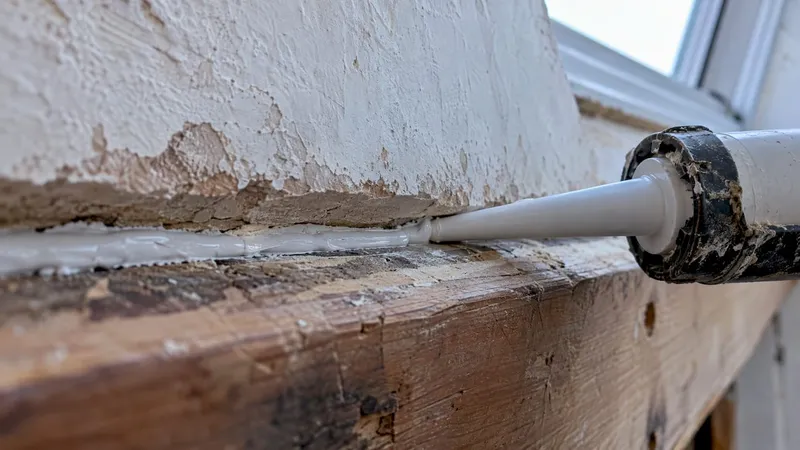
Sealing without foam. The same NRDC guidance suggests that where you want air sealing and insulation together, caulk or tape can seal the gaps before insulation goes in. That is a useful route if you are leaning towards blown-in.
Embodied energy. As noted above, cellulose has the lowest embodied energy of the sprayed or blown options. If you are building sustainably, our guide to avoiding costly mistakes with sustainable insulation goes deeper on that choice.
Spray foam vs blown-in cellulose vs batts
Many readers also ask how blown-in compares with batts (the rolled or pre-cut blankets). The US Department of Energy's Building America team says batts can be very cost-effective where cavities are a uniform size and match the batt's width and depth, but compressing a batt reduces its R-value. Blown-in can effectively fill irregular, inaccessible or obstructed cavities and, at sufficient density, can inhibit convective airflow.
A quick way to see how the three compare:
| Factor | Spray foam | Blown-in (cellulose or fibreglass) | Batts |
|---|---|---|---|
| Air sealing | Excellent | Needs separate sealing | Needs separate sealing |
| R-value per inch | Highest (closed-cell) | Moderate | Lower |
| Fits awkward gaps | Yes, bonds to surfaces | Yes, flows around obstacles | Poorly, if cavities are irregular |
| Typical cost | Highest | Low | Low to moderate |
| Best for | Rim joists, roof slopes, draughty shells | Lofts, retrofit walls | Uniform, accessible cavities |
| Installer needed | Yes | Usually yes | Often DIY-friendly |
Which one for which part of the house?
The US Department of Energy's guide for contractors says the best insulation depends on where you plan to install it, the R-value recommended for your climate and the cost of buying and installing it. So think area by area.
- Loft floor: blown-in is the natural fit. It is cheap, easy to top up to a generous depth and flows around joists and wiring.
- Existing cavity walls and retrofits: blown-in fills hidden voids without stripping the wall. That is why it is well suited to retrofits.
- Sloped roofs and tight rafters: closed-cell foam gives the most R-value in limited depth, with a fire-protective covering where required.
- Draughty rim joists and odd junctions: foam seals and insulates in one step, though caulk or tape plus blown-in can also work.
- New build timber-frame walls: either works. Blown or sprayed products suit the highest overall wall R-value, and your designer will set the target for your climate and regulations.
- Noisy rooms: insulation helps with sound too, but it is only part of the picture. See our practical soundproofing fixes.
A quick decision path
- Start with a whole-house energy assessment. The same US guide recommends a checkup before any insulation project, looking at insulation levels, signs of mould or moisture and the most cost-effective improvements.
- Fix moisture and ventilation problems first.
- Seal the air leaks you can reach.
- Choose the material by space, budget and health priorities.
- Ask for itemised quotes with the same R-value target and scope.
Our perspective
We see the same pattern with first-time builders and renovators: the material debate swallows weeks, while the decisions that really cost money slip past. Spray foam or blown-in is rarely the expensive mistake. The expensive mistakes are an unsealed shell, a quote that does not match the specification, or an insulation order that clashes with the electrics, the ceiling design and the budget.
That is why we built House A-Z as one place for it all. Budget tracking, room mapping, product tracking and project management sit together, with AI agents that work in plain language and turn your budget, preferences and timeline into personalised suggestions. When a contractor sends two insulation quotes, you can log both against the same room, compare them like for like and share the plan with your partner and your contractor.
Our users tell us the clarity is the point: one customer reported avoiding €20K of potential errors. Insulation is a perfect example of a choice that rewards a clear head and a clear plan. Pick the material that fits each space, write it down, and let the plan do the worrying for you.
Azai
Questions readers ask
Is spray foam better than blown-in insulation?
Spray foam is better at air sealing and, in its closed-cell form, gives more R-value per inch. Blown-in costs less and suits lofts and retrofits. The Insulation Institute says any material of equal R-value performs equally when installed and sealed properly, so the better choice is the one that fits the space and budget.
How much does spray foam cost compared with blown-in?
In US figures, spray foam runs around $1 to $2 per square foot, while a typical blown-in attic job costs $975 to $2,200 on average. UK prices differ, so ask for itemised quotes in pounds for the same R-value and area.
What is closed-cell spray foam?
It is a dense, rigid foam in which over 90% of the cells stay closed, trapping insulating gas. It has a higher R-value per inch than open-cell foam and is applied in thin layers, typically 2 to 3 inches per pass. It needs a curing and off-gassing period before you can use the space again.
Is blown-in insulation or spray foam safer for indoor air?
An NRDC review ranks fibreglass and cellulose among the best options for health and says spray foam contains asthma-causing isocyanates. If asthma or sensitivities are a concern, talk to your GP and follow your installer's re-entry and ventilation instructions.
Sources
- Installation of Common Insulation Types, ICC Safe
- Building America Best Practices Series: Volume 12, US Department of Energy (2012)
- Building America Best Practices Series: Volume 12, US Department of Energy (2023 edition)
- Which Spray Foam Is Right For You?, US Department of Energy
- Keeping the Heat In, Chapter 3, Natural Resources Canada
- FAQs, Spray Polyurethane Foam Alliance
- Insulation Types, Insulation Institute
- Practical Residential Wall Systems: R-30 and Beyond, US Department of Energy
- Guide to Home Insulation, US Department of Energy
- 2026 Cost to Install Insulation, HomeAdvisor
- Insulation Recommendations, BuildingGreen
- Guidance for Specifying Healthier Insulation and Air-Sealing Materials, NRDC
- BSC Information Sheet 501, Installation of Cavity Insulation, US Department of Energy