A builder's contract is a legally binding agreement between a homeowner and a building contractor that defines the scope of work, payment terms, project timeline, and the responsibilities of both parties. Known formally as a construction contract, this document is your primary protection if anything goes wrong during a build. Without one, disputes over costs, delays, or unfinished work become far harder to resolve. Standard forms like the RIBA Domestic Building Contract and JCT Minor Works Agreement exist precisely because verbal agreements and informal arrangements leave homeowners exposed.
What is a builder's contract and why does it matter?
A builder's contract, or construction contract, is the foundation of any successful building project. It captures every commitment made before work begins, covering who does what, by when, and for how much. According to experienced construction attorneys, contracts facilitate collaboration by defining budget, scope, and timeline upfront, which reduces conflict and improves the likelihood of project success.
The importance of builder contracts goes beyond legal formality. When a dispute arises over a delayed roof installation or an unexpected cost increase, the contract is the document both parties return to. Without clear terms, you are relying on memory and goodwill. A well-drafted agreement sets shared expectations from day one, so both you and your builder understand exactly what success looks like.

For first-time builders, the contract also serves as a project management tool. It tells you when to expect each phase of work, when payments are due, and what happens if the builder falls behind schedule. Understanding your home building timeline before signing makes it far easier to spot gaps or unrealistic commitments in the contract itself.
What key elements must a builder's contract include?
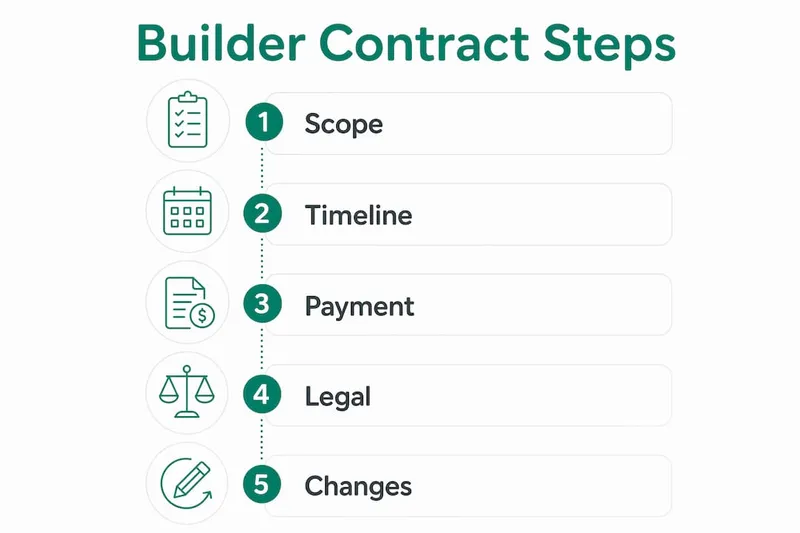
A thorough builder's contract should contain at least 25 critical clauses covering scope, timelines, payment, change orders, and dispute resolution. That is not excessive detail. Each clause closes a potential gap that could cost you money or cause delays.
The core elements to look for are:
- Legal names and registration details. The contract must name the contractor's registered legal entity, not just an individual's name. If the builder operates as a limited company or LLC, that exact registered name must appear, or the agreement may not hold up in court.
- Detailed scope of work. Vague descriptions like "kitchen renovation" are insufficient. The contract should specify materials by brand and model where relevant, dimensions, finishes, and which subcontractors will carry out specialist work such as MEP rough-in (mechanical, electrical, and plumbing).
- Project timeline and completion dates. Include start date, key milestones, and a practical completion date. Pair this with a clause addressing what happens if the builder misses those dates.
- Payment schedule. Payments should be tied to milestones, not calendar dates. This protects you from paying for work that has not yet been completed.
- Change order procedures. Any modification to the original scope must be documented. The contract should specify how changes are requested, approved, and priced.
- Dispute resolution mechanism. This could reference adjudication, mediation, or arbitration before court action. Having a defined process saves time and money if disagreements arise.
- Warranties and defects liability. Specify the period during which the builder is responsible for fixing defects after practical completion, typically 12 months.
- Permits and compliance. The contract should confirm who is responsible for obtaining planning permission and building control sign-off.
One detail many first-time builders overlook: architectural plans and specifications must be explicitly attached to or referenced within the contract to be legally enforceable. If your drawings are not listed as contract documents, the builder is not legally bound to follow them.
Pro Tip: Ask your builder to provide their company registration number before signing. Cross-check it against the official companies register in your jurisdiction to confirm you are contracting with the correct legal entity.
What types of construction contracts exist?
Construction contracts are not one-size-fits-all. The right form depends on your project's scale, complexity, and value.
| Contract type | Best suited for | Key characteristic |
|---|---|---|
| RIBA Domestic Building Contract | UK residential projects of any size | Designed specifically for homeowner-builder relationships |
| JCT Minor Works Agreement | Smaller UK projects under £250,000 | Straightforward terms with limited contractor design responsibility |
| NEC4 Engineering and Construction Contract | Large or complex builds | Collaborative, programme-driven approach |
| Fixed-price (lump sum) contract | Projects with a fully defined scope | Builder carries cost risk; price is agreed upfront |
| Cost-plus contract | Projects where scope is uncertain | Homeowner pays actual costs plus an agreed fee or percentage |
For residential projects, the scale of the job often determines the legal requirements around the contract form. Residential building work over £5,000 requires a written contract, with more detailed contracts mandated for jobs over £20,000. This threshold distinction matters because a small job contract and an extensive contract carry different obligations around progress payments and documentation.
The UK Construction Act 1996 defines what constitutes a construction contract in law, but it explicitly excludes contracts with residential homeowners from its provisions. This means the statutory payment and adjudication rights the Act provides do not automatically apply to your domestic build. You need to negotiate those protections directly into your contract, which is one reason using a standard form like RIBA or JCT is strongly advisable.
Prime contracts sit between the homeowner and the main contractor. Subcontracts sit between the main contractor and specialist trades such as electricians or groundworkers. As a homeowner, you are typically party only to the prime contract, but understanding the subcontract structure helps you ask the right questions about who is actually on site and accountable for each element of the work.
How do payment schedules and change orders work?
Payment terms are where many building disputes originate. Structuring them correctly from the outset protects your cash and gives the builder clear targets to work towards.
A milestone-based payment schedule is the most protective arrangement for homeowners. Milestone-tied payments ensure you only release funds when specific stages of work are verified as complete. A typical residential schedule might look like this:
- Deposit (10%). Paid on contract signing to cover mobilisation costs and materials procurement. Keep this as low as possible.
- Foundation and slab completion (20%). Released once the concrete is poured and inspected.
- Frame and roof structure (25%). Released after the structural frame and roof are weather-tight.
- MEP rough-in (25%). Released after mechanical, electrical, and plumbing first-fix work passes inspection.
- Practical completion (15%). Released when the building inspector signs off and you have conducted your own walkthrough.
- Defects liability period end (5%). Retained until the agreed defects period expires, typically 12 months after completion.
Retaining that final 5% is not about distrust. It is a standard industry practice that gives the builder a financial incentive to return and fix any defects that emerge after you move in. Never release the full contract sum at practical completion.
Change orders are a separate but equally important topic. Every project encounters changes, whether a client upgrades a kitchen worktop or a structural survey reveals unexpected groundwork. Minor non-structural changes may be agreed informally, but they should always be documented in writing afterwards. For anything affecting cost or programme, a formal written change order is non-negotiable. It should state the change in scope, the agreed additional cost, and any impact on the completion date.
Pro Tip: Keep a dedicated folder, physical or digital, for every change order, approval email, and site instruction. If a dispute arises six months into the build, this paper trail is your strongest asset. House A-Z users can log change orders directly within the platform to keep everything in one place.
Managing construction modifications carefully from the start prevents the cost creep that catches many first-time builders off guard.
What legal protections apply to builder's contracts?
Legal compliance in a builder's contract goes beyond simply having a signed document. Several specific requirements determine whether your contract is enforceable and whether you are adequately protected.
Key legal protections and compliance requirements include:
- Written contract obligation. For residential building work above the relevant value threshold, a written contract is a legal requirement, not a choice. Verbal agreements for significant works leave you with no reliable record of what was agreed.
- Timely delivery of the signed contract. Builders must provide a copy of the signed contract to the homeowner within five business days of signing. If your builder delays this, request it in writing immediately.
- Integration of all project documents. A construction contract integrates work orders, design drawings, specifications, and permits as part of the contract documents. Any document not explicitly referenced may be excluded from the legal agreement, which can create serious ambiguity about what the builder is actually required to deliver.
- Building Code compliance clause. The contract should confirm that all work will comply with current building regulations and any conditions attached to your development consent or planning permission.
- Liability limitation clauses. Some contracts include clauses limiting the contractor's liability to the contract sum or to specific conditions. Read these carefully. A clause that caps liability at a low figure could leave you undercompensated if major defects emerge.
- Dispute resolution pathway. Without a defined process, disputes default to litigation, which is expensive and slow. Adjudication, mediation, or a named arbitration body should be specified in the contract.
Different jurisdictions apply different legal definitions and protections to construction contracts, so always verify the rules that apply in your location. What is mandatory in one country or state may be optional in another. Consulting a construction solicitor before signing a contract for any project above £20,000 is a sound investment.
Understanding how to set expectations with contractors before work begins also reduces the risk of disputes reaching the formal resolution stage.
Key takeaways
A builder's contract protects both parties by defining scope, payment milestones, legal compliance obligations, and dispute resolution before a single brick is laid.
| Point | Details |
|---|---|
| Written contracts are mandatory | For residential work above £5,000, a written contract is a legal requirement in most jurisdictions. |
| Name the correct legal entity | Always contract with the builder's registered business name, not an individual, to ensure enforceability. |
| Use milestone-based payments | Tie payments to completed work stages and retain 5% until the defects liability period ends. |
| Attach all project documents | Plans, permits, and specifications must be explicitly referenced in the contract to be legally binding. |
| Define change order procedures | All scope changes affecting cost or timeline must be documented in writing before work proceeds. |
Why the contract is really about trust, not paperwork
I have reviewed enough building projects to say this clearly: the contracts that cause the most problems are not the ones with missing clauses. They are the ones where both parties signed without genuinely reading what they agreed to.
A builder's contract works best when it reflects an honest conversation between the homeowner and the contractor before it is drafted. The scope should come from a real discussion about what you want and what the builder can deliver. The timeline should be realistic, not optimistic. The payment schedule should reflect the actual cost of each phase, not a structure designed to front-load cash for the builder.
What I find most telling is that experienced builders rarely resist detailed contracts. They welcome them, because a clear agreement protects them too. It is the builders who push back against written change orders or resist specifying materials by name that you should be cautious about. Vagueness in a contract almost always benefits the party who drafted it.
The importance of builder contracts is not that they prevent all disputes. They do not. Their real value is that they give both parties a shared reference point when disagreements arise, which means most disputes get resolved without lawyers. That is worth every hour spent reviewing the document before you sign.
— Azai
FAQ
What is the builder contract definition in simple terms?
A builder's contract is a legally binding written agreement between a homeowner and a contractor that sets out the scope of work, price, payment schedule, timeline, and responsibilities of both parties. It is also called a construction contract or building agreement.
What should be in a builder's agreement as a minimum?
At minimum, a builder's agreement should include the legal names of both parties, a detailed scope of work, project start and completion dates, a milestone-based payment schedule, a change order process, and a dispute resolution clause.
Are there different types of construction contracts for homeowners?
Yes. Common types include fixed-price (lump sum) contracts, cost-plus contracts, and standard forms such as the RIBA Domestic Building Contract or JCT Minor Works Agreement. The right choice depends on your project's size, complexity, and how well the scope is defined before work begins.
Do I legally need a written builder's contract?
For residential building work above a certain value threshold, a written contract is a legal requirement. Work valued over £5,000 typically requires a written small job contract, while projects over £20,000 require a more detailed extensive contract with progress payment provisions.
What happens if architectural plans are not attached to the contract?
If plans, specifications, or permits are not explicitly referenced or attached to the contract, they may not be legally enforceable as part of the agreement. Always confirm that all project documents are listed as contract attachments before signing.