Home warranty records are your warranty certificates, appliance warranties, builder handover documents and the supporting build records that prove what you bought, when it was installed, and how it has been cared for since. The single most urgent step is to photograph every serial number and save every receipt the day they arrive, then register each appliance with its manufacturer before the paperwork disappears into a drawer. Do this in your first week after handover and the rest of the system becomes far easier to maintain.
TL;DR:
- Photograph serial numbers and save receipts immediately after appliance installation to simplify warranty claims and proof of purchase.
- Keep warranty certificates and maintenance records for the full coverage period, with manuals and as-built drawings stored indefinitely.
- Organize all documents into a digital folder system with consistent naming, regular backups, and linked serial number and receipt photos.
- Register appliances with manufacturers right after installation and maintain up-to-date, dated maintenance logs to protect warranty validity.
- Use a centralized digital platform to store warranties, manuals, appliance registrations, and contractor contacts, reducing lost documents and missing claims.
Table of Contents
- What to collect: the checklist every first-time builder needs
- How long to keep records: practical retention rules of thumb
- How to organise records: digital folder structures, naming and backups that scale
- Protecting warranty validity: registering goods and keeping maintenance records
- Handover and claim steps: a concise step-by-step process
- What we see go wrong, and how to fix it
- Keep every warranty record in one place with House A-Z
- Sources
- FAQ
What to collect: the checklist every first-time builder needs
A new build or renovation generates a surprising volume of paper and PDFs, and most of it matters more than it looks. The trick is capturing it as it arrives, not chasing it down six months later when a boiler fails and the installer has moved on to another site.
Government consumer guidance recommends saving a copy of every warranty and receipt and photographing serial numbers so proof of purchase and product identity are on hand whenever you need them. For a first-time builder, that means gathering:
- Warranty certificates, receipts, invoices and sales contracts for every appliance and system.
- Make, model, serial number, and purchase and installation dates for each item.
- Builder handover documents: completion certificate, operation and maintenance (O&M) manuals, as-built drawings and any snagging list.
- Contractor and subcontractor contact details alongside statutory closeout paperwork.
- Time-stamped photographs of deliveries, installations and serial number plates.
This last point is easy to skip and often the most useful later. A photograph of a boiler's rating plate taken on installation day, with the date visible on your phone, becomes hard evidence if a manufacturer questions when a unit went in. Our handover checklist for renovations walks through the exact documents worth chasing before your contractor leaves site.
How long to keep records: practical retention rules of thumb
Not every document needs forever, but some genuinely do. Warranty certificates should be kept for the full length of their stated cover, and O&M manuals and as-built drawings are worth holding indefinitely, since they describe the building itself rather than a single transaction with an expiry date.
Receipts sit in between: keep them for at least as long as the warranty period, plus a reasonable margin in case a claim runs late. Regulatory retention rules for equipment like HVAC systems illustrate the principle well: installation and serial-number records can be required to be retained by contractors and manufacturers for several years after installation, which is a sensible benchmark for homeowners keeping their own copies of the same information.
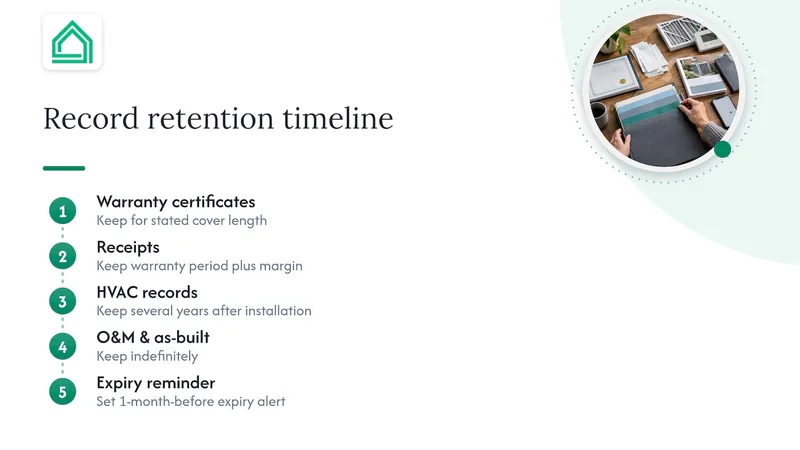
A practical habit beats a perfect archive. Set a calendar reminder or metadata tag for each product's warranty expiry date, ideally a month before it lapses, so you have time to raise any lingering issue while it is still covered. A simple spreadsheet column for "expiry date" does the job just as well as a dedicated app, as long as you actually check it.
How to organise records: digital folder structures, naming and backups that scale
Chaos creeps in fast when receipts live in three different inboxes and photos sit in a phone's camera roll. A consistent structure fixes that permanently, and it takes less time to set up than most people expect.
- Create a top-level folder per property, then subfolders by system: heating, plumbing, electrical, appliances, structural.
- Name each file with a consistent pattern, such as property_system_date_supplier_item_serial, so anything is searchable in seconds.
- Scan or photograph paper originals into searchable PDFs, but keep the physical receipt where possible, since some manufacturers still ask for it.
- Back up everything in at least two independent places: a cloud drive and a local NAS or encrypted external drive, with version history turned on for anything you edit.
Templates make this far quicker than building your own system from scratch. An appliance register, a maintenance log and a handover checklist template each save you from reinventing the wheel, and our guide on construction document control covers version control for anyone juggling multiple trades and revisions.
Pro Tip: Photograph the serial number plate and the receipt together in one shot, then file both under the same filename, so proof of purchase and product identity never get separated.
Protecting warranty validity: registering goods and keeping maintenance records
Two habits protect warranty rights more than anything else: registering products immediately and keeping documented proof that maintenance actually happened. The FTC's guidance on federal warranty law notes that registering products with manufacturers creates a verified record, allows status checks, and can flag recalls before they become a bigger problem.
Register each appliance as soon as it is installed and note the registration ID and date alongside your other records. Then follow the maintenance schedule set out in the O&M manual and keep dated entries or service receipts every time work is done.
- Register products with manufacturers immediately after installation, not weeks later.
- Log every scheduled service with a date, the work carried out, and who did it.
- If a receipt is lost, acceptable alternatives include a card statement, delivery note, or supplier confirmation.
BC Housing's guidance is blunt on this point: builders and warranty providers use O&M manuals and maintenance schedules to assess claims, and skipped maintenance is a common reason claims are refused.
Handover and claim steps: a concise step-by-step process
Handover day sets the tone for everything that follows, and a rushed one costs you later.
- Walk through the O&M manual with your builder, collect every warranty document and contact list, note any snags, and get written acknowledgement of what was handed over.
- If you spot a defect afterwards, write a dated notice describing the item, its location, photographs, and any relevant maintenance history, then send it to both the builder and the warranty provider.
- Assemble a claim pack containing the warranty, proof of purchase, maintenance logs, photographs and correspondence, and keep a copy of everything you send.
- Give the provider a reasonable window to respond before escalating, and if the issue stalls, raise it through the warranty provider's formal process or a relevant regulator.
Our guide to how builder warranties work covers what typically falls inside and outside cover, which is worth reading before you draft a claim.
What we see go wrong, and how to fix it
Receipts scattered across three email accounts. Serial numbers never written down. Registrations left for "another day" that never comes. Maintenance skipped because nobody wrote the schedule anywhere visible. These are the patterns behind most lost warranty claims we hear about, and none of them are complicated to prevent.
A single project register, kept up daily rather than reconstructed from memory months later, removes nearly all of this risk. It turns a pile of loose paperwork into a searchable, defensible record the moment you need it most.
— Azai
Sources
- Businesspersons' guide to federal warranty law — FTC
- Receipts and warranties – information for businesses — NSW Government
- Residential construction performance guide — BC Housing
- Warranties — Consumer Information (FTC)
FAQ
What counts as home warranty records for a new build?
Home warranty records include warranty certificates, appliance warranties, receipts and invoices, builder handover documents such as completion certificates and O&M manuals, and photographic evidence of serial numbers and installations. Keeping all of these together makes any future claim far easier to support.
How long should I keep appliance receipts and warranty certificates?
Keep warranty certificates for their full stated cover period, and hold receipts for at least as long as that warranty, plus some extra margin in case a claim is raised late. O&M manuals and as-built drawings are worth keeping indefinitely since they describe the property itself rather than a single purchase.
What if I have lost the original receipt for an appliance?
A lost receipt is not necessarily fatal to a claim. Acceptable alternatives include a card or bank statement, a delivery note, or written confirmation from the supplier showing the date, item and price.
Does House A-Z help with organising warranty documents?
House A-Z provides a central document store, an appliance register and maintenance scheduling designed for first-time builders and renovators. Plans include a Free option and a Pro plan at 29 € per month, with details on the pricing page.
Can poor maintenance void a home warranty claim?
Yes, builders and warranty providers commonly assess claims against the maintenance schedule set out in the O&M manual, and skipped maintenance is a recognised reason for a claim to be refused. Keeping dated maintenance logs or service receipts is the simplest way to protect your position.