Delays are common right now, and the sensible move is to plan for multi-week variability rather than hope for the best. Where no delivery date was agreed, the law gives you a 30-day maximum default, a useful backstop when a retailer goes quiet. The sections below walk through what causes the delays, realistic wait times by appliance type, your rights when things slip, and how to build a schedule that bends without breaking.
TL;DR:
- Delivery delays are often caused by factory shortages, container congestion, and capacity limits, with recent shipping on-time performance dropping to 29 percent.
- Freestanding appliances typically arrive within a few weeks, while built-in and bespoke finishes can extend wait times significantly, sometimes by several weeks.
- If no fixed delivery date was agreed upon, the law requires delivery within 30 days, and missing this period justifies canceling and claiming a full refund.
- Planning renovation schedules should prioritize ordering high-lead-time items first and building flexible booking options to accommodate unpredictable delivery delays.
- Using project management tools with AI alerts can help track appliance lead times, prevent schedule conflicts, and mitigate the impact of delays on renovation timelines.
Table of Contents
- Why are appliance deliveries taking so long right now?
- How long should you expect to wait for different appliances?
- What are your rights when a delivery is late or missed?
- Getting delivery day and installation to actually line up
- Building renovation timelines around uncertain lead times
- What the current shipping data suggests for the months ahead
- What actually matters when your timeline is uncertain
- A steadier way to manage delivery risk in your renovation
- Sources
- FAQ
Why are appliance deliveries taking so long right now?
Delays rarely come from one culprit. They stack: a factory shortage meets a congested port, which meets a courier network already stretched thin during a peak period.
- Factory backlogs and model-specific shortages, especially for popular finishes or newly launched ranges
- Global shipping disruption, including rerouting and port congestion that slows container movement between continents
- Domestic courier capacity limits and retailer scheduling errors, sometimes caused by software or stock-system faults
- Seasonal surges around Q4, January sales and factory shutdown periods in the appliance's country of manufacture
Container schedule reliability has fallen to around 29% on-time performance, with average delays rising to roughly 5.1 days, according to recent shipping analysis. That figure matters because a delay measured in days at the port often becomes a delay measured in weeks by the time it reaches a domestic delivery slot.
Some causes are short-lived, a single factory fire or a weather event clears within a season. Others are structural: larger vessels needing longer berth times, persistent route congestion and rerouting around disrupted corridors tend to keep lead times elevated for longer stretches, as analysis of container reliability sets out.
Pro Tip: Ask the retailer whether your model ships from a regional warehouse or direct from the manufacturer's home country. Regional stock tends to arrive far more reliably.
How long should you expect to wait for different appliances?
Freestanding appliances, the fridges, washers and cookers you can buy off a showroom floor, generally move faster than built-in equivalents, because integrated models depend on matching cabinetry and specific finish runs.
- Freestanding fridges, washers and cookers: often available from stock or within a few weeks
- Built-in and integrated appliances: routinely take longer because they're tied to cabinet dimensions and finish availability
- Popular or newly released models: frequently sit on backorder regardless of category
- Bespoke finishes, such as a particular stainless steel or a custom integrated door panel, can add several weeks to any of the above
A few practical steps help you read a lead-time notice properly.
- Check whether the quoted date is a dispatch date or an actual delivery date, they're often different.
- Ask whether installation, old-appliance removal and disposal are bundled or scheduled separately, since each adds its own booking queue.
- If a date looks vague ("Q4" or "within 6 to 8 weeks"), ask the retailer to commit to a narrower window in writing.
Model popularity and custom finishes remain the most common reasons an otherwise ordinary order slips into the long-wait category.
What are your rights when a delivery is late or missed?
Where you agreed a specific delivery date and that date genuinely mattered to you, the law treats it as an essential term. Where no date was fixed, regulation 42 of the Consumer Contracts Regulations 2013 allows you to end the contract if delivery doesn't happen within a reasonable additional period after you've pressed for it. Separately, the Consumer Rights Act 2015 sets a 30-day default: without an agreed date, the trader must deliver within 30 days of the contract date, and missing that entitles you to cancel and claim a full refund.
If your delivery has slipped, work through this sequence:
- Check your order confirmation for the exact date or window promised, and screenshot it.
- Contact the retailer in writing (email, not just a phone call) and ask for a firm new delivery date.
- Set a written deadline for that redelivery, giving a reasonable but specific number of days.
- If the new deadline is missed too, request cancellation and a full refund rather than accepting another open-ended promise.
Citizens Advice recommends keeping every communication in writing and using plain, specific language: "My order was due on [date]. Please confirm a new delivery date within 7 days, or I will cancel and request a full refund." If the retailer still stalls, trading standards and the small claims process are the next escalation routes.
Pro Tip: Keep a single email thread per order rather than mixing calls and messages. A clean paper trail is the strongest thing you can hand to Citizens Advice or a small claims court if it comes to that.
Getting delivery day and installation to actually line up
Booking the appliance is only half the job. Getting it through the door on the day your installer is standing by is the part that goes wrong most often.
- Decide upfront whether you want appliance-only delivery, white-glove service, or delivery with installation included, each carries a different price and a different risk of no-show
- Ask the retailer to confirm a specific day, not just a week, and get that confirmation in writing
- If they won't commit to a date, ask about holding the item in their warehouse and booking your installer provisionally with a free cancellation window
- Inspect the appliance before you sign anything: photograph any damage and refuse delivery if the packaging or unit looks compromised
Once the delivery team has left, proving transit damage becomes far harder, so the Citizens Advice guidance on damaged parcels is worth following at the door, not after.
Pro Tip: Book your installer for a day or two after the confirmed delivery date, never the same day. That buffer absorbs the small slips that happen constantly.
Building renovation timelines around uncertain lead times
Renovation planning works best when you treat appliance delivery as the least predictable part of the schedule, not the last box to tick. For a kitchen aiming at Q4 completion, the cumulative window of factory production plus sea freight can run to 75 to 100 days before congestion delays are even added, which pushes ordering deadlines earlier than most people expect.
- Order the longest lead-time items first: ovens, ranges and integrated units before the smaller accessories
- Decouple your installer booking from a fixed delivery date, and use provisional slots with cancellation flexibility instead
- Build contingency milestones into your handover documents so a slipped delivery doesn't cascade into a slipped plastering or tiling date
- Keep a short list of acceptable substitute models in case your first choice stalls indefinitely
Planning work often leans on exactly this kind of staggered approach, and the full scheduling guide walks through booking windows for first-time builders in more depth. Broader timeline planning resources cover how appliance slips interact with the rest of a renovation calendar, and it's worth pairing that with a handover checklist so proof of delivery dates and inspection notes don't get lost between contractors.
What the current shipping data suggests for the months ahead
Recent reporting puts overall container schedule reliability at around 29% on-time, with the Far East to Europe corridor reported as low as 6% on-time and average delays running over a week in some months, according to the same FreightWaves analysis. Analysts describe the volatility as structural rather than a short-term blip.
- Expect lead times to lengthen further around Q4 ordering peaks and factory shutdown periods overseas
- Route-specific congestion on Far East to Europe lanes is likely to keep affecting appliances manufactured or assembled in Asia
- If your renovation timeline has any flexibility, ordering outside peak season reduces your exposure to the worst of these delays
The practical takeaway is straightforward: if you're weighing whether to wait for a specific model or take an available alternative, Consumer Reports' shopping guidance is a sensible place to check current stock realities before you commit.
What actually matters when your timeline is uncertain
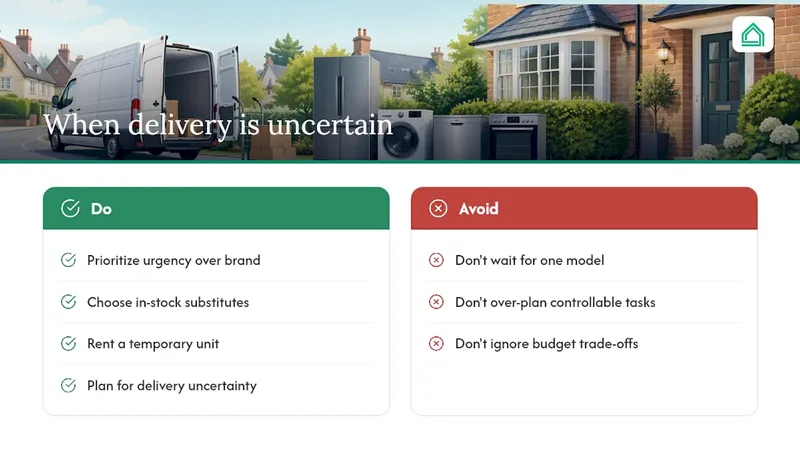
Most people over-plan the parts of a renovation they can control and under-plan the one part they can't: the delivery date. My honest read after watching renovation schedules for a living is that urgency and budget should decide your trade-offs, not brand loyalty to a single model.
If a delay threatens a hard deadline, a temporary rental unit or an in-stock substitute usually beats waiting. For more on how these delays ripple through the wider renovation budget, our piece on why kitchens are expensive to renovate is worth a read.
— Azai
A steadier way to manage delivery risk in your renovation
Appliance lead times are one of the hardest things to pin down in any renovation, and some planning platforms build delivery risk into the planning itself rather than treating it as a surprise. Tools with budget trackers and AI agents can surface where a long lead-time item sits against your broader timeline, so you can order the slow items first and keep your installer bookings flexible instead of fixed.
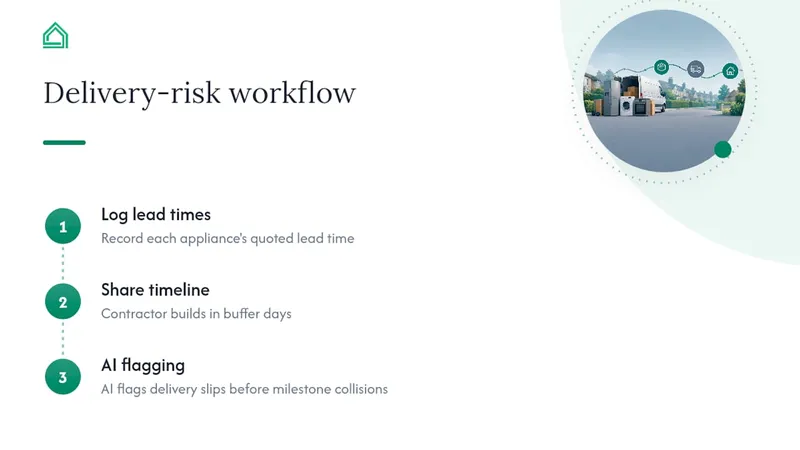
A typical workflow looks like this: log each appliance's quoted lead time in your project plan, share that timeline with your contractor so they can build in buffer days, and let the AI agents flag when a delivery slip is about to collide with another milestone. You can explore the AI agents directly, or see the full Free, Pro and Enterprise plans to find the tier that fits your project.
This article is general information, not a substitute for advice from a qualified lawyer. Consult a qualified legal professional about your own circumstances before acting on anything here.
Sources
- The Consumer Contracts (Information, Cancellation and Additional Charges) Regulations 2013 — regulation 42
- If something you ordered hasn't arrived - Citizens Advice
- New report: Just a third of container shipping on‑time - FreightWaves
FAQ
What are my rights as a consumer regarding delivery delays?
If you agreed a specific delivery date that mattered to you, the trader must meet it or you can treat the contract as ended under regulation 42 of the Consumer Contracts Regulations 2013. Where no date was agreed, delivery must happen within 30 days under the Consumer Rights Act 2015, and missing that entitles you to cancel and claim a full refund.
How long can a delivery be delayed?
Without an agreed date, the law sets a 30-day maximum before you can cancel and demand a refund. In practice, current shipping conditions mean many appliance orders take considerably longer than that to even reach dispatch, so setting a written deadline with the retailer is the more reliable safeguard.
What is causing shipping delays today?
Container schedule reliability has fallen to around 29% on-time, with average delays near 5.1 days and the Far East to Europe corridor performing far worse, according to recent analyst reporting. Port congestion, rerouting and larger vessels needing longer berth times are behind much of it, and these are considered structural rather than temporary.
What should I do if my delivery is delayed?
Contact the retailer in writing, ask for a firm new delivery date, and set a written deadline for that redelivery, as Citizens Advice recommends. If the new deadline is also missed, request cancellation and a full refund rather than accepting another open-ended promise.