Value engineering strips out cost that adds nothing to how a room performs, feels, or lasts, without touching the things that actually matter to you. On a renovation, it usually means keeping the layout that suits your life while swapping materials, phasing works, or simplifying details you never actually see. Run it early, before drawings are locked, and ask your designer or contractor for a formal VE review before pricing goes final.
TL;DR:
- Value engineering focuses on optimizing functions and lifecycle costs rather than just cutting expenses, often saving homeowners money in material substitutions and simplified layouts.
- Early VE implementation, before final drawings and ordering, provides the most flexibility and largest potential savings by allowing simple design changes without added costs.
- Comparing alternatives should prioritize performance, landed cost, lead time, and long-term maintenance, not just initial price or brand labels.
- Using dedicated platforms that consolidate budgets, product costs, and schedules reduces errors and ensures decisions are made with full visibility, avoiding costly delays.
- Involving homeowners, designers, contractors, and suppliers early ensures VE choices meet performance standards, align with project schedules, and preserve renovation quality and sustainability.
Table of Contents
- What is value engineering in construction, and how is it different from cost cutting?
- What savings can homeowners realistically expect?
- When should value engineering happen?
- How do you actually run value engineering on a renovation?
- How does a connected platform help you run VE checks?
- Who needs to be involved in a value engineering renovation?
- What tools and methods are actually used for VE on a renovation?
- How do you know if VE actually worked?
- Does value engineering affect renovation quality?
- Can value engineering support sustainability and energy efficiency?
- Where homeowners get value engineering wrong
- Run your VE checks without losing track of a single decision
- Sources
- FAQ
What is value engineering in construction, and how is it different from cost cutting?
Value engineering (VE) is a systematic, function driven review, not a hunt for the cheapest option. The Federal Highway Administration defines it as a multidisciplinary process that identifies how to deliver the functions a project needs at the lowest overall lifecycle cost, while protecting or improving quality. That distinction between "function" and "cost" is the whole point: VE asks what a wall, a worktop, or a roofline actually needs to do, then finds the smartest way to do it.
Cost cutting just removes spend, often blindly, and often at the expense of durability or comfort. Value management sits above both. According to RICS guidance, value management is the broader framework for defining what "value" means to a project's stakeholders, while VE is the technical exercise applied within it, comparing options against that agreed definition of value.
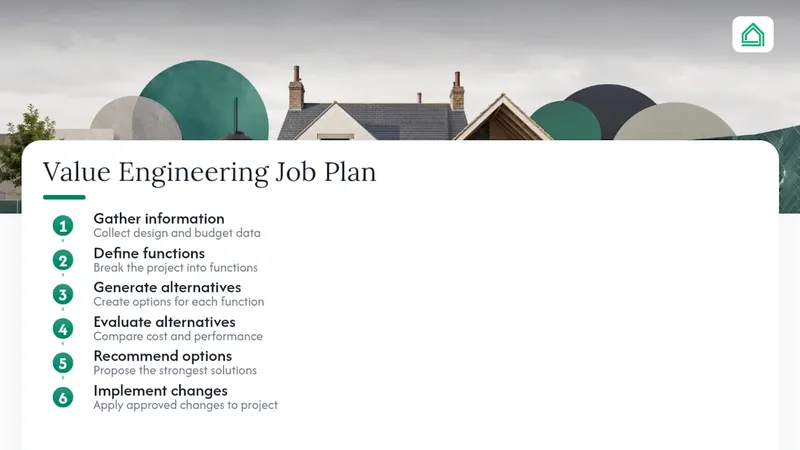
A proper VE process, adapted from the FHWA's job plan, moves through recognisable stages: gathering information about the design and budget, breaking the project into functions, generating alternatives for each function, evaluating those alternatives against cost and performance, recommending the strongest options, and implementing the changes. Skipping straight to "just make it cheaper" is cost cutting wearing a VE badge. The real process asks a harder, more useful question first: what is this element actually for?
What savings can homeowners realistically expect?
VE tends to deliver its biggest wins in three places: reduced risk of costly change orders, better lifecycle cost, and smoother scheduling. Autodesk's construction guidance notes that VE applied early reduces surprises during construction, because alternatives get tested on paper rather than discovered mid-build when they're expensive to fix.
The saving ranges vary hugely by category, which is why blanket percentages are misleading. Interior finishes are where the biggest swings happen: swapping a branded stone worktop for an engineered alternative with matching performance can cut that line item substantially, according to industry case examples. Simplifying a complicated roofline or reducing the number of internal angles in a floor plan also produces outsized savings, because every offset and intersection adds labour, waste, and future maintenance risk.
| VE technique | Where it applies | Typical saving driver |
|---|---|---|
| Material substitution by attribute | Worktops, flooring, tiling | Matching performance, not brand, cuts material cost |
| Roofline or layout simplification | New extensions, loft conversions | Fewer angles mean less labour and waste |
| Phasing works | Whole-house renovations | Spreads cost, avoids rushed decisions |
| Trade consolidation | Multi-room projects | Fewer mobilisations, less scheduling risk |
Pro Tip: Ask your contractor to flag which finishes are "performance critical" and which are cosmetic before you start comparing alternatives. It's a five-minute conversation that saves hours of second-guessing later.
None of this should touch structural integrity, code compliance, or thermal performance. A VE review that suggests thinner insulation to save money isn't value engineering. It's cost cutting with a good name, and it usually costs more once heating bills and remedial work are counted.
When should value engineering happen?
Timing decides how much VE can actually save you. The earlier it happens, the more options are still on the table and the cheaper it is to change your mind.
- Early design. This is where VE has the most leverage, before drawings, permits, or orders are locked. Changing a layout or a roofline here costs nothing but time.
- Procurement. Once designs are set but before materials are ordered, VE narrows to substitutions and sourcing decisions, still valuable but with fewer structural options open.
- Construction. VE at this stage is largely damage control. Changing a spec once trades are on site usually means demolition, delay, and change orders, exactly what VE is meant to prevent.
For a kitchen or bathroom, that means raising VE questions the moment layouts are drafted, not once cabinetry is ordered. For an extension, it means before the structural engineer finalises the roof form. Build a short decision calendar into your contract meetings, listing which choices need sign off by which date, and assign one person as the decision owner for each. Without that, VE conversations happen too late to matter.
How do you actually run value engineering on a renovation?

Running VE well comes down to comparing alternatives properly, not just swapping in whatever's cheaper on a catalogue page. Here's what that looks like in practice.
Techniques worth asking your team about:
- Simplify layouts and rooflines before finalising drawings, since reducing structural complexity early cuts labour and waste disproportionately.
- Favour standard sizes for windows, doors, and cabinetry over bespoke dimensions, which avoid custom fabrication costs.
- Compare materials by performance attribute (hardness, water resistance, maintenance) rather than brand, so porcelain or engineered stone can genuinely substitute for natural stone in secondary spaces.
- Ask about prefabricated elements (staircases, bathroom pods, roof trusses) where site-built alternatives add labour time without adding quality.
- Phase non-structural work, such as decorating or landscaping, separately from structural work to spread cash flow without compromising the build.
- Consolidate trades where possible, so one contractor handles plumbing and heating together rather than mobilising two separate crews.
When comparing any two options, four questions matter more than price on a spec sheet:
- Does it meet the same performance attributes (durability, water resistance, thermal rating)?
- What is the landed cost, meaning the product price plus freight, duties, and delivery, not just the catalogue figure?
- What is the lead time, and does it fit your build schedule without forcing delays elsewhere?
- What does it cost to maintain over ten years, not just to install this year?
Landed cost trips up more DIY renovators than any other factor. A worktop that looks like a bargain online can end up costlier once freight and installation are added, a mistake industry analysis flags as one of the most common VE failures. Understanding how hidden costs emerge in renovations before you compare alternatives saves you from choosing the wrong one for the wrong reasons.
Pro Tip: Bring three questions to your next design meeting: "What function does this element serve? What's the landed cost of the alternative? What does it cost to maintain in ten years?" Those three questions do more work than any spreadsheet.
A simple checklist keeps this from becoming abstract:
- List every major finish and system by function, not by brand name.
- For each, note the performance attribute that actually matters (waterproofing, load, insulation value).
- Request two alternatives per item with landed cost and lead time attached.
- Confirm which choices need sign off by which date, and who owns that decision.
- Revisit the list once before final ordering, since prices and lead times shift.
How does a connected platform help you run VE checks?
Most VE failures aren't about bad decisions. They're about decisions made without the full picture, because budget lives in one spreadsheet, product pricing in a browser tab, and the contractor's schedule in a group chat somewhere else entirely. House A-Z consolidates those pieces so a VE comparison actually holds up under scrutiny.
Inside the platform, that looks like:
- A budget tracker that shows the real impact of a substitution against your allowance, not just its sticker price.
- Landed-cost comparisons between alternatives, so freight and delivery aren't a surprise after you've committed.
- A shared decision calendar that flags when a choice needs signing off before it blocks the schedule.
- Contractor collaboration tools so your builder can see the same comparison you're looking at, in the same place.
One common failure this catches directly: a homeowner finds a cheaper tile online, orders it without checking lead time, and the whole bathroom install stalls for three weeks waiting for delivery. Its AI agents can flag that kind of mismatch before the order goes in, helping users avoid costly errors.
Pro Tip: Before approving any substitution, check its lead time against your contractor's schedule, not just its price against your budget. A cheaper item that delays the whole job rarely ends up cheaper.
Who needs to be involved in a value engineering renovation?
VE works best as a conversation between roles, not a decision made in isolation by whoever holds the budget.
You, as the homeowner, set the priorities VE is measured against. That means deciding early whether resale value, daily comfort, or running costs matter most, because what counts as "value" depends entirely on stakeholder priorities. Without that clarity, a contractor can't know which substitutions you'll be happy with.
Your architect or designer translates those priorities into function statements, the "what does this need to do" thinking that separates VE from guesswork. They're usually best placed to suggest alternatives that preserve design intent.
Your main contractor brings buildability and cost knowledge, flagging which substitutions genuinely save money on site versus which look cheaper on paper but add installation time.
Specialist trades (electricians, heating engineers, joiners) often spot the most useful VE opportunities, because they know which details cause callbacks and which barely matter once tiled or plastered over.
Suppliers matter more than homeowners expect. A supplier who can confirm landed cost and lead time on the spot prevents the scheduling failures that undo VE's savings elsewhere. Getting everyone aligned early, using something like a shared renovation vision, keeps VE conversations productive instead of adversarial.
What tools and methods are actually used for VE on a renovation?
The formal method behind most VE work is Function Analysis System Technique (FAST), a structured way of asking "what does this do, and why does it need to do that" for every element in a project. It sounds academic, but the practical version is simple: for each item, list its function in a verb-noun pair (for example, "resist water," not "tile"), then ask whether a cheaper or simpler option performs that same function.
Alongside FAST, most VE reviews lean on a few practical tools:
- Function-cost worksheets, which pair each building element with its function and its cost, making it obvious where money and purpose are mismatched.
- Life-cycle cost analysis, comparing not just purchase price but installation, maintenance, and expected lifespan.
- Landed-cost comparison sheets, tracking freight, duties, and delivery alongside catalogue price, which is where many DIY VE attempts go wrong.
- Decision calendars, sequencing which choices need approval by which date so VE doesn't collide with ordering deadlines.
None of these need to be complicated spreadsheets built from scratch. A renovation planning platform that already tracks budget and product pricing gives you most of this structure without extra admin, which is precisely the gap tools like House A-Z are built to close.
How do you know if VE actually worked?
Validating VE savings means comparing the final spend and outcome against what the original, unengineered specification would have cost, not against an arbitrary target. Keep a simple log: for every substitution or simplification, note the original spec's price, the alternative's landed cost, and the reason for the swap.
Add up the difference across the whole project, not per item, since some substitutions save more than others and a few might cost slightly more if they buy back schedule time or reduce future maintenance. That total is your real VE saving.
Validation also means checking the "not sacrificed" column. Did the substitution meet the same performance attribute you set out for it? A cheaper extractor fan that can't clear steam properly isn't a saving, it's a problem deferred. Keep photos and spec sheets for anything swapped, so if a warranty question comes up in three years, you can show the alternative met the required standard when installed.
The most reliable sign VE worked isn't the number on a spreadsheet. It's the absence of change orders during construction, because that's where unplanned cost usually hides. Fewer surprises mid build is the clearest proxy for a VE process that was actually run early and run properly.
Does value engineering affect renovation quality?
Done properly, VE tends to improve satisfaction rather than dilute it, because it forces decisions that would otherwise get made under time pressure, late, and badly. Autodesk's analysis links early VE to fewer change orders and smoother project delivery, both of which are strongly tied to how satisfied homeowners report feeling at handover.
The quality risk only appears when VE gets confused with cost cutting. Swapping a branded worktop for a functionally equivalent alternative rarely shows up in daily use. Thinning out insulation or downgrading a boiler's output to save money absolutely does, usually within the first winter. The difference is whether the substitution was measured against a function or simply against a price tag.
There's a scheduling dimension too. Homeowners who phase or simplify work through VE, rather than descoping under pressure near the end of a budget, tend to experience less disruption while living through the renovation. If you're staying in the property during works, that matters more than most cost tables suggest, and it's worth reading up on living at home during a renovation before you finalise a phasing plan.
Quality perception also depends on expectations set early. A homeowner told upfront that a substitution trades a slightly different finish for a meaningful saving tends to feel positive about that choice later. One who discovers a downgrade after the fact, without ever agreeing to it, feels cheated, even if the technical performance is identical.
Can value engineering support sustainability and energy efficiency?
Sustainability and VE line up more naturally than most homeowners expect, because both are ultimately about lifecycle cost rather than sticker price. A cheaper boiler that runs inefficiently for fifteen years is not a VE win. A slightly pricier heat pump or better insulated wall build that cuts running costs over that same period usually is, once lifecycle cost is the measure.
Retrofit decisions are a good example of where this plays out. Choosing how to upgrade heating in an older property involves real trade-offs between upfront cost, disruption, and long-term running costs, and practical retrofit guidance on historic homes shows how those choices differ from a straightforward new-build swap. The VE question is the same one you'd ask about a worktop: what function does this system need to perform, and what's the true cost of performing it over its full life, not just this year's invoice.
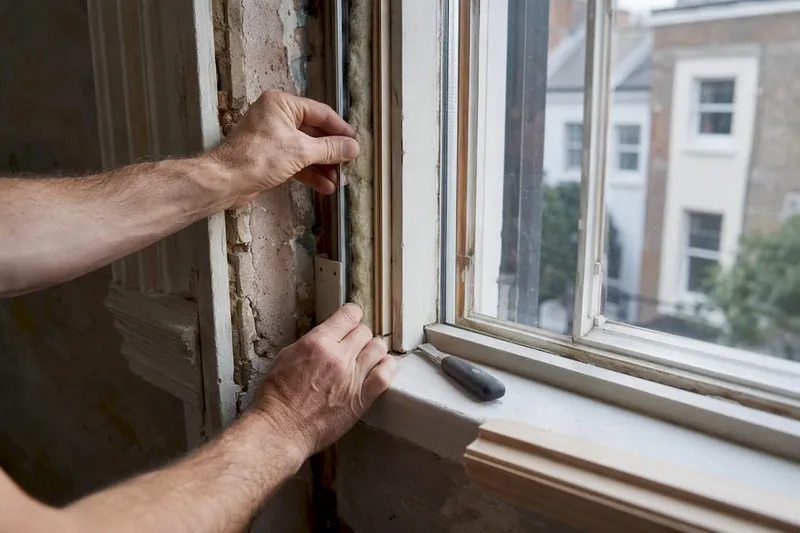
Energy efficiency upgrades also tend to reduce the risk of expensive retrofits later. Upgrading insulation or glazing during a renovation, when walls and windows are already open, costs a fraction of doing the same work as a standalone project five years on. That's VE thinking applied to timing rather than material choice: the cheapest moment to improve efficiency is while the building is already disrupted, not after it's finished and closed back up.
Where homeowners get value engineering wrong
The most common mistake isn't choosing the wrong material. It's comparing catalogue prices without checking landed cost or lead time, then discovering weeks into the build that the "saving" cost more in delays than it ever saved in cash.
Three corrections fix most of this. First, always price landed cost, not shelf price, before approving a swap. Second, agree who owns each decision and by what date, so VE conversations happen before ordering, not during it. Third, measure every substitution against the function it needs to serve, not just against the number on the invoice.
— Azai
Run your VE checks without losing track of a single decision
House A-Z gives you one place to run the comparisons VE actually depends on, instead of juggling a spreadsheet, a contractor's WhatsApp thread, and a dozen browser tabs of product pricing. The platform's budget and allowance tracker shows exactly how a substitution affects your total the moment you consider it, its landed-cost line items catch freight and delivery costs before they surprise you, and its decision calendar keeps sign-offs from colliding with ordering deadlines. Contractor sharing means your builder sees the same comparison you do, so VE stops being a conversation had twice, badly.
Start on the Free plan to map your budget and try the basics, then move to Pro when you want the fuller AI-driven insights and allowance tracking a live renovation demands. If you're coordinating multiple contractors or managing a larger project, the agent collaboration tools are worth a look before you finalise your team.
Sources
- Federal Highway Administration — Value Engineering (VE) program
- RICS — Value management and value engineering (practice note)
- Autodesk — Value engineering (construction guide)
- Tryflume
FAQ
What does value engineering mean in construction?
It's a systematic review process that identifies how to deliver a building's required functions at the lowest overall lifecycle cost, without reducing quality, as defined in FHWA's VE programme.
What are the five phases of value engineering?
The classic job plan runs through information gathering, function analysis, generating alternatives, evaluating those alternatives, and recommending and implementing the chosen changes.
What are examples of value engineering in a renovation?
Common examples include swapping branded stone for performance-matched porcelain, simplifying a complex roofline, phasing non-structural work separately from structural work, and consolidating trades to reduce scheduling risk.
What is NPD and VAVE?
NPD (New Product Development) and VAVE (Value Analysis/Value Engineering) are manufacturing terms describing how VE principles get applied during product design; in renovation contexts, the equivalent is applying that same function-first thinking to material and system choices before construction locks them in.
Can a platform like House A-Z help me apply value engineering at home?
Yes. Its budget tracker, landed-cost comparisons, and decision calendar give homeowners the structure a formal VE review normally requires, without needing construction industry tools or spreadsheets.