A design concept is defined as the central, unifying idea that guides every creative and functional decision in a project, connecting the initial brief to the final outcome. In product design and architecture, this idea is often called the "concept statement," and it acts as a strategic north star for the entire team. Understanding what is a design concept separates projects that stay coherent under pressure from those that drift into confusion. A design concept is typically expressed in one or two sentences, supported by sketches or mood boards, and it governs every choice from layout to material selection.
Why are design concepts important in design projects?
A clear design concept reduces subjective, opinion-based debates among stakeholders. Without one, every decision becomes a negotiation based on personal taste rather than shared criteria. That wastes time, creates friction, and produces inconsistent results.
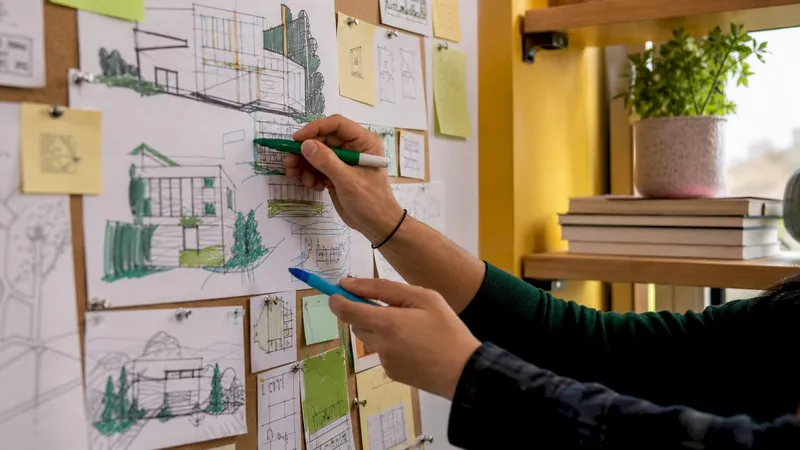
Well-defined design concepts significantly reduce misaligned development efforts and save project time. This matters most when teams are large or when clients are involved at multiple stages, because alignment breaks down fastest when there is no shared reference point.
The practical benefits of a strong concept include:
- Faster decisions. Teams refer to the concept rather than reopening settled questions.
- Reduced rework. Designers and contractors know which directions are out of scope before work begins.
- Clearer communication. A single statement replaces lengthy briefs when briefing new contributors.
- Stronger client relationships. Clients understand the rationale behind decisions rather than reacting to aesthetics alone.
Design concepts serve as communication tools that simplify complex objectives into a shared vision. That shared vision is what keeps a residential renovation or a product launch from becoming a series of disconnected choices. For teams managing construction modifications, a clear concept also reduces the frequency and cost of change orders.
How does a design concept differ from design thinking and conceptual design?
These three terms appear together constantly, and confusing them causes real problems in project planning. Each describes a different phase and purpose.
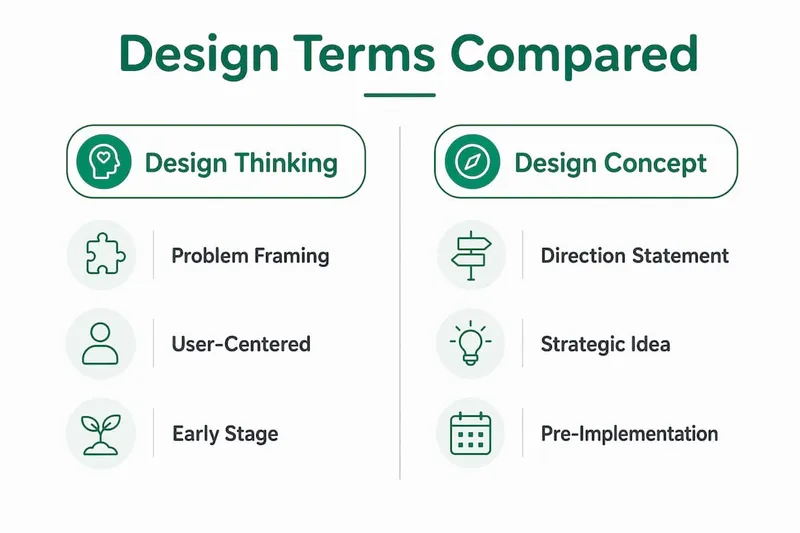
| Term | Phase | Purpose |
|---|---|---|
| Design thinking | Early problem framing | User-centred method for defining the right problem to solve |
| Conceptual design | Exploration phase | Generating and comparing multiple possible directions |
| Design concept | Direction-setting | The single chosen idea that guides all subsequent decisions |
Design thinking frames problems early, while the design concept finalises direction before implementation begins. Design thinking asks "what problem are we solving?" The design concept answers "here is the specific idea we will use to solve it."
Conceptual design sits between the two. It is the phase where teams explore multiple futures, test assumptions, and compare options. Distinguishing conceptual design from the design concept prevents feature creep and misalignment. Skipping this distinction can cause timeline risks and conflict during development.
The sequence matters. Design thinking produces a problem definition. Conceptual design produces candidate solutions. The design concept locks in one direction. Teams that treat all three as interchangeable tend to revisit decisions they thought were settled, which is one of the most common causes of construction delays and budget overruns in residential projects.
What are the key elements of an effective design concept?
A strong design concept is concise, specific, and functional. It is not a mood board, a colour palette, or a list of inspirations. Those are outputs of the concept, not the concept itself.
A design concept acts as "invisible architecture" rather than a visual style. It defines how the product or space should feel and function, not just how it should look. Misunderstanding this distinction leads teams to focus on surface choices before the underlying idea is clear.
The core elements of an effective concept include:
- A concise statement. If you cannot express the concept in one or two sentences, you have a collection of ideas, not a concept.
- User experience goals. The concept must describe what the end user will feel or achieve.
- Unique values. It should capture what makes this project distinct from a generic solution.
- Explicit exclusions. Design concepts must act as decision filters, clearly excluding tasks or features outside their scope. This "negative definition" is especially important for complex or multi-platform projects.
- Consistency across disciplines. The concept must hold up whether you are briefing an architect, a contractor, or a graphic designer.
Pro Tip: Write your concept statement, then write a second sentence beginning with "This means we will not..." Defining what the concept excludes is as important as defining what it includes.
Experts confirm that design concepts are strategic ideas guiding product feelings and values rather than visual styles or colours. Teams that treat the concept as a style guide tend to produce visually consistent but strategically incoherent results.
How to create and apply a design concept effectively
Creating a concept is a deliberate process. It requires input from the team, grounding in the brief, and discipline to stay concise. The following steps reflect best practice across product design and residential construction.
- Start with the brief, not the visuals. Read the project brief and extract the core user need. Write it in plain language before any sketching begins.
- Involve the team early. A concept created by one person and handed to others rarely sticks. Run a short workshop where contributors propose candidate statements, then converge on one.
- Write the concept statement. Draft a one or two sentence statement that captures the core idea, the user experience goal, and the key value. Test it by asking: does this help us decide between two competing options?
- Define the exclusions. Write down at least three things the concept explicitly rules out. This prevents scope creep and "design by committee" later.
- Embed it in your process. Pin the concept statement at the top of every brief, meeting agenda, and review document. Shared design language should be applied with discretion to avoid excessive debates and enhance workflow.
- Review and refine, but do not abandon. The concept can evolve if the brief changes significantly, but it should not be rewritten because someone prefers a different aesthetic.
Pro Tip: Test your concept statement against a real decision you face this week. If it does not help you choose between two options, rewrite it until it does.
"If teams are constantly debating direction, the concept is either too vague or not embedded enough in the process."
Overlong or vague design concepts cause confusion and slow progress. A concise, embedded concept enables faster decisions and reduces subjective aesthetic-driven choices. For residential projects, this principle applies directly to setting expectations with contractors, where a clear concept statement replaces pages of verbal instruction.
Key takeaways
A design concept is the single most important tool for keeping a project coherent, because it converts a brief into a shared direction that every contributor can act on.
| Point | Details |
|---|---|
| Definition | A design concept is a one or two sentence statement that unifies all creative and functional decisions. |
| Strategic role | It acts as a decision filter, not a visual style guide, guiding what the project includes and excludes. |
| Process sequence | Design thinking frames the problem; conceptual design explores options; the design concept locks in direction. |
| Team alignment | A shared concept reduces subjective debates and speeds up decision-making across disciplines. |
| Application | Embed the concept in every brief and review document, and define exclusions explicitly from the start. |
Why I think most teams misunderstand design concepts entirely
Most teams treat a design concept as a mood board with a caption. They gather images, pick a colour palette, and write a sentence that describes the aesthetic. Then they wonder why the project drifts halfway through.
The concept is not about how the project looks. It is about what the project does and why it does it that way. A residential renovation concept like "a calm, functional space for a family that works from home" tells you nothing useful. A concept like "every room prioritises acoustic separation and natural light, with no space dedicated solely to display" tells you exactly how to decide between two competing layouts.
The exclusion clause is the part most teams skip. Stating what the concept rules out is uncomfortable because it closes doors. But closed doors are the point. A concept that permits everything guides nothing.
I have also seen teams abandon their concept the moment a client expresses a preference that conflicts with it. That is not refinement. That is design by committee, and it produces exactly the kind of incoherent results the concept was meant to prevent. The concept should change only when the brief changes, not when someone has a new favourite colour.
Treat the concept as a living guide, not a fixed document. Review it when the project scope shifts. But protect it from aesthetic drift. The teams that do this consistently produce work that feels intentional, because it is.
— Azai
FAQ
What is a design concept in simple terms?
A design concept is a short, clear statement that defines the central idea guiding all decisions in a project. It connects the project brief to the final outcome and acts as a reference point for the entire team.
How long should a design concept statement be?
A design concept statement should be one or two sentences. If it cannot be stated that concisely, it is more likely a collection of ideas than a true concept.
What is the difference between a design concept and a mood board?
A mood board is a visual tool that illustrates aesthetic direction. A design concept is a strategic statement that defines purpose, user experience goals, and scope. The mood board supports the concept; it does not replace it.
When should a design concept be created?
A design concept should be created after problem framing and before any visual design begins. Creating it too late leads to decisions driven by aesthetics rather than strategy, which increases rework and misalignment.
Can a design concept change during a project?
A design concept can be refined if the project brief changes significantly. It should not be rewritten in response to aesthetic preferences or stakeholder opinions that fall outside the original brief.