If you are considering buying a property that needs work, or you already own a home and want to fund improvements, a renovation loan could be the financing tool you need. Many homebuyers mistakenly assume these are simply personal loans with a different label. In reality, a renovation loan is a specialised mortgage product that combines purchase and renovation costs into a single facility, giving you structured, lender-managed access to funds across your entire project.
Table of Contents
- Key takeaways
- What a renovation loan actually is
- Types of renovation loans
- Renovation loan requirements and the application process
- Benefits of renovation loans and how they compare to other options
- Managing your renovation loan project
- My take on renovation loans
- Plan your renovation with House A-Z
- FAQ
Key takeaways
| Point | Details |
|---|---|
| Single mortgage product | A renovation loan rolls your purchase price and renovation costs into one monthly repayment. |
| Multiple loan types exist | Government-backed and conventional programmes carry different caps, timelines, and eligibility rules. |
| Staged fund release | Renovation funds sit in escrow and are released in draws after lender inspections at milestones. |
| Documentation is critical | You will need detailed renovation plans, contractor bids, and consultant sign-offs to meet lender criteria. |
| Planning tools save money | Aligning your renovation scope with the correct loan sub-type helps you avoid funding shortfalls. |
What a renovation loan actually is
A renovation loan is a mortgage that bundles the cost of buying or refinancing a property together with the cost of carrying out repairs or improvements. Rather than taking out a separate personal loan or credit facility to cover building work, you finance everything through one product. This structure matters because it means one set of paperwork, one interest rate, and one monthly payment to manage.
The way renovation loans differ from home equity loans or lines of credit is in their timing. Home equity products let you borrow against equity you already hold. A renovation loan lets you borrow against the future, improved value of the property, which the lender assesses through an as-completed appraisal. That distinction is significant if you are purchasing a fixer-upper with limited equity from day one.
Key characteristics that define most renovation loan structures include:
- Combined financing. The purchase price (or existing mortgage balance for a refinance) and the renovation budget are wrapped into a single loan amount.
- Escrow-held funds. The renovation portion does not go directly to you. It is held in a separate escrow account and disbursed to contractors in stages.
- Staged draws. The lender releases funds after inspectors verify that specific milestones have been reached, such as completing structural work before moving to finishes.
- Approved contractors. Most programmes require you to use licensed, lender-approved contractors rather than doing the work yourself.
- Renovation consultant. For more complex programmes, a HUD-approved or lender-approved consultant reviews plans and monitors progress.
Pro Tip: Get your contractor bids confirmed in writing before submitting your loan application. Lenders use these figures to set the escrow amount, so a vague estimate can cause delays or underfunding.
Types of renovation loans
Renovation loan programmes vary widely in allowable work, borrowing limits, and eligibility criteria. Broadly, they fall into two categories: government-backed options and conventional products.
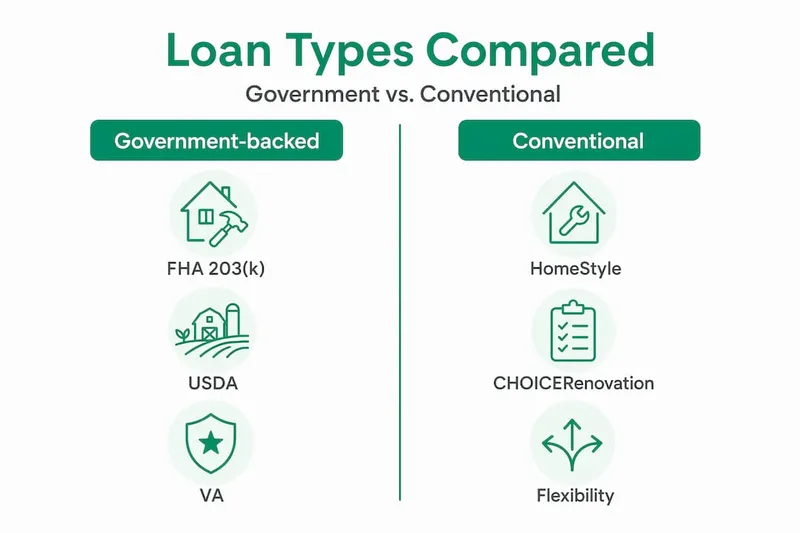
Government-backed programmes include FHA 203(k), USDA renovation loans, and VA renovation options. The FHA 203(k) standard loan requires a minimum of £5,000 in repairs and gives you up to 12 months to complete work. The limited version caps renovation costs at £75,000 and allows nine months for completion. Both require a 203(k)-approved consultant on more complex projects. USDA renovation loans, available in eligible rural areas, can finance up to 100% of the as-improved property value. The limited USDA version caps renovation spend at £35,000, which suits lighter cosmetic work.
Conventional programmes include Fannie Mae HomeStyle and Freddie Mac CHOICERenovation. Both allow you to borrow up to 75% of the purchase price plus renovation costs, or 75% of the as-completed appraised value, whichever is lower. Conventional products tend to allow a broader range of improvement types, including luxury upgrades, which government-backed loans generally do not permit.
Here is a comparison of the main programmes:
| Loan type | Backed by | Renovation cap | Down payment | Best for |
|---|---|---|---|---|
| FHA 203(k) Standard | Government | No set cap | 3.5% | Major structural work |
| FHA 203(k) Limited | Government | £75,000 | 3.5% | Cosmetic repairs |
| USDA Renovation | Government | £35,000 (limited) | 0% (eligible areas) | Rural fixer-uppers |
| Fannie Mae HomeStyle | Conventional | 75% as-completed value | 3–5% | Broad renovation types |
| Freddie Mac CHOICERenovation | Conventional | 75% as-completed value | 3–5% | Resilience upgrades |
Understanding minor versus structural work distinctions is the starting point for choosing correctly between these programmes. A bathroom refresh and a full structural remodel sit in entirely different categories, and selecting the wrong sub-type can leave you short of funds or ineligible for the programme altogether.
Renovation loan requirements and the application process
Applying for a renovation loan involves more documentation than a standard mortgage. You are not just proving your ability to repay. You are also demonstrating that your renovation plan is credible, costed, and deliverable within the lender's timeframe.
Here is a typical step-by-step process:
- Get a detailed scope of works drawn up. This document describes every element of the renovation, from structural changes to fixtures. Lenders use it to assess risk and set the escrow amount.
- Obtain at least two contractor bids. These must come from licensed contractors. Lenders require contractor bids and detailed plans as part of underwriting. Vague or verbal estimates are not acceptable.
- Commission an as-completed appraisal. An appraiser visits the property and estimates its value once all planned work is finished. This figure determines your maximum loan amount.
- Appoint a renovation consultant (if required). For FHA 203(k) standard loans and some conventional products, an approved consultant must review your plans and confirm their feasibility before the loan closes.
- Close the loan and open the escrow account. At closing, the renovation funds are transferred into escrow rather than released to you directly.
- Begin construction and request draws. Your contractor completes a phase of work, a lender-appointed inspector verifies progress, and then funds are released for that phase.
- Final inspection and loan completion. Once all work is finished and signed off, the remaining escrow balance is reconciled and the loan moves into its standard repayment phase.
Additional costs to plan for include appraisal fees, consultant fees, inspection fees per draw, and potentially higher origination costs. These vary by lender and programme.
Pro Tip: When considering mortgage loan types, ask your broker specifically whether a renovation product is available and whether the lender has experience with the escrow draw process. An inexperienced lender can cause significant delays at inspection milestones.
Benefits of renovation loans and how they compare to other options
The core appeal of a renovation loan is consolidation. Rather than managing a mortgage and a separate home improvement loan simultaneously, you handle one product. This means one monthly payment, one interest rate negotiated at the outset, and one closing process. For buyers targeting fixer-upper properties, renovation loans enable purchase and renovation without needing upfront cash reserves to cover building costs separately.
Benefits that renovation loans offer include:
- Long-term fixed rates. Because the renovation cost rolls into the mortgage, you avoid the higher variable rates typically attached to personal loans or unsecured credit.
- Higher borrowing capacity. The as-completed appraisal allows you to borrow against future value rather than current equity, which is useful when buying a property in poor condition.
- Property value uplift. Completing targeted renovations can increase the market value of the property, meaning the investment pays back through equity growth over time.
- Flexibility for first-time buyers. Government-backed renovation loans require relatively low down payments, making them accessible even without a large deposit.
When you compare renovation loans to alternatives, the picture becomes clearer. A home equity loan requires existing equity and creates a second monthly payment. A HELOC offers flexibility but comes with variable rates and a draw period that can complicate cash flow. A personal loan carries no property security, which typically means a higher interest rate and a shorter repayment term. For owners with substantial equity and a modest project scope, a home equity product may be simpler. But for buyers with limited equity or those taking on significant structural work, a renovation loan is usually more cost-effective over the long term.
Managing your renovation loan project

Understanding how the draw schedule works is the most important practical skill once your loan closes. Staged fund release through escrow means that your contractor will not receive payment until an inspector confirms the relevant phase is complete. This protects you, but it also creates pressure points if the contractor works ahead of schedule or if inspections are delayed.
Practical steps to keep your project on track:
- Map your contractor's programme to the draw schedule. Share the lender's draw milestones with your contractor before work begins so payment expectations are aligned from the start.
- Keep all permits current. Many lenders require permits to be in place before releasing funds for structural phases. A delay in permitting can freeze a draw at a critical moment.
- Document everything. Photograph each phase before and after, retain all invoices, and keep records of every communication with your contractor and lender.
- Build a contingency into your scope. Most advisers recommend a 10 to 15% contingency buffer above your estimated renovation cost. If the loan does not cover this, you need cash reserves to bridge any gap.
- Communicate proactively with your lender. Effective communication with lenders and contractors is vital to maintain project cash flow and timelines. Do not wait for a problem to surface before making contact.
Common pitfalls include underestimating the scope, choosing a contractor who is unfamiliar with lender inspection requirements, and failing to account for the time gap between completing a phase and receiving the draw payment.
My take on renovation loans
I have worked with enough first-time buyers and property owners to know that renovation loans are consistently misunderstood. People either assume they are too complicated to be worth pursuing, or they underestimate how much structure and planning they actually require.
What I have found is that the complexity is front-loaded. The paperwork, the contractor bids, the consultant reviews. Once those are in place and the loan closes, the process is more manageable than most people expect. Where projects go wrong is almost always at the planning stage. Borrowers select a loan sub-type without fully understanding the renovation scope it covers. They get contractor bids that are too vague to satisfy underwriting. They do not factor inspection timelines into their project schedule.
My genuine advice is this: treat the loan application as a project plan in its own right. Matching your project scope closely with the right loan sub-type is not an administrative detail. It is the decision that determines whether your funding holds up through to completion. Choose your contractor before you apply, not after. And set a realistic contingency budget before you look at what the loan will cover.
— Azai
FAQ
What is a renovation loan in simple terms?
A renovation loan is a mortgage that combines the cost of buying or refinancing a property with the cost of renovating it, wrapping both into a single monthly repayment. The renovation funds are held in escrow and released in stages as work is completed.
How does a renovation loan work once funds are released?
Renovation funds are held in a lender-managed escrow account and disbursed to your contractor in draw payments after an inspector confirms each phase of work is complete.
What are the main renovation loan requirements?
You will typically need a detailed scope of works, licensed contractor bids, an as-completed appraisal, and in some cases a renovation consultant, before your loan can be approved and closed.
Can I finance renovation costs if I have little existing equity?
Yes. Renovation loans are based on the as-completed appraised value of the property rather than current equity, which makes them accessible for buyers purchasing properties in poor condition.
Renovation loan vs home equity: which is better?
A home equity loan suits owners with substantial existing equity taking on smaller projects. A renovation loan is generally more suitable for buyers with limited equity or those undertaking significant structural work, as it draws on the future value of the property.