Owner-builder stress is defined as the sustained psychological and logistical pressure that arises when a private individual takes on full responsibility for managing a home construction project. This is distinct from simply doing physical building work. The industry term is "owner-builder," and the stress factors for owner-builders are well documented: underestimated time demands, complex planning requirements, financial exposure, and decision fatigue that compounds over months. Why owner-builders face more stress than they anticipate comes down to one core reality. Managing a build is a second full-time job, and most people start without realising that.
Why owner-builders face more stress than they plan for
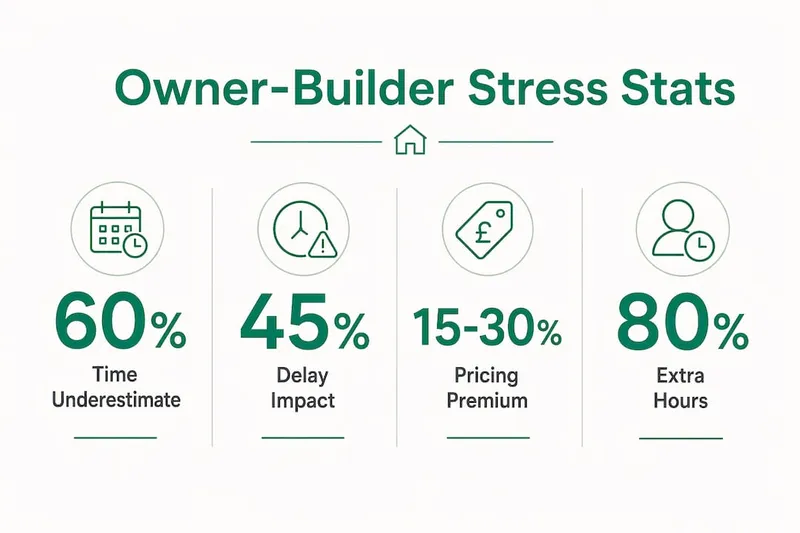
Owner-builders underestimate project time commitment by 60–80%, with most medium-sized builds requiring 15–25 hours of project management per week. That figure excludes physical construction work entirely. The result is a workload comparable to holding two jobs simultaneously for well over a year.

Most owner-builders expect a build to take 9–12 months. The reality is that typical projects run 16–24 months, and that extended timeline stretches stress across a much longer period than anticipated. Every additional month means more decisions, more contractor coordination, more budget monitoring, and more personal sacrifice.
First-time owner-builders also underestimate non-construction hours by up to 80%, with medium-sized homes often requiring 2,800–3,400 hours of project management alone. That is not a rounding error. It is a fundamental miscalculation that catches most people off guard within the first few months.
Pro Tip: Before you commit to an owner-builder permit, map out your current weekly schedule honestly. If you cannot identify 20 free hours per week for at least 18 months, the project will put serious strain on your work, relationships, and health.
How planning complexity and delays compound the pressure
Effective project management for a home build demands roughly 1,000 hours of planning across six months before site work even begins, covering 300–400 individual workflow steps. Professional builders dedicate around 60% of their time to administrative tasks before breaking ground. Owner-builders rarely account for this upfront investment.
Poor sequencing is one of the most damaging causes of owner-builder stress. When one trade is delayed, every subsequent trade is affected. A delayed concrete pour pushes back the framing contractor. A delayed framing contractor pushes back the MEP rough-in. The domino effect adds weeks to your programme and costs money at every stage.
The most common sources of delay include:
- Weather events that halt outdoor work for days or weeks at a time
- Supply chain disruptions affecting materials such as structural steel, windows, and roofing
- Trade availability gaps when subcontractors are booked elsewhere
- Council and inspection delays that hold up the next phase of work
- Design changes requested mid-build that require new approvals
Weather delays and unforeseen site conditions cause 45% of global construction projects to require contingency funds of at least 15%. Extreme environmental conditions reduce labour productivity by up to 40%, forcing costly rescheduling. That 15% contingency figure is not a suggestion. It is the minimum buffer that experienced builders build into every project.
The recommended approach to managing delays is to build contingency into both your budget and your programme from day one. A complete home building timeline that accounts for realistic phase durations reduces the shock when delays occur. Knowing that concrete curing, inspection windows, and trade lead times all add buffer time helps you plan rather than panic.
| Delay type | Typical impact | Mitigation |
|---|---|---|
| Weather | 1–4 weeks per event | Build weather windows into programme |
| Supply chain | 2–8 weeks per item | Order long-lead materials early |
| Trade availability | 1–6 weeks | Book trades 3–4 months in advance |
| Council inspections | 1–3 weeks | Submit documentation ahead of schedule |
Pro Tip: Lock in your trade sequence before any work starts. A written schedule shared with every contractor reduces the chance of gaps and gives you a clear record if disputes arise.
The emotional toll: decision fatigue, burnout, and daily life
Decision fatigue and burnout are direct consequences of juggling project management with full-time employment or family responsibilities. Every day on a build site brings dozens of decisions, from material substitutions to contractor queries to budget trade-offs. Over months, that cognitive load accumulates into genuine exhaustion.
The mental health issues for owner-builders are rarely discussed openly, but they are real. Anxiety about cost overruns, marital strain from time away from family, and the persistent fear of making an irreversible mistake are all common experiences. Recognising these pressures early is the first step toward managing them.
Practical strategies that reduce the emotional burden include:
- Scheduling mandatory rest days each week where you do not engage with the project at all
- Delegating decisions below a set financial threshold to your site supervisor or lead trade
- Setting communication boundaries with contractors, such as no calls after 6pm
- Talking openly with your family about the demands before the project starts, not during it
- Keeping a decision log so you do not revisit resolved choices under stress
Managing expectations with contractors is equally important for your mental state. Unclear communication creates ambiguity, and ambiguity creates anxiety. Written briefs, confirmed schedules, and regular site meetings reduce the number of surprises that drain your energy.
Pro Tip: Treat your rest days as non-negotiable appointments. Owner-builders who skip rest consistently make more expensive mistakes in the second half of their build than in the first.
Financial and professional pressures unique to owner-builders
Owner-builders face a trade pricing premium of 15–30% compared to licensed builders. Trades price higher because owner-builders are perceived as disorganised and unable to enforce contractual discipline. That premium is not personal. It is a calculated risk adjustment by tradespeople who have been burned before.
The financial exposure does not stop at trade costs. Owner-builders cannot purchase Home Building Compensation insurance for their own work. This gap in cover can reduce resale value by up to $150,000. Buyers and lenders treat uninsured owner-built homes as high risk, which affects both the sale price and the ability to secure a mortgage on the property.
The table below compares the financial risk profile of an owner-builder against a licensed builder arrangement:
| Financial factor | Owner-builder | Licensed builder |
|---|---|---|
| Trade pricing | 15–30% premium | Standard market rate |
| Statutory warranty insurance | Not available | Mandatory for most states |
| Resale value impact | Potential reduction up to $150,000 | No equivalent penalty |
| Cost overrun responsibility | Fully personal | Shared or contractual |
| Finance approval | More complex | Standard process |
Cost overrun prevention requires early identification of budget risks, not reactive responses when the money runs short. Successful owner-builders invest more in planning and budget contingency from the outset, treating the 15% contingency buffer as a fixed line item rather than an optional reserve.
The hidden resale penalty is the financial risk that surprises owner-builders most. You may save money during construction, but the absence of statutory warranty cover can cost you significantly when you sell. That trade-off deserves serious consideration before you apply for an owner-builder permit.
Key takeaways
Owner-builder stress accumulates from underestimated time demands, poor planning, financial exposure, and emotional fatigue across a project that typically runs far longer than expected.
| Point | Details |
|---|---|
| Time is the biggest shock | Builds run 16–24 months and demand 15–25 hours of management per week. |
| Planning prevents domino delays | 300–400 workflow steps require sequencing before site work begins. |
| Budget for 15% contingency | Weather and supply delays affect 45% of projects and require a financial buffer. |
| Trade premiums are real | Owner-builders pay 15–30% more than licensed builders for the same trades. |
| Insurance gaps affect resale | No Home Building Compensation cover can reduce property value by up to $150,000. |
What I have learned from watching owner-builders succeed and struggle
Having spent years working alongside first-time builders, I have seen the same pattern repeat. The people who struggle most are not the ones who lack building knowledge. They are the ones who underestimate the management burden and overestimate their available time.
The owner-builders who come through with their sanity intact share a few habits. They treat the build as a second full-time job from day one, not a weekend project that occasionally demands attention. They hire licensed trades for anything involving structural work, electrical, or plumbing, and they focus their own energy on coordination, documentation, and decision-making.
What I find most underappreciated is the value of thorough pre-construction planning. Most people want to break ground quickly. The ones who spend six months on detailed planning before touching a shovel consistently finish faster and with fewer cost blowouts. The home layout planning guide approach, where you lock in every decision before work starts, is not excessive caution. It is the single most effective way to reduce stress across the entire build.
My honest advice: have a direct conversation with your family before you commit. Not a general "this will be hard" conversation, but a specific one. Show them the weekly hour commitment. Talk through what you will not be able to do for the next two years. The builds that damage relationships are almost always the ones where that conversation never happened.
— Azai
FAQ
Why do owner-builders feel overwhelmed so quickly?
Owner-builders underestimate the management workload by 60–80%, facing 15–25 hours of project coordination per week on top of existing commitments. The gap between expectation and reality creates stress within the first few months.
What is the biggest financial risk for owner-builders?
The inability to purchase Home Building Compensation insurance is the most significant long-term financial risk, as it can reduce resale value by up to $150,000 and complicate mortgage approval for future buyers.
How can owner-builders reduce decision fatigue?
Scheduling mandatory rest days, delegating low-value decisions, and locking in a written decision log before the build starts are the most effective ways to manage cognitive exhaustion across a long project.
Why do trades charge owner-builders more?
Trades apply a 15–30% pricing premium to owner-builder projects because they perceive higher organisational risk and reduced ability to enforce contractual terms compared to licensed builders.
How much contingency budget should an owner-builder set aside?
A minimum contingency of 15% of the total build cost is recommended, as weather delays and unforeseen site conditions affect 45% of construction projects globally.