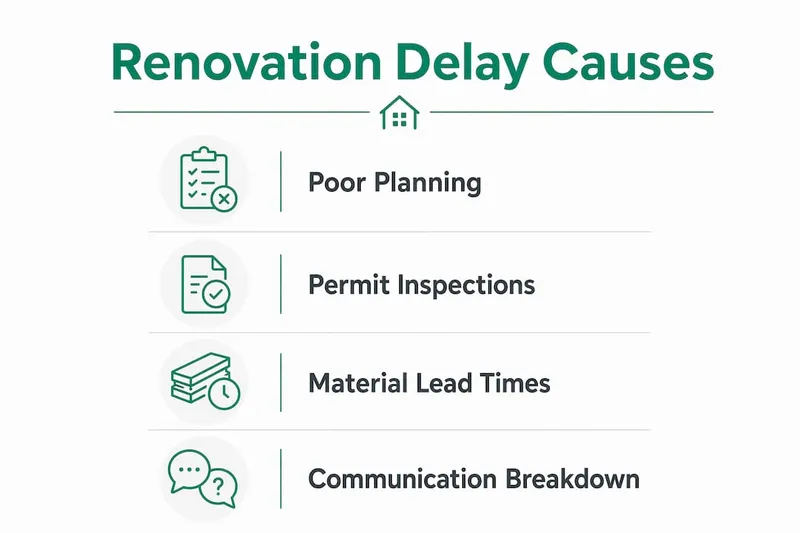
Renovation delays are defined as project stoppages caused primarily by inadequate upfront planning and poor coordination among contractors, council permit offices, and suppliers. Understanding why renovations cause delays is the first step to preventing them. Most delays stem from poor planning and communication before a single wall comes down, not from bad luck or unforeseeable events. Permit resubmissions, long material lead times, and contractor scheduling conflicts are the three most common culprits. The good news is that each one is largely within your control.
Why does poor planning cause renovation delays?
Incomplete design decisions are the single biggest driver of construction project delays. When you start building before finalising your finishes, fixtures, and layout choices, work stops every time a decision is needed. Late design decisions cause continuous pauses as contractors wait for your input before they can proceed. Those pauses compound quickly across a multi-week project.
Incomplete documentation creates a second layer of problems. When drawings are missing dimensions, specifications are vague, or structural details are unresolved, contractors submit permit applications that fail on first review. Each failure triggers a resubmission, which sends your application to the back of the municipal queue. That alone can add weeks to your timeline before any physical work begins.
The most common planning gaps that cause project hold-ups include:
- Tile, flooring, and paint selections not confirmed before trades are booked
- Kitchen and bathroom fixture specifications missing from drawings
- Structural engineer's report not obtained before permit submission
- Electrical and plumbing layouts not finalised before MEP rough-in (the installation of mechanical, electrical, and plumbing systems behind walls)
- Scope of works document not signed off by all parties
Pro Tip: Finalise every material selection, finish choice, and fixture specification before your contractor mobilises on site. A single undecided tile can hold up a bathroom fit-out for days.
Treating the planning phase as optional preparation rather than a critical project stage is the root cause of most renovation scheduling problems. Invest two to four weeks in documentation before works commence and you will avoid the majority of mid-project pauses.
How do permit inspections add weeks to your project?
Municipal permit inspections are a mandatory checkpoint in almost every renovation project, and failing one triggers a full work stoppage. You cannot continue construction in the affected area until corrections are made and a reinspection is passed. Resubmission adds at least 15 business days to your timeline because the application returns to the back of the council queue. That is three calendar weeks of delay from a single failed inspection.
The permit process typically follows this sequence:
- Submit permit application with drawings and specifications
- Council reviews application (timeframe varies by local authority)
- Permit granted or corrections requested
- Work commences and reaches an inspection milestone
- Inspector visits site and passes or fails the work
- If failed, corrections are made and a reinspection is booked
- Reinspection passes before work continues
Each step carries its own waiting period. Steps 3 and 6 are where most delays accumulate. Experienced contractors submit permit plans that anticipate local council requirements, reducing the risk of first-round failures. Choosing a contractor who has worked regularly with your local authority is one of the most practical ways to cut permit-related delays.
Track your permit application status actively rather than waiting for your contractor to report back. Contact the council directly if you have not received a decision within the expected timeframe. Pre-empting inspector concerns by asking your contractor what the inspector typically flags in your area is a straightforward way to avoid a failed inspection.
Short vs long lead times: how materials stall renovations
Supply chain disruptions are a structural feature of renovation projects, not an occasional exception. Specialty materials can exceed 20 weeks in lead time. Ordering custom cabinets after your permit is approved means your kitchen fit-out could be waiting five months for cabinetry while every other trade sits idle.

The table below shows typical lead time differences between standard and specialty items:
| Material Type | Typical Lead Time | Risk Level |
|---|---|---|
| Standard paint and plaster | 1–3 days | Low |
| Stock kitchen cabinets | 2–4 weeks | Low |
| Custom kitchen cabinetry | 12–20 weeks | High |
| Imported tiles or stone | 6–14 weeks | Medium |
| Bespoke windows and doors | 8–16 weeks | High |
| Structural steel sections | 4–10 weeks | Medium |
The practical implication is clear. Any item with a lead time over four weeks must be ordered during the planning phase, not after the permit is granted. A proactive builder orders long-lead items early and sequences trades around confirmed delivery dates. If you are managing the project yourself, this responsibility falls to you.
Supply chain volatility adds another layer of risk. Manufacturer delays, port disruptions, and stock shortages can push confirmed delivery dates back by weeks. Always get delivery commitments in writing and identify an alternative product before you need it.
Pro Tip: Order all specialty items, including custom cabinetry, bespoke windows, and imported tiles, during the design phase. Confirm delivery dates in writing and build a two-week buffer into your schedule around each delivery.
Explore renovation budgeting and contingency planning to understand how unexpected material costs and delays affect your overall budget.
How do contractor communication breakdowns cause delays?
Delays in one trade create a domino effect that pushes back every subsequent trade on the schedule. If your plumber runs three days late on rough-in, your plasterer cannot start. If plastering is delayed, your painter cannot begin. By the time the delay reaches the final trades, a three-day slip has become a two-week overrun. This is the most common pattern in renovation scheduling problems.
Verbal agreements are the primary source of contractor communication failures. A builder who says "I'll be there Monday" without written confirmation has made no commitment you can enforce. Contractor promises confirmed in writing with specific start dates and scope details create a paper trail that prevents vague excuses later. Send a follow-up email after every verbal conversation summarising what was agreed.
Best practices for managing contractor communication on your renovation:
- Confirm all start dates, milestones, and scope in a written contract before works begin
- Send a follow-up email after every site meeting summarising decisions and next steps
- Request weekly progress updates in writing, not just verbal check-ins on site
- Include a completion holdback clause retaining 10–15% of the project cost until the punch list (final defects list) is signed off
- Specify a cure period of 10–14 days in your contract for the contractor to address any schedule breach before you escalate
The cure period is a standard contractual mechanism. Standard cure periods run 10–14 days, giving your contractor a defined window to correct a delay before you have grounds to terminate or seek compensation. Without this clause in your contract, enforcing a schedule is significantly harder.
For detailed guidance on setting clear expectations from the outset, read how to communicate with contractors before your project starts.
Pro Tip: After any verbal agreement with a contractor, send an email within the hour summarising the date, scope, and next step. This single habit prevents more delays than any other communication practice.
Key takeaways
Renovation delays are mostly preventable when you address planning gaps, permit risks, material lead times, and contractor communication before work begins.
| Point | Details |
|---|---|
| Planning drives most delays | Finalise all design decisions and documentation before works commence to avoid mid-project stoppages. |
| Permit failures cost weeks | A failed inspection adds at least 15 business days; choose contractors familiar with your local council. |
| Order specialty items early | Custom materials can take 20 weeks or more; order during the design phase, not after permit approval. |
| Document contractor agreements | Confirm all start dates and scope in writing; verbal promises are unenforceable and a leading cause of delays. |
| Use financial levers | A 10–15% completion holdback clause motivates contractors to finish on time and address defects promptly. |
Most renovation delays are preventable: here is what i have seen
After working with homeowners and property investors across dozens of renovation projects, the pattern is consistent. The projects that run on time share one characteristic: the homeowner treated the planning phase as seriously as the construction phase. The projects that overran almost always traced their delays back to a decision that was not made, a document that was not finalised, or a conversation that was not confirmed in writing.
Most delays arise from a compound effect of multiple small issues rather than a single catastrophic event. A missing tile specification here, a permit resubmission there, a contractor who assumed you knew he was starting a week late. Each issue alone is manageable. Together, they can add months to a project.
The uncomfortable truth is that homeowners often contribute to their own delays by staying passive. Waiting for your contractor to flag problems is not a strategy. You need to track permit status, confirm material deliveries, and follow up on every verbal commitment. This is not micromanagement. It is basic project oversight, and it is your responsibility as the client.
The emotional weight of a delayed renovation is real. Living in a partially demolished home or paying rent while your property sits unfinished is genuinely stressful. The best antidote is preparation. When you have confirmed delivery dates, signed contracts with cure periods, and a complete set of design documents, you have done everything within your control. That clarity makes delays far easier to manage when they do occur.
Review the complete home building timeline to understand what to expect at each phase and where delays most commonly emerge.
— Azai
FAQ
What is the most common reason renovations get delayed?
Poor planning and incomplete design decisions before work begins are the leading cause of renovation delays. When homeowners make selections during construction rather than before it, contractors face repeated pauses waiting for direction.
How long can a failed permit inspection add to a renovation?
A failed inspection triggers a mandatory work stoppage and a resubmission process that adds at least 15 business days to your timeline. Choosing a contractor experienced with your local council significantly reduces this risk.
When should i order custom materials for a renovation?
Order all specialty and custom items during the design phase, before your permit is even submitted. Lead times for custom cabinetry and bespoke windows can exceed 20 weeks, making early procurement one of the most effective ways to avoid project stalls.
What is a cure period in a renovation contract?
A cure period is a contractual clause giving your contractor 10–14 days to address a schedule breach before you can escalate or terminate the agreement. Including this clause in your contract gives you a defined, enforceable mechanism for managing delays.
How do i handle unexpected renovation delays once they start?
Document every delay in writing, confirm revised timelines with your contractor by email, and check whether your completion holdback clause applies. For guidance on managing changes that arise mid-project, the change orders guide covers how to handle scope modifications without losing further time.