Good demolition planning means answering five questions before anyone lifts a sledgehammer: do you need to tell the council, do you need planning permission, what is hiding in the structure, who is legally responsible for safety, and where will every tonne of waste go? Get those right and the knock-down is the easy, satisfying part. Get them wrong and a tidy plot turns into a stalled site, a neighbour dispute or a fine.
This guide is written for first-time builders and renovators in the UK, mainly England. Rules differ in Scotland, Wales and Northern Ireland, so check your own local authority before you commit to dates.
TL;DR
- You must normally give your local authority written notice at least six weeks before demolition starts for buildings over 50m³, and that notice is not the same as planning permission.
- Planning permission, prior approval, listed building or conservation area rules may apply on top, so ask your local planning authority before you book contractors.
- A refurbishment and demolition asbestos survey is a legal requirement before the work begins.
- Under CDM 2015, demolition is treated like any other construction work, and you as client carry duties you cannot hand away.
- Plan waste, working hours and neighbour contact in the same document as the programme and budget.
Table of Contents
- What demolition planning actually covers
- Step 1: Tell the council with a Section 80 notice
- Step 2: Check whether you need planning permission
- Step 3: Survey for asbestos before anything else
- Step 4: Understand who is responsible under CDM 2015
- Step 5: Plan waste before the first skip arrives
- Step 6: Services, access and the neighbours
- A realistic demolition timeline
- Perspective: why demolition needs a plan, not a hope
- Keeping the plan in one place
- Document everything
- FAQ
- Sources
What demolition planning actually covers
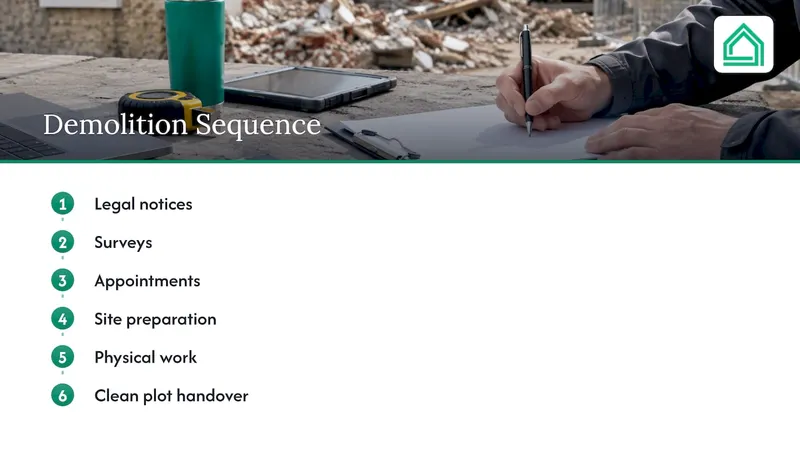
Demolition is not a single task. It is a sequence of legal notices, surveys, appointments, site preparation, the physical work and a clean handover of the plot. Planning it means putting those steps in order, with dates and costs beside each one.
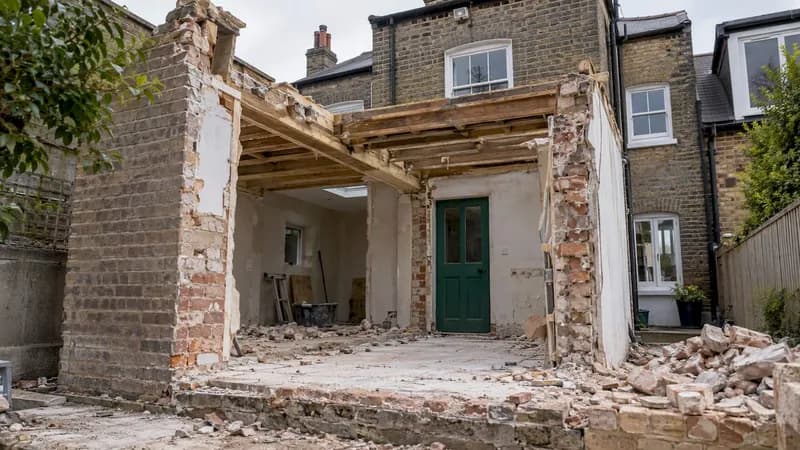
The scale does not change the logic. Whether you are removing a rear extension, a garage or a whole house for a rebuild, the same questions apply, only with different consequences. A partial demolition inside a renovation counts too: the Building Act notice duty applies to the whole or part of a building, with very limited exceptions.
Step 1: Tell the council with a Section 80 notice
Section 80 of the Building Act 1984 requires anyone intending to demolish a building to notify the local authority first. Guidance from councils says the notice applies to buildings with a volume greater than 50m³ and must be given at least six weeks before work starts. Demolition cannot proceed until the authority issues a Section 81 notice or the six weeks expire.
The same guidance lists exemptions, including greenhouses, sheds, prefabricated garages and internal parts of occupied buildings. If your building is close to the 50m³ line, measure it properly and ask building control rather than guessing. Castle Point's demolition guidance note sets out the same threshold and exemptions if you want a second council's wording.
What the notice is for
The notice gives the authority control over how the building comes down and how the site is left safe. It is not a permission to demolish. Many homeowners assume that a Section 80 notice settles everything, and it does not: it is separate from planning permission, which may still be needed.
Practical tips
- Put the six weeks into your programme as dead time. Use it for surveys, tendering and scaffold bookings.
- Check your council's page for the form and any fee. Some building control teams, such as the Building Control Partnership, state there is no charge, but this varies by authority, so confirm locally.
- Keep proof of the date you served the notice. It starts your clock.
Step 2: Check whether you need planning permission
This is where first-time builders most often trip. Planning rules treat demolition differently depending on the type of building, its location and its use. A building in a conservation area, a listed building, or a site with protected features can all carry extra consent requirements.
In England, permitted development rights include a class for demolition of buildings. Under Class B of Part 11 of the General Permitted Development Order, the developer must apply to the local planning authority before starting, to ask whether prior approval is needed for the method of demolition and the restoration of the site. If the authority does not respond within 28 days, the work can go ahead under the details you submitted. Not every building qualifies for this route, so read the conditions for your property type.
A sensible order of play:
- Ring or email your local planning authority and describe the building, its use and its address.
- Ask directly: is the building listed, in a conservation area or covered by an Article 4 direction?
- Ask whether prior approval or full permission applies, and what drawings they want.
- Get the answer in writing and file it with your project records.
If you are rebuilding, demolition is usually bundled with the planning application for the replacement. Our UK renovation permit checklist and the explainer on what a building permit is in the UK walk through the paperwork sequence. If the house is old and protected, historic home permits will matter early.
Step 3: Survey for asbestos before anything else
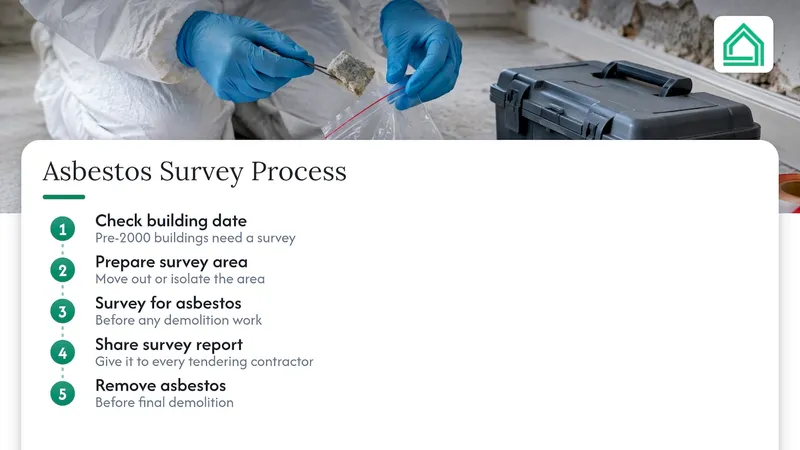
If the building was built or refurbished before the year 2000, assume nothing is clean until a surveyor says so. HSE's survey guide HSG264 states that a refurbishment and demolition survey is needed before any demolition work, and it locates and describes, as far as reasonably practicable, all asbestos-containing materials in the structure.
This survey is intrusive and destructive. It often means breaking into walls, floors and ceilings, so it is standard practice to carry it out in an unoccupied building or to isolate the survey area with floor-to-ceiling partitions. If you are living in the house while planning a rebuild, arrange to move out or section off the area first.
If asbestos turns up, it has to be removed as far as reasonably practicable before the final demolition. Pass the report to every contractor who tenders. Under CDM 2015, failing to share that information is a serious compliance failure, not an administrative slip.
Budget for what the survey finds
Asbestos removal can reshape a budget. Treat the survey as the first line item in your demolition budget and add a contingency for the unexpected. Never ask contractors to price demolition without the report in their hands.
Step 4: Understand who is responsible under CDM 2015
The Construction (Design and Management) Regulations 2015 treat demolition as construction work. HSE guidance says the client has a duty to ensure the project is managed by competent individuals, whatever the scale and even if professionals are hired.
In practice, that means:
- Provide pre-construction information on asbestos and structural stability. These duties cannot be contracted away.
- Appoint a competent principal designer and principal contractor where more than one contractor is involved. For a domestic client, these duties normally pass to the contractor or principal contractor unless you appoint otherwise, so confirm this in writing with whoever you hire.
- Make sure there is a written demolition plan covering sequence, temporary support and exclusion zones.
If you do not give a proper survey of existing conditions, you cannot expect a contractor to carry all the risk of what lies beneath. You may also lose the right to argue over delays or costs when hidden hazards surface. The HSE demolition guidance is written for commercial clients, but the principles are a useful benchmark for any homeowner. The industry guide The Management of Demolition Projects explains how clients, administrators and contractors split responsibility.
Can you demolish your own house? Legally there is no ban on a homeowner doing it, but the notice, planning, asbestos and CDM duties still apply, and structural collapse is not forgiving. For anything beyond a small outbuilding, hire a competent demolition contractor.
Step 5: Plan waste before the first skip arrives
Demolition makes a startling amount of waste, and the law follows it from your site to its final destination. Under the Environmental Protection Act 1990, section 34, a duty of care applies to those who produce, carry, keep, treat or dispose of controlled waste, with a limited exception for householders, as Newcastle City Council explains. Businesses you hire are fully bound by it, so choose them carefully.
The Waste Management Plan for England sets out the waste hierarchy: prevent first, then reuse, then recycle, and only then recover or dispose. It also notes that every load needs a written description (a waste transfer note), kept for at least two years, and that carriers should hold an up-to-date registration with the Environment Agency. Ask to see the carrier's registration before they take anything away.
The same document reports a recovery rate of 92.1% for non-hazardous construction and demolition waste in England as of 2016. That is the national picture, not a promise for your site: it only happens when someone separates materials at the source.
A simple waste plan
- Salvage first. Doors, radiators, bricks, slates, timber and fittings often have resale or reuse value.
- Segregate on site. Separate skips for metal, timber, inert rubble and plasterboard make recycling cheaper and easier.
- Chase the metals. Copper, steel and brass are worth sorting. Brass fittings, for instance, are highly recyclable, as this UK guide to recycling brass explains.
- File the paperwork. Keep every transfer note in one folder, digital or paper.
Step 6: Services, access and the neighbours
Before a machine arrives, the site needs to be dead safe: electricity, gas, water and drainage disconnected and capped by the right providers, with written confirmation. Book these early, because utility lead times are rarely short.
Then think about the street. Local authority environmental health teams regulate noise, dust and working hours, with typical limits of 8am to 6pm Monday to Friday and 8am to 1pm on Saturdays, according to council guidance. Your own council may set different hours, so check.
The same guidance warns that not giving neighbours clear contact details for complaints often turns small grievances into statutory nuisance enforcement that can halt your project. A letter a week before the work, with a named contact and a phone number, costs almost nothing. Our neighbour renovation notice checklist has a ready structure for it. If you share a wall, also look into party wall obligations with your surveyor.
A realistic demolition timeline
| Stage | What happens | Typical lead time |
|---|---|---|
| Planning check | Ask the planning authority about permission, prior approval, listing, conservation area | 1 to 4 weeks, depending on the council |
| Asbestos survey | Intrusive refurbishment and demolition survey, report issued | Book before notice; allow time for lab results |
| Section 80 notice | Notice served; wait for Section 81 or six weeks | Up to 6 weeks |
| Appointments | Principal designer, principal contractor, demolition plan | Runs in parallel |
| Utilities | Disconnections confirmed in writing | Start early |
| Neighbour letters | Contacts, hours, scaffold and skip notices | At least a week before |
| Demolition | Soft strip, asbestos removal, structure, site clearance | Depends on size |
| Handover | Waste notes filed, site left safe and level | Final week |
The lead times in this table are planning assumptions, not statutory periods, except the six weeks for the Section 80 notice and the 28-day prior approval window. Your council and contractors will give the real numbers.
Perspective: why demolition needs a plan, not a hope
We see the same pattern with first-time builders. Demolition feels like the exciting start, so it gets the least paperwork, and then the surprises arrive in a pile: an asbestos report nobody commissioned, a notice served too late, a skip bill nobody budgeted. None of these is difficult on its own. They hurt because they land in the wrong order.
Our view is that the cure is visibility. Put the notice date, the survey, the waste plan and the contractor's quote in the same place as the budget, so a change in one shows up in the others. When your demolition slips by three weeks because the council has not replied, you should be able to see at once what that does to the build start, the rental you are paying and your contingency.
We also think plain language matters. Legal duties such as CDM are not meant to be a mystery for homeowners. Ask your contractor to explain in a sentence who is doing what, and write the answer down.
— Azai
Keeping the plan in one place
Demolition is the first of many decisions that depend on each other. At House A-Z we built a planning platform for first-time builders and renovators that brings budget tracking, project management, permit guidance and contractor collaboration into one interface, instead of spreadsheets and scattered apps. You can start on the Free plan, move to Pro at 29 € per month when you want advanced features, and professional contractors and real estate firms can look at Enterprise from 99 € per month. See the plans and pricing or explore House A-Z to set up your demolition timeline and budget in one view.
Document everything
Photograph the building before work starts, during the soft strip, and once the site is clear. If a neighbour later claims damage, or a contractor disputes what was there, dated images settle the question quickly. Our guide to three-phase photo documentation shows how to do this for both owners and contractors.
Before signing with anyone, run through the contractor onboarding checklist and verify references. Once the rebuild begins, construction stage inspections are the next milestones to diarise. For more on the contractor side, browse our building and contractors articles.
FAQ
Does demolition need planning permission?
Often, yes, but it depends on the building and where it stands. Some demolitions fall under permitted development subject to a prior approval application, while listed buildings and conservation areas carry extra rules. Ask your local planning authority and keep the reply in writing.
Can I demolish my own house in the UK?
There is no general ban, but you must still serve the Section 80 notice, deal with planning, commission an asbestos survey and meet CDM duties. For anything larger than a small outbuilding, a competent demolition contractor is the safe choice.
How long before demolition must I notify the council?
For a building over 50m³, six weeks is the standard minimum notice under Section 80. Work can start earlier only if the authority issues a Section 81 notice sooner.
What size building does not need a Section 80 notice?
Buildings of 50m³ or less are generally outside the notice requirement, and greenhouses, sheds and prefabricated garages are among the listed exemptions. Planning rules are separate, so a small building can still need consent in sensitive locations.
Sources
- North Norfolk District Council: Demolition of Buildings guidance notes
- Castle Point Borough Council: Demolition Guidance Note
- Haringey Council: Demolition notices
- legislation.gov.uk: GPDO 2015, Part 11, Class B
- HSE: Asbestos, the survey guide HSG264
- HSE: Demolition
- IDE: The Management of Demolition Projects
- Defra: Waste Management Plan for England
- Newcastle City Council: Waste duty of care