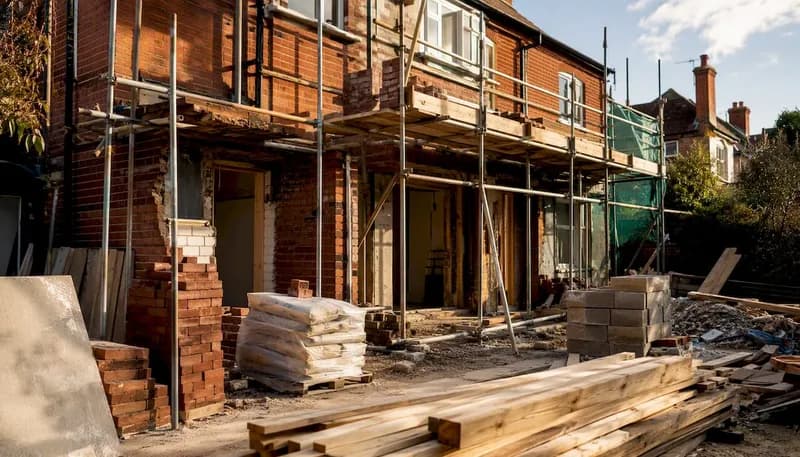
Standard homeowners insurance rarely covers the renovation itself, only certain damage from covered perils while work is underway, so you almost always need to notify your insurer before starting. Contact them immediately if the project involves structural changes, a rebuild, or a property left vacant or open to the weather. Left unaddressed, you risk theft of materials, damage to unfinished work, and personal liability for injuries on site going uncovered.
TL;DR:
- Notify your insurer before starting structural work, extensions, or if the property will be vacant to ensure coverage for on-site materials and damages.
- Standard homeowners policies usually exclude renovation work, requiring separate builder's risk or renovation add-on policies for materials, fixtures, and works-in-progress.
- Document all communications, obtain contractor liability certificates, and have endorsements in writing to prevent claim denials due to incomplete or missing proof.
- Set accurate rebuild cost limits with a professional estimate and consider inflation guards or extended replacement options to avoid under-insurance.
- Understand that contractor insurance covers the builder, not the homeowner, making proper liability proof and contractual agreements essential for protection.
Table of Contents
- What renovation insurance covers (and typical exclusions)
- When to tell your insurer and what happens if you don't
- Types of specialist cover: builders' risk, contract works and renovation add-ons
- Liability and contractor insurance: what to request and why it matters
- Sums insured and under-insurance: how to set the right limits
- How much renovation cover costs and the factors that move premiums
- Pre-renovation checklist: exact questions to ask insurers and contractors
- Differences between renovation insurance and standard homeowners insurance during renovations
- Risks not covered by renovation insurance and recommended extra protections
- How to file a claim related to renovation insurance, including documentation and common pitfalls
- Author perspective: what homeowners consistently get wrong
- Keep your renovation paperwork organised with House A-Z
- Sources
- FAQ
What renovation insurance covers (and typical exclusions)
Your existing home and standard homeowners policy work differently once building work starts. Damage caused by a covered peril, such as a fire spreading from a neighbouring property or a storm ripping off scaffolding sheeting, is usually still paid out under your normal policy. What it will not pay for is the renovation itself: the labour, the materials, or fixing a contractor's mistake.
That gap is where things go wrong for homeowners. Standard policies generally exclude elective renovation projects entirely, which means you are relying on separate cover for the work in progress and the materials sitting in your garden or garage.
Typical treatment looks like this:
- Covered: fire, storm, or vandalism damage to the existing structure during works
- Usually excluded: theft of building materials from an open site
- Usually excluded: subsidence or cracking caused directly by the new construction
- Often needs an endorsement: materials and fixtures stored on site awaiting installation
- Rarely automatic: Ordinance and Law cover for code upgrades the local authority now requires
Ask your insurer directly whether works-in-progress and on-site materials are included, or whether you need a separate endorsement.
When to tell your insurer and what happens if you don't
Notify your insurer before you notify your contractor to start. Insurers price a policy against a specific risk profile, and a renovation changes that profile the moment scaffolding goes up.
Projects that almost always require notification include:
- Structural work, including load-bearing wall removal or foundation changes
- Extensions, loft conversions, or basement digs that add square footage
- Any project pushing total spend above roughly 10% of your home's insured value
- Work that leaves the property vacant, unoccupied, or without a roof for any stretch of time
Occupancy status matters more than most homeowners expect. Insurers typically apply strict time limits, often 30 to 60 days, before an unoccupied property triggers reduced cover or a separate vacancy clause. Treat your project start date as a hard deadline for confirming cover, not a rough guideline, particularly if the property will sit empty or partly open to the elements at any stage.
Skip the notification and the consequences are blunt: a declined claim, a reduced payout, or outright cancellation once the insurer discovers undisclosed works during a claims investigation.
Types of specialist cover: builders' risk, contract works and renovation add-ons
Three product types dominate this space, and they solve slightly different problems.
- Builders' risk / contract works policies cover the structure under construction, materials on site, and sometimes tools and equipment, typically for the duration of a defined project.
- All risks policies offer broader protection across a wider set of causes of loss, often at a higher premium.
- Renovation and extension add-ons, offered by some insurers as an extension to an existing household policy, bundle the existing structure, possessions, materials, and works in progress under one policy for the length of the build, usually up to a stated project value threshold.
The add-on route suits smaller, contained jobs, a kitchen refit or bathroom overhaul. A standalone project policy makes more sense once you cross that value threshold, commonly cited by advisors as around 10% of your home's value or a fixed monetary limit, or when the works involve structural risk your standard insurer won't touch.
Pro Tip: Ask your insurer to confirm the exact project value threshold in writing before you commit to an add-on. Verbal assurances rarely hold up when a claim gets contested.
Liability and contractor insurance: what to request and why it matters
A contractor's insurance protects the contractor, not you. That distinction catches out more homeowners than any other part of this process, because contractor insurance is not a substitute for homeowner cover, even on a well-run project with a reputable builder.
Before any work starts, request:
- A current certificate of insurance (COI) naming the contractor and confirming active general liability cover
- Written confirmation that subcontractors carry their own valid COIs, not just the main contractor
- An Additional Insured endorsement, or "joint names" wording on larger projects, so you're protected if a dispute arises over who caused a loss
Homeowners insurance may cover certain injuries and some damage during renovation, but it will not cover a contractor's poor workmanship, so this documentation matters well beyond the planning stage.
Pro Tip: If you'll have multiple trades on site at once, ask your broker whether your existing liability limit is still adequate, or whether umbrella cover makes sense for the project's duration.
Sums insured and under-insurance: how to set the right limits
Rebuild cost and market value are not the same number, and confusing the two is the single most common under-insurance mistake homeowners make. Rebuild cost reflects what it would take to reconstruct your home at today's labour and materials prices, which almost always rises once high-end finishes and upgraded systems enter the mix.
A renovation that adds square footage, upgrades a kitchen to stone worktops, or replaces standard fittings with custom joinery pushes your rebuild cost up whether or not you update your policy to reflect it.
Practical steps that close the gap:
- Get a professional rebuild estimate once the scope is finalised, not before
- Ask your insurer about an extended replacement cost or inflation guard endorsement, particularly on projects running longer than a few months
- Keep an itemised record of upgraded finishes, appliances, and fixtures as they go in, with receipts attached
Skipping this step is how homeowners end up with a payout that covers a rebuild at last year's prices, not this year's.
How much renovation cover costs and the factors that move premiums
Premiums for renovation cover move on a handful of predictable levers. Total project value sits at the top of the list, followed by the value of materials stored on site, the number of separate contractors working simultaneously, and whether the property becomes unoccupied at any point.
Location and claims history matter too, in the same way they do for standard homeowners insurance. A property in a flood zone or an area with a higher burglary rate will usually see a steeper premium for the same scope of work.
Cost factors worth asking your broker about directly:
- Whether the policy is refundable or adjustable if the project finishes early
- Whether short-term extension options exist if the build overruns the original schedule
- Whether completed upgrades, rewiring, a new roof, added security systems, can lower your ongoing premium once the project wraps
Modern wiring and a new roof often earn a discount on your renewal premium precisely because they reduce the insurer's ongoing risk.
Pre-renovation checklist: exact questions to ask insurers and contractors
Work through this before a single wall comes down.
- Tell your insurer the full scope, estimated cost, timeline, and whether the property will be occupied throughout
- Ask whether you need a renovation add-on or a standalone project policy given the project's value
- Request a COI from every contractor and subcontractor, confirming policy numbers and licence status
- Photograph the property, room by room, before work starts, and keep receipts and serial numbers for materials and appliances
- Get any special terms, endorsements, or coverage extensions confirmed in writing, not by phone call
| Step | What you're confirming |
|---|---|
| Notify insurer | Scope, timeline, occupancy plan |
| Check policy type | Add-on vs standalone project cover |
| Collect COIs | Contractor and subcontractor liability |
| Document the site | Photos, receipts, serial numbers |
| Get endorsements in writing | Ordinance and Law, inflation guard, Additional Insured |
Written confirmation matters more than any other item on this list. A verbal assurance from an agent carries no weight if a claim is contested months later.
Differences between renovation insurance and standard homeowners insurance during renovations
Standard homeowners insurance is priced against your home as it currently stands, occupied, finished, and static. It assumes a stable risk: a family living in a completed house, not scaffolding, exposed roofing, or a skip full of materials sitting in the driveway.
Renovation insurance, whether that's an add-on to your existing policy or a standalone builders' risk product, is priced against a moving target. It accounts for the fact that your home's value, occupancy, and physical condition all change during the build, sometimes week to week.
The practical differences show up in three places. First, works-in-progress and on-site materials typically fall outside a standard policy entirely, while renovation-specific cover is built to include them. Second, standard policies often have vacancy clauses that kick in faster than most homeowners assume, sometimes within 30 to 60 days, while renovation cover can be structured around an extended vacancy if the property will sit empty for the project's duration. Third, liability exposure looks different: a standard policy assumes normal household risk, not multiple contractors and heavy equipment moving through the property daily.
The two aren't interchangeable, and treating your existing policy as sufficient once construction starts is the assumption that causes the most declined claims.
Risks not covered by renovation insurance and recommended extra protections
Even a well-chosen renovation policy leaves gaps. Poor workmanship sits at the top of that list: contractor errors and substandard work are typically excluded from both homeowners insurance and most renovation add-ons, because insurers treat that as a contractual dispute between you and your builder, not an insurable loss.
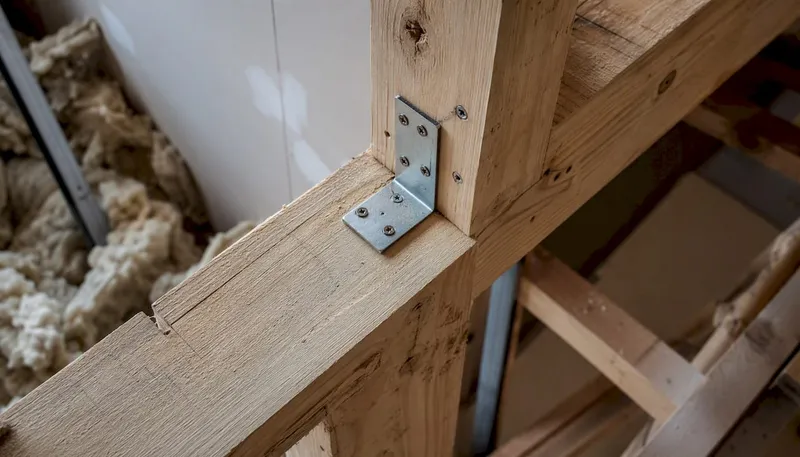
Design and planning errors fall into a similar grey area. If a contractor builds to the wrong specification, or a structural element fails because of a design flaw rather than an external event, most policies won't step in.
Delay-related costs, additional rent if you can't live in the property longer than expected, storage fees, or lost income from a rental property under renovation, usually need a separate rider or aren't covered at all.
Sensible extra protections to weigh up alongside your main policy:
- Latent defects insurance for larger structural projects, covering hidden defects that surface after completion
- Umbrella liability cover if multiple trades are on site simultaneously and your existing limits feel thin
- A written contract with your builder specifying liability for workmanship errors, since insurance won't resolve that dispute for you
None of this replaces a solid contract and a properly vetted contractor. Insurance covers loss; it doesn't cover a bad hire.
How to file a claim related to renovation insurance, including documentation and common pitfalls
Start the claim the moment damage or loss occurs, not once the dust settles at the end of the week. Insurers expect prompt notification, and delays can weaken an otherwise solid claim.
Photograph the damage before anything is moved, cleared, or repaired. Pull together your pre-renovation photographs, the ones you took before work began, alongside receipts for materials, your contractor's COI, and any written endorsements confirming the scope of cover. This is where homeowners who skipped the paperwork stage struggle most: an insurer asking for proof of what existed before the loss, with nothing to show for it.
Common pitfalls that slow or sink claims:
- No pre-renovation photographic record to compare against the damage
- Missing or expired COIs from the contractor at the time of loss
- Assuming a standard homeowners claim adjuster automatically understands renovation-specific endorsements without prompting
- Reporting a loss weeks after it happened, once repair work has already begun
Work with your broker or claims adjuster to confirm which policy, your standard cover or a renovation add-on, actually applies to the specific loss. Overlapping cover between two policies sometimes creates confusion about which insurer pays first, and that's a conversation worth having before a claim, not during one.
Author perspective: what homeowners consistently get wrong
The costliest mistake isn't skipping insurance altogether, it's assuming existing cover stretches to fit a bigger, more valuable home once the renovation finishes. A homeowner who spends £40,000 on a kitchen extension but never updates their dwelling limit is often under-insured by exactly that amount the day the last invoice clears.
The second pattern is trusting a contractor's insurance to cover you. It doesn't, not automatically. Being named as Additional Insured or securing joint names wording closes that gap, and it costs nothing but a conversation with your broker.
Good records aren't paperwork for its own sake. They're what turns a contested claim into a paid one.
— Azai
Sources
- Does home insurance cover remodeling? | Liberty Mutual
- Renovating your home: what you need to know about insurance | Gallagher
- Does Homeowners Insurance Cover Renovations? | Progressive
- Home renovation and extension insurance | Hiscox
FAQ
What insurance do I need when renovating a house?
You typically need to notify your existing insurer and add either a renovation and extension endorsement or a standalone builders' risk policy, depending on project size, plus proof of contractor liability insurance.
How expensive is renovation insurance?
Cost depends on total project value, materials stored on site, the number of contractors involved, and whether the property is occupied, with larger structural projects and vacant properties typically costing more to insure.
What are the biggest home renovation mistakes homeowners make with insurance?
The most common mistakes are failing to notify the insurer before work starts, assuming a contractor's insurance protects the homeowner, and not updating the dwelling limit once the renovation raises the rebuild cost.
Do I need to tell my insurer about home improvements?
Yes, insurers require notification of major renovations because the work changes your property's risk profile, and not disclosing it can lead to a declined claim or cancelled policy.
What's the difference between renovation insurance and my regular homeowners policy?
Regular homeowners insurance is priced for a finished, occupied home and typically excludes works-in-progress and on-site materials, while renovation-specific cover is designed to include both for the length of the project.