You must formally notify neighbours for some permit-triggering works, including party wall jobs and major additions, while for most smaller projects a courteous written notice is simply good practice. Start by checking your local permit rules and party wall requirements, then prepare a short notice with your approximate dates, scope and a direct contact before any work begins.
TL;DR:
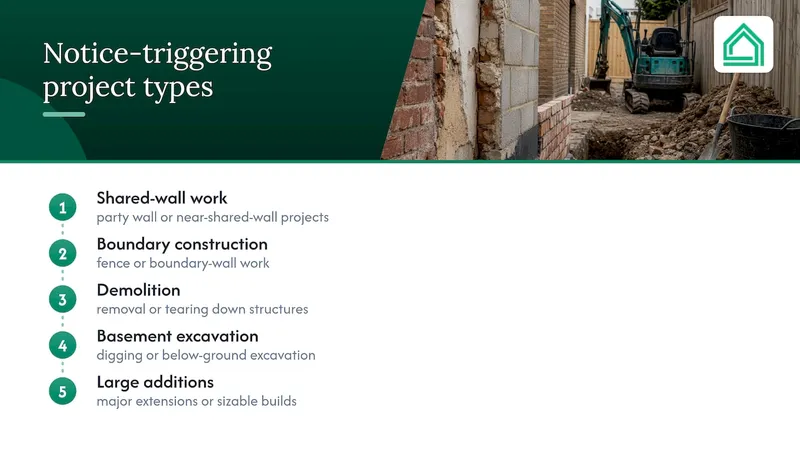
- Formal notice commonly applies to shared walls, boundary construction, demolition, basement excavation, and large additions; check local authorities because rules differ by location.
- Philadelphia requires written notice when applying for a permit and at least 10 days before work begins, so confirm deadlines before setting a start date.
- Include dates, project scope, work hours, contractor contact and insurance, and the permit number when applicable; keep receipts, sign photographs, or affidavits as proof.
- New York City generally limits weekday construction to 7:00 a.m. to 6:00 p.m.; outside those hours, impact equipment may require a noise mitigation plan.
- Some jurisdictions allow court petitions for necessary protective access after a neighbor refuses, but the requesting party remains liable for resulting damage.
Table of Contents
- Why notify neighbours: legal obligations and neighbour relations
- Common legal and permit notification rules to check
- When to notify: timelines and scheduling
- What to include in a neighbour notice and a short template
- How to deliver notices and keep proof
- Managing disruption: working hours, noise and coordination
- Access requests and party wall basics
- Keeping notices and proof organised from one place
- A practical note from the author
- Keep every notice and proof in one organised plan
- FAQ
- Sources
Why notify neighbours: legal obligations and neighbour relations
Two separate motivations sit behind every neighbour notice, and conflating them causes confusion. One is regulatory: certain building works must be notified to neighbours under party wall rules, and skipping that step can delay permits or trigger formal disputes. The other is relational: a courtesy notice, even when no law demands one, keeps goodwill intact and heads off complaints before they start. Missing a required notice risks enforcement action, stalled paperwork and strained relationships that outlast the build itself. Reach out early, and most neighbours respond with patience rather than suspicion, because they feel informed rather than ambushed by scaffolding and skip lorries.
Common legal and permit notification rules to check
Certain project types consistently trigger a formal notification requirement, whatever your location. Work on or near a shared wall, boundary construction, demolition, basement excavation and large additions are the usual culprits. GOV.UK's guidance on work you must tell your neighbour about covers party wall consultation and notice procedures for homeowners in England and Wales, and similar boundary-work rules exist in other jurisdictions, so check your own council or city authority rather than assuming the English framework applies.
Municipal programmes elsewhere add their own layers. Some authorities require a posted sign on site, others want certified mail to adjoining owners, and many ask for a sworn affidavit of posting uploaded alongside the permit application. Washington, D.C.'s neighbour notification programme, for instance, treats notice as a procedural box to tick for permit issuance rather than a veto for neighbours to exercise.
Before you finalise drawings or book a contractor, contact your local building authority directly and check the party wall or neighbour-notification page for your area. Rules vary enough between cities and countries that a five-minute call saves weeks of delay later.
When to notify: timelines and scheduling
Timing a notice well means satisfying both etiquette and procedure, and the two rarely align by accident. A courtesy letter to adjacent households typically goes out several weeks before work starts, giving neighbours enough warning without the detail going stale. Formal programmes run on stricter clocks: Philadelphia requires written notification both when you apply for the permit and at least 10 days before work begins, while some neighbourhood notice schemes ask for a sign posted several weeks ahead of issuance.
Build in a buffer for permit processing itself, since approval timelines rarely move at the pace your contractor hopes for, as covered in our guide to permit lead times. When you are scheduling your notices, work through this short list:
- Confirm your permit's required notice period before setting a start date.
- Send the courtesy letter first, then the formal notice closer to the regulatory deadline.
- Keep a buffer week between notice completion and the planned start, in case of weather or supplier delays.
What to include in a neighbour notice and a short template
A good notice is brief, factual and easy to act on. Keep these elements in order:
- Project address and a one-line description of the work.
- Start date and estimated completion date.
- Expected working hours and any particularly noisy phases.
- Contractor name, contact number and insurance confirmation.
- Permit number, where one applies.
- Your own contact details for questions or concerns.
A short template covers most situations:
"We're writing to let you know that renovation work will begin at [address] on or around [start date], expected to finish by [end date]. The project involves [brief scope], with work generally taking place during expected working hours. Our contractor, [name], can be reached at [contact] and maintains current insurance. If you have any concerns during the project, please contact us directly at [contact]. We appreciate your patience while the work is underway."
For sensitive neighbours, a line offering to photograph their property's current condition beforehand is a small gesture that heads off later disputes, a tactic renovation etiquette guidance commonly recommends alongside clear scheduling and a single point of contact.
How to deliver notices and keep proof
Delivery method matters as much as content when a permit authority reviews your file. Hand-delivery works for a friendly courtesy note, but certified or recorded post gives you a dated receipt that stands up if questioned later. Agency-approved posted signs, often required for larger projects, need a time-stamped photo as evidence they went up on schedule.
Many permit offices will not release approval without proof of notification, whether that is a mail receipt, a photographed sign, or a notarised affidavit. Keep every scrap of evidence together from day one rather than scrambling to reconstruct a timeline when the inspector asks.
Managing disruption: working hours, noise and coordination
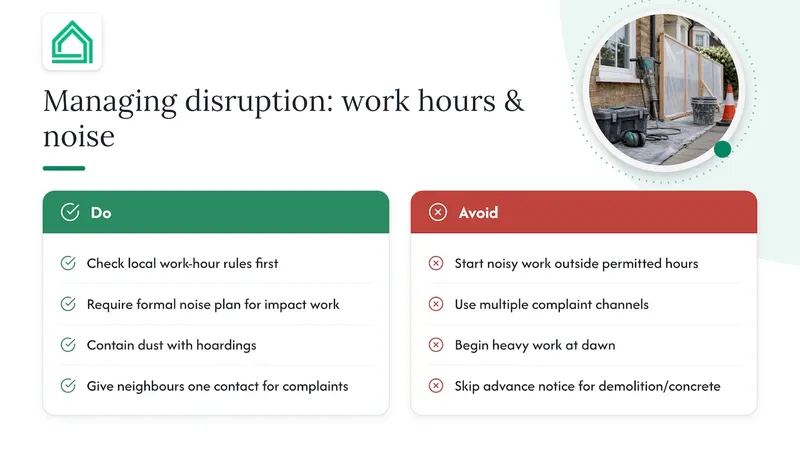
Most municipal rules set clear boundaries on when noisy work can happen. New York City restricts construction to roughly 7:00 a.m. to 6:00 p.m. on weekdays and requires a formal noise mitigation plan for anything outside that window or using impact equipment such as jackhammers. Other cities set their own hours, often stricter for high-impact tasks, so check local rules before your contractor fires up heavy machinery at dawn.
Beyond the legal minimum, small mitigation steps go a long way: hoardings to contain dust, scheduling the loudest tasks mid-week rather than on a Monday morning, and a heads-up message before an especially disruptive day such as demolition or concrete pouring. Our guide to living at home during renovation covers more on keeping a household functional while the noise is at its worst.
Pro Tip: Give neighbours one phone number or email for complaints, not several, so concerns reach you directly instead of multiplying through group chats and hearsay.
Access requests and party wall basics
Some projects need physical access to a neighbour's land, typically for scaffolding, foundation work or anything built directly on a shared boundary. Offer proof of contractor insurance and licensing upfront, since that reassures a cautious neighbour far more than a verbal promise. A practical party wall agreement playbook walks through the typical notice and consent steps for homeowners in England and Wales, including when a party wall surveyor gets involved to resolve disagreements.
If access is refused, document the refusal and explore alternative protective measures before escalating. Statutory remedies in some jurisdictions allow a court petition for access to carry out protective work, though the party seeking access usually needs to show prior attempts at agreement and remains liable for any damage caused.
Keeping notices and proof organised from one place
Juggling notice templates, contact lists, permit dates and scanned proofs across separate folders and emails is where most homeowners lose track of a deadline. A project organiser built for renovation keeps all of that in one shared space: templates ready to customise, AI-generated reminders ahead of notice deadlines, document uploads for mail receipts and sign photos, and a shared contractor contact list everyone involved can see. One client reported catching a design error worth €20,000 in potential rework simply by having every document and conversation visible in a single dashboard rather than scattered across apps. The same visibility applies to notice compliance: fewer missed windows, and proof ready to export the moment a permit office asks for it.
A practical note from the author
Courtesy and paperwork aren't competing priorities, they're the same job done properly. Send the warm letter, keep the receipts, and when your local rules feel unclear, ring the building authority rather than guessing from a forum thread. Good relationships and clean records protect each other.
— Azai
Keep every notice and proof in one organised plan
We built House A-Z for exactly this kind of administrative juggling: storing your notice templates, tracking permit dates, and keeping delivery proof together with your wider renovation plan rather than scattered across emails and photo rolls. Our Pro plan at €29 per month adds AI reminders ahead of key deadlines and shared contractor access, while our free plan covers the basics for a first project. None of this replaces your local building authority's own procedures, so always confirm requirements there first, then let your plan hold the paperwork once you know what's needed. Have a look at House A-Z's pricing to see which plan fits your project.
FAQ
Can neighbours complain about construction noise?
Yes, neighbours can raise noise complaints with the local authority, particularly when work falls outside permitted hours or uses equipment covered by a noise mitigation plan requirement. Keeping to local working-hour guidelines and warning neighbours in advance reduces the likelihood of a formal complaint.
What time should my neighbour stop drilling?
Permitted hours vary by city, but New York City generally limits construction to weekdays between 7:00 a.m. and 6:00 p.m., with stricter rules for impact equipment. Check your own local noise ordinance, since many areas set tighter limits for evenings, weekends and particularly disruptive tools.
Do you have to notify neighbours of building work?
For certain works, particularly those on a party wall or at a shared boundary, formal notification is legally required before you proceed. For smaller projects without a legal trigger, a courtesy notice isn't mandatory but is widely recommended to avoid complaints and preserve goodwill.
Do I have to let my neighbour on my property to build his extension?
There's no blanket legal duty to grant access, and requirements depend heavily on local law and the specifics of the project. Some regions allow court petitions or statutory remedies when access is refused but genuinely needed for protective work, with the requesting party typically liable for any resulting damage.
Sources
- Work you must tell your neighbour about
- Construction Noise Rules & Regulations - DEP
- Notification to Adjacent Owner information sheet (Philadelphia)
- Neighbor notification (DC Department of Buildings)