
Renovation financing options are the range of borrowing and credit methods homeowners use to fund home improvements, from unsecured personal loans to government-backed programmes. Choosing the right option depends on your project budget, available equity, credit score, and how quickly you need funds. This renovation financing options guide covers every major loan type, explains how to match each to your circumstances, and flags the pitfalls that cost homeowners the most. Whether you are planning a kitchen refit or a full structural overhaul, the right financing method makes the difference between a project that stays on budget and one that does not.
What types of renovation financing options are available?
Renovation financing splits into two broad categories: unsecured lending, which requires no collateral, and secured lending, which is tied to your property. Each category contains several distinct products, and understanding how they differ is the first step in any sound renovation budget guide.
Unsecured personal loans
Personal loans are the fastest route to renovation funds. Unsecured personal loans fund in as little as 1–2 days, with no property appraisal required. That speed makes them the practical choice for urgent repairs or projects under £40,000. Interest rates vary considerably: personal loan APRs range from 6.25% to 36% depending on your credit profile. Borrowers with strong credit access the lower end; those with weaker scores pay significantly more. Some lenders offer loan terms up to 20 years, which keeps monthly payments manageable on larger personal loans.
Home equity loans and HELOCs
A home equity loan releases a lump sum at a fixed interest rate, secured against the equity you hold in your property. It suits single, large-scale projects where you know the total cost upfront. A Home Equity Line of Credit (HELOC) works differently: it functions as revolving credit you draw on as needed, typically at a variable rate. HELOCs suit phased projects where costs arrive in stages, while fixed home equity loans suit single large-scale jobs. Both products require 2–6 weeks for underwriting and property appraisal before funds are released.

Cash-out refinance
A cash-out refinance replaces your existing mortgage with a larger one, releasing the difference as cash. This approach suits major renovations where the funding required is substantial. The trade-off is that you restart your mortgage term and pay closing costs, so the total cost of borrowing is higher than it first appears.
Government-backed renovation loans
Government-backed products combine purchase and renovation funding into a single loan. In the United States, the FHA 203(k) programme requires a credit score of 580 or above, while the Fannie Mae HomeStyle conventional equivalent requires 620 or above. These products are particularly useful for buyers purchasing a property that needs work, as they avoid the need to arrange separate financing after completion.
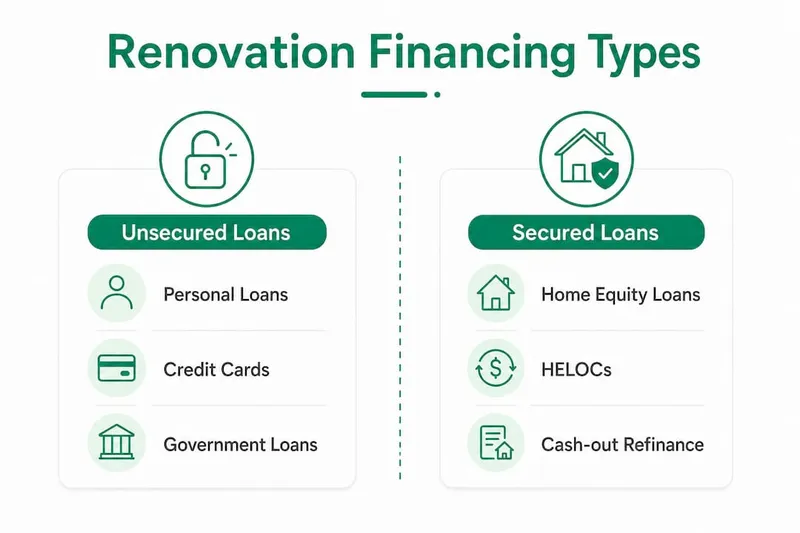
Credit cards and other options
Credit cards carry interest rates of 25% or more, making them unsuitable for anything beyond small, immediately payable repairs. Government grants and tax credits for energy-efficient renovations offer an alternative funding source for qualifying projects and are worth investigating before committing to a loan.
| Financing type | Best suited for | Funding speed | Typical rate |
|---|---|---|---|
| Personal loan | Urgent or smaller projects | 1–2 days | 6.25%–36% APR |
| Home equity loan | Single large-scale projects | 2–6 weeks | Lower, fixed |
| HELOC | Phased or ongoing projects | 2–6 weeks | Variable |
| Cash-out refinance | Major structural renovations | 4–8 weeks | Mortgage rate |
| FHA 203(k) | Purchase and renovate | 4–8 weeks | Government-backed |
| Credit card | Small, immediate repairs only | Instant | 25%+ |
How do you choose the right renovation financing for your project?
The right financing method depends on four factors: project cost, available equity, credit score, and your timeline. No single product suits every homeowner, and the optimal financing choice varies significantly by individual circumstance.
Match the loan type to your project cost. For projects under £5,000, a 0% purchase credit card paid off within the promotional period is often the cheapest option. For projects between £5,000 and £25,000, a personal loan offers speed and simplicity. For projects above £25,000, a home equity loan or HELOC typically delivers lower rates, provided you have sufficient equity.
Assess your available equity. Secured loans require equity in your property. If your home has appreciated significantly since purchase, a home equity loan or HELOC unlocks that value at a lower rate than unsecured borrowing. If equity is limited, a personal loan or government-backed product is the more realistic path.
Check your credit score before applying. Credit scores strongly influence both eligibility and the rate you receive. Scores below 700 attract sharply higher APRs on personal loans. Spending three to six months improving your score before applying can save a meaningful amount over the loan term.
Factor in your timeline. If your project starts in four weeks, a personal loan is the only realistic unsecured option. If you have two to three months before work begins, a HELOC or home equity loan becomes viable. Homeowners should plan financing months ahead to accommodate the slower secured loan process and avoid delays on site.
Build in a contingency budget. Renovation costs almost always exceed initial estimates. Allocate 10%–20% above your quoted project cost as a contingency, and factor that figure into the amount you borrow. Reviewing your renovation spending priorities before you apply helps you borrow the right amount from the start.
Pro Tip: Get quotes from at least three contractors before applying for financing. Lenders for secured loans often require detailed renovation plans, and having accurate quotes strengthens your application and reduces the risk of underborrowing.
How do you apply for and secure renovation financing?
The application process differs by loan type, but the core steps follow a consistent pattern. Understanding what to expect at each stage prevents delays and avoids surprises.
Check your credit report. Obtain your credit report from a registered credit reference agency before applying. Correct any errors, as mistakes on your file can reduce your score and affect the rate you are offered.
Prequalify with multiple lenders. Most lenders offer a soft credit check that shows indicative rates without affecting your score. Use this stage to compare offers across at least three lenders before committing to a full application.
Gather your documentation. Lenders typically require proof of income (payslips or tax returns), bank statements, proof of address, and, for secured loans, details of your property. Secured loans also require detailed renovation plans so the lender can assess the "as improved" value of your home.
Submit your formal application. Once you select a lender, submit the full application with all supporting documents. Personal loan decisions often arrive within 24 hours. Secured loans enter an underwriting and appraisal phase that typically lasts 2–6 weeks.
Review the loan offer carefully. Pay close attention to the Annual Percentage Rate (APR), not just the headline interest rate. Origination fees on personal loans range from 1% to 8% of the loan amount and are frequently overlooked when comparing products.
Manage disbursement and draw schedules. Personal loans are usually paid in a single lump sum. HELOCs operate on a draw schedule aligned to project phases. Coordinate disbursement timing with your contractor to avoid funds sitting idle or work stalling while you wait for the next draw.
Common pitfalls when financing home renovations
Financing mistakes compound quickly in renovation projects. The errors below are the most common, and the most expensive.
Underestimating total costs. Most homeowners underestimate renovation costs, particularly for structural or older properties. Always add a contingency of at least 10%–20% to your budget. Reading about hidden renovation costs before you borrow helps you set a realistic loan amount.
Ignoring fees in APR comparisons. The headline interest rate is not the full cost. Closing costs and origination fees on secured loans can reach 1%–8% of the loan amount. Always calculate the total cost of borrowing, not just the monthly payment.
Overborrowing beyond resale value. Borrowing more than your renovation adds to your property's value leaves you in negative equity if you sell. Research comparable property values in your area before deciding how much to borrow.
Misusing credit cards for large projects. Credit card rates of 25% or more make them a costly choice for anything beyond minor repairs. The debt accumulates faster than most homeowners anticipate.
Overlooking tax deductibility. Interest on home equity debt may be tax-deductible when funds are used to substantially improve your primary residence. Interest on unsecured personal loans is generally not deductible. This distinction affects the true cost of each product and is worth discussing with a tax adviser.
Risking your home unnecessarily. Using home equity as collateral increases financial risk if your circumstances change. If there is any uncertainty about your income stability, an unsecured personal loan is the safer choice, even at a higher rate.
Pro Tip: Improve your credit score before applying by paying down existing balances and avoiding new credit applications for at least three months. A score improvement from 680 to 720 can reduce your personal loan APR by several percentage points.
Comparing renovation loan quotes is as important as comparing contractor quotes. The difference between the best and worst rate on a £20,000 personal loan can amount to thousands of pounds over the loan term. Treat financing as a procurement decision, not an afterthought.
Key takeaways
The best renovation financing option is the one that matches your project cost, equity position, credit score, and timeline, not the one with the lowest headline rate.
| Point | Details |
|---|---|
| Match loan type to project size | Personal loans suit projects under £40,000; secured loans suit larger or phased renovations. |
| Speed varies significantly | Personal loans fund in 1–2 days; home equity products take 2–6 weeks due to appraisal. |
| Credit score affects your rate | Scores below 700 attract sharply higher APRs; improve your score before applying where possible. |
| Fees change the true cost | Origination fees of 1%–8% on secured loans alter the real cost beyond the headline rate. |
| Plan financing early | Start the financing process months before work begins to avoid delays on site. |
My honest view on renovation financing decisions
I have seen homeowners make the same mistake repeatedly: they choose a financing product based on the monthly payment figure alone, without accounting for fees, total interest, or the risk attached to secured borrowing. A low monthly payment on a 20-year home equity loan can mask a total repayment figure that far exceeds what a shorter-term personal loan would have cost.
The other pattern I notice is urgency overriding judgement. A contractor is available next month, so the homeowner grabs the first loan offer they receive rather than spending two weeks comparing rates. That impatience routinely costs more than the contingency budget they forgot to include.
My practical advice is this: treat the financing decision with the same rigour you apply to choosing a contractor. Get multiple quotes, read the full terms, and calculate the total cost of borrowing rather than the monthly instalment. If you are using secured borrowing, be honest with yourself about your income stability. The lower rate is not worth the risk if your financial position is uncertain.
Finally, do not underestimate the value of planning. Homeowners who arrange financing two to three months before work begins have time to improve their credit score, compare lenders properly, and negotiate rates. Those who arrange it in the final fortnight before work starts take whatever is available.
— Azai
FAQ
What is the fastest renovation financing option?
Unsecured personal loans are the fastest option, with funds typically available within 1–2 days of approval. Secured products such as HELOCs and home equity loans require 2–6 weeks for appraisal and underwriting.
What credit score do I need for a renovation loan?
Requirements vary by product. FHA 203(k) government-backed loans accept scores from 580, while conventional options such as Fannie Mae HomeStyle require 620 or above. Personal loan rates improve significantly for scores above 700.
Is the interest on renovation loans tax-deductible?
Interest on home equity loans and HELOCs may be tax-deductible when funds are used to substantially improve your primary residence. Interest on unsecured personal loans is generally not deductible.
How much should I borrow for a renovation?
Borrow your total quoted project cost plus a contingency of 10%–20% to cover unexpected expenses. Avoid borrowing more than the renovation is likely to add to your property's resale value.
Are credit cards a good option for financing renovations?
Credit cards are suitable only for small repairs you can repay immediately. Rates of 25% or more make them an expensive choice for larger projects, where a personal loan or home equity product is almost always cheaper.