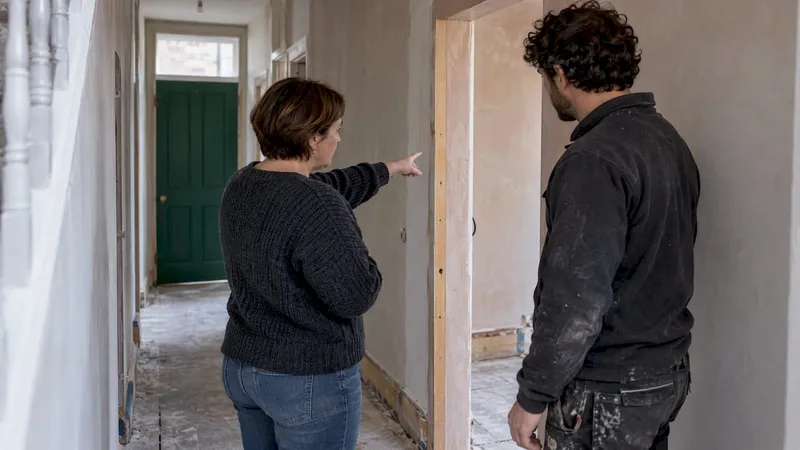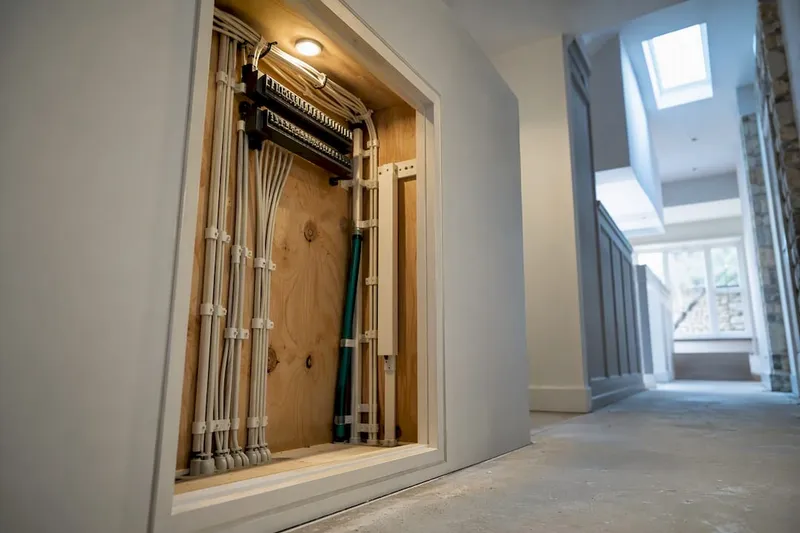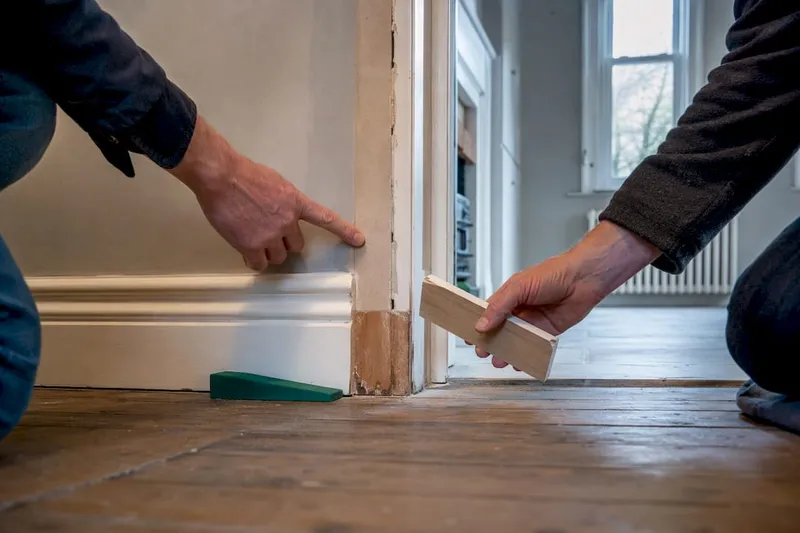
A renovation kickoff meeting must produce five things before anyone leaves the room: agreed scope, a confirmed schedule with milestones, named owners for every open decision, a communication protocol, and a decision log distributed within 24 hours. Anything less leaves gaps that surface later as disputes. Industry guidance from Atlassian backs this structure, and platforms like House A-Z now build these outputs directly into a shared project record rather than scattered notes.
TL;DR:
- The kickoff meeting must produce a clear scope, schedule, decision owners, communication protocol, and a decision log shared within 24 hours to prevent future disputes.
- Splitting the kickoff into two sessions, a short client-facing and a longer internal meeting, helps maintain clarity and focus on decision-making rather than information sharing.
- Attendees should have decision-making authority and be prepared with a scope walk, risk list, milestones, and a schedule to ensure quick consensus and avoid delays.
- Prepare and send updated drawings, selections, and the schedule at least 48 hours in advance, and record decisions immediately after to keep the project on track.
- Assign responsibility for tracking permits, approvals, and contingencies in advance to prevent schedule stalls and budget overruns caused by overlooked delays.
Table of Contents
- What is a renovation project kickoff meeting for?
- Two ready-to-use kickoff agendas with timings
- Who should attend and what authority they need
- What to cover in every renovation kickoff agenda item
- What to prepare and send before the meeting
- How to run the meeting without losing control of it
- Turning meeting notes into a working decision log
- A practical example: consolidating the kickoff in one hub
- Clarifying roles and responsibilities beyond attendance
- Setting expectations and defining goals together
- Reviewing permits, approvals, and regulatory requirements
- Common kickoff challenges and how to handle them
- Timeline overview and critical milestones to confirm
- Discussing budget and financial considerations openly
- Three habits worth applying at every kickoff
- A simpler way to keep kickoff decisions on track
- Sources
- FAQ
What is a renovation project kickoff meeting for?
A renovation project kickoff meeting exists to turn a signed contract into a working plan everyone can act on. It is not a courtesy chat or a chance to admire the drawings together. It is the moment scope, schedule, budget, and decision rights get locked down, in writing, with names attached.
Think of it as the meeting that decides how every future disagreement gets resolved. If the contractor and homeowner leave without a shared understanding of who approves a change order, or what happens when a tile selection is late, the kickoff has failed regardless of how friendly it felt. Asana's guidance on kickoff meetings frames this well: treat the session as a decision meeting, not an information meeting. That single shift in framing changes how you write the agenda, who you invite, and what you consider a successful outcome.
For renovations specifically, the stakes are higher than for a typical office project. People are often living in or near the site. Structural surprises behind a wall can blow a schedule apart. And unlike a brand-new build, a renovation kickoff has to reconcile what exists on paper with what actually exists on site, which is why a proper scope walk belongs on the agenda alongside the usual introductions and timeline review.
Two ready-to-use kickoff agendas with timings
Renovation projects benefit from splitting the kickoff into two sessions rather than forcing one meeting to do everything.
Client-facing kickoff (1 to 2 hours):
- Introductions and roles (10 minutes) — confirm who does what.
- Project overview and goals (15 minutes) — restate scope in plain terms.
- Schedule highlights and milestones (20 minutes) — dates, not detail.
- Key decisions pending (20 minutes) — selections, budget checkpoints.
- Questions and concerns (15 minutes).
- Next steps and recap ownership (10 minutes).
Internal or trade kickoff (2 to 4 hours):
- Full scope walk against drawings and contract (45 minutes).
- Sequencing and trade coordination (45 minutes).
- Long-lead item review (30 minutes).
- Technical clarifications and RFIs (30 minutes).
- Risk register and site logistics (30 minutes).
Contractor Foreman's research on preconstruction meetings confirms this split works well: a shorter client session keeps homeowners engaged without drowning them in trade detail, while the longer internal meeting lets trades resolve sequencing questions that would otherwise stall the client-facing version.
Who should attend and what authority they need
The single biggest cause of a wasted kickoff is inviting people who cannot actually decide anything. A meeting full of representatives who "need to check with someone" produces notes, not decisions.
- Homeowner or property owner — must be able to approve budget and design changes on the spot, or bring someone who can.
- Project manager — owns the schedule, the decision log, and the 24-hour recap.
- Site superintendent — speaks for day-to-day site sequencing and logistics.
- Key trades (electrical, plumbing, structural where relevant) — attend when their scope has open questions or long lead times.
- Designer or architect — confirms drawings match intent and resolves discrepancies live.
Avoid inviting junior staff, secondary family decision-makers who won't commit, or trades with no open scope questions. If someone genuinely needs to join remotely, record their delegated authority in writing beforehand, such as "spouse approves selections up to £2,000 without further sign-off," so the meeting doesn't stall waiting for a call-back.
Pro Tip: Before the meeting, ask each attendee one direct question: "What decision are you authorised to make today?" If the answer is vague, replace them or get written delegation in advance.
What to cover in every renovation kickoff agenda item
Each agenda item needs a specific confirmation, not a general discussion. Here is what to check and what to ask.
- Scope review — walk the drawings against the signed contract line by line; ask "does this match what we agreed and priced?"
- Schedule and critical path — confirm milestone dates, long-lead items, and seasonal constraints (concrete curing, permit turnaround).
- Budget and payments — review the payment schedule, allowances, and how incomplete selections will be priced provisionally.
- Change control — agree the documentation required, who signs off, and the expected turnaround time.
- Site logistics and safety — confirm access hours, dust and floor protection, and neighbour mitigation plans.
- Risk register — flag the top three risks and assign an owner to each mitigation action.
- Communication protocols — set a single point of contact, response time expectations, and the tool used (email thread, project app, or shared platform).
Indeed's construction kickoff guidance treats the scope walk and change-order process as non-negotiable inclusions, since ambiguity here causes most later disputes.
| Agenda item | Confirmation needed | Typical owner |
|---|---|---|
| Scope | Drawings match contract | Designer/PM |
| Schedule | Milestone dates and long-lead items | Site superintendent |
| Budget | Payment schedule and allowances | Homeowner/PM |
| Change orders | Documentation and sign-off process | PM |
| Site logistics | Access, protection, neighbour notice | Superintendent |
| Communication | Point of contact and response time | PM |
A clear payment schedule template helps here, since allowance gaps are one of the most common reasons budget conversations stall mid-project.
What to prepare and send before the meeting
Preparation determines whether the kickoff produces decisions or just clarifying questions. Send the following at least 48 hours ahead:
- Updated drawings — the current, approved version, not an early draft.
- Selections list — everything chosen, everything outstanding, with deadlines for each gap.
- Schedule summary — one-page showing milestones, not a full Gantt chart.
- Contact sheet — names, roles, phone numbers, and preferred contact method for every attendee.
- Relevant contract excerpts — payment terms and change-order clauses, so nobody argues from memory.
Homeowners should review the selections list and flag anything they're unsure about before the meeting, not during it. Contractors should arrive with a risk list and a long-lead item list already drafted, per the kind of preconstruction checklist Tranni Home Remodeling recommends, so ordering delays get caught before they threaten the start date. A full home building timeline is useful background reading for anyone unfamiliar with how phases typically sequence.
How to run the meeting without losing control of it
Open by stating the meeting's purpose and expected outputs out loud, then display the agenda where everyone can see it. This single habit prevents the drift into small talk or side conversations that eats the first twenty minutes of most kickoffs.
- Timebox every agenda item and stick to it; move unresolved detail to a "parking lot" for follow-up rather than letting it consume the room.
- Assign one person as scribe for the decision log; this should not be the person also leading the discussion.
- Record every decision using a simple script: "Decision — owner — due date — consequence if missed."
- When a technical dispute emerges (a structural detail, a spec conflict), don't let it stall the whole meeting. Schedule a separate technical review with a named owner and date, and move on.
Pro Tip: Write "Decision — Owner — Due Date — Consequence" on a whiteboard or shared screen before the meeting starts. It trains attendees to answer in that format without you having to prompt them each time.
Turning meeting notes into a working decision log
The meeting record only works if it goes out fast and gets used afterwards. A one-page recap distributed within 24 hours keeps momentum and gives everyone a shared reference before memory starts to drift.
The recap should include:
- Attendees present and their roles.
- Confirmed scope items and any changes from the original contract.
- Every decision made, with owner, deadline, and format such as "Decision — owner — deadline — impact if missed."
- Open items still unresolved, each with a named owner and a follow-up date.
- Links to the documents referenced (drawings, selections list, schedule).
Use the decision log as your primary tool for avoiding disputes later. When a disagreement arises over who approved a change or when a milestone was due, the log settles it without argument. Store it somewhere version-controlled, whether that's a shared project folder, a dedicated project management app, or a platform built for this purpose, and confirm by email that everyone has received and reviewed it.
A practical example: consolidating the kickoff in one hub
Running a kickoff across email threads, a spreadsheet, and a separate messaging app is where most of the follow-up chaos comes from. Nobody can agree what the "latest" version of anything is.
- A single hub can hold the agenda, current drawings, the selections list, a schedule snapshot, and the decision log in one place, visible to homeowner, PM, and trades alike.
- Certain platforms offer AI agents that generate personalised insights based on budget, preferences, and timeline, flagging conflicts (an allowance that's already overspent, a selection deadline that's slipping) before they become arguments at the next meeting.
- Some user testimonials report avoiding substantial potential errors by catching specification conflicts early, illustrating what consolidated tracking can surface that a scattered spreadsheet often misses.
Kickoff meetings save time, money, and relationships by aligning decision-makers before work starts, and that alignment only holds if the record of what was agreed stays accurate and accessible to everyone involved.
None of this replaces a signed contract or statutory approval. A platform supports organisation and transparency; it does not substitute for formal change orders, permits, or legal sign-off.
Clarifying roles and responsibilities beyond attendance
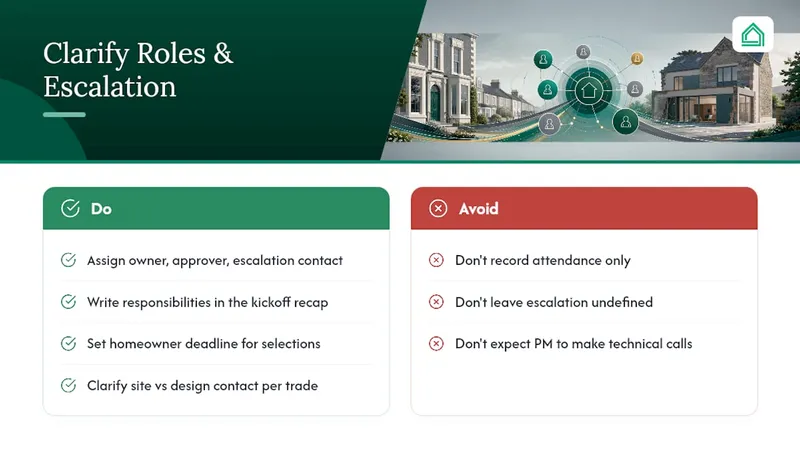
Attending the kickoff is not the same as having a defined role in it. Every attendee needs a specific answer to three questions: what am I responsible for, what am I authorised to approve, and who do I escalate to when I can't resolve something myself.
The homeowner's role usually extends beyond approvals into timely responses. If selections are outstanding, the homeowner owns the deadline for closing that gap, not the contractor. The project manager owns the schedule and the decision log, but not necessarily technical judgement calls on structural or electrical matters, those sit with the relevant trade or designer.
Write these responsibilities down in the recap, not just the attendee list. "Sarah (homeowner) to confirm tile selection by Friday" is a responsibility. "Sarah attended" is not. This distinction matters most when things go wrong midway through the project: a vague attendee list gives everyone room to say "I didn't realise that was on me," while a documented responsibility list closes that gap before it opens.
Superintendents and trades should also leave with clarity on who they contact for site-level decisions versus design-level ones. Blurring that line is a common source of delay, since a trade waiting on a design answer from the wrong person can lose days. Setting clear communication expectations with contractors at the outset avoids this confusion taking root later in the project.
Setting expectations and defining goals together
Every stakeholder walks into a kickoff with a slightly different idea of what "done" looks like. The homeowner might be picturing a finished aesthetic; the contractor is thinking about sequencing and inspections; the designer is focused on whether the build matches intent. Left unspoken, these differences surface as disappointment later.
Spend real time at the start of the kickoff getting everyone to state, out loud, what a successful outcome looks like to them. This isn't a soft exercise, it directly shapes priorities when trade-offs inevitably appear. If the homeowner's top priority is finishing before a family event, that changes how the schedule gets sequenced. If the contractor's priority is minimising change orders, that shapes how selections get locked down early.
Document these goals in the recap alongside the scope and schedule. When a scope creep request comes in during week six, the recap becomes the reference point: "We agreed the priority was completing the kitchen before the holidays; does this request support or threaten that?" That single sentence resolves more arguments than any clause in the contract.
Goals should be specific enough to test against later. "We want a beautiful kitchen" isn't testable. "We want the kitchen functional for cooking by 1 December, within the agreed allowance" is. Push stakeholders toward the second kind of statement during the kickoff itself, not after.
Reviewing permits, approvals, and regulatory requirements
Permits and approvals belong on the kickoff agenda, not as an afterthought discovered mid-project. Confirm at the outset which permits have already been submitted, which are pending, and which haven't started, then assign an owner to each.
Regulatory requirements vary significantly by jurisdiction and by the scope of work. Structural changes, electrical rewiring, and plumbing relocations typically trigger inspection requirements that a simple cosmetic refresh does not. Rather than assume permit status, ask each trade directly at the kickoff whether their portion of the work requires a specific approval, and confirm the expected turnaround time with the relevant local authority.
Build permit timelines into the schedule discussion, since approval delays are one of the most common causes of a stalled start date. If an electrical permit is pending and typically takes several weeks in your area, that date needs to appear on the schedule summary circulated before the meeting, not discovered as a surprise once the crew is ready to start.
Assign one person, usually the project manager or contractor, as the single point of accountability for tracking permit status throughout the project. Record this in the decision log along with the expected approval date for each outstanding item, so nobody has to ask "did we ever hear back about that permit?" three weeks into the job.
Common kickoff challenges and how to handle them
A handful of problems recur across nearly every renovation kickoff, and each has a straightforward fix if you catch it early.
Incomplete selections. If tile, fixtures, or finishes aren't chosen yet, don't let the meeting stall waiting for them. Set a firm deadline for each outstanding selection and note the schedule impact if that deadline slips.
Vague scope language. Contract language like "update the bathroom" invites disagreement later. Push for specifics during the scope walk itself, comparing drawings against contract line by line rather than accepting general descriptions.
Attendees without authority. Covered earlier, but worth repeating here: a decision made by someone who later gets overruled by a spouse or business partner costs more time than the delay of rescheduling to get the right person in the room.
Unresolved technical disputes. Don't let a disagreement over a structural detail consume the whole meeting. Park it, assign a named owner and a follow-up date for a separate technical review, and keep the kickoff moving.
Schedule optimism. Long-lead items (custom cabinetry, specialty windows) often get underestimated. Confirm lead times with suppliers before the kickoff, not during it, so the schedule reflects reality rather than hope. Guidance on managing construction delays is useful reading if this has bitten you before.
Timeline overview and critical milestones to confirm
The kickoff should produce a shared, dated view of the whole project, not just the start date. Walk through each phase and confirm the milestone that marks its completion.
Demolition or removal typically comes first, followed by any structural or rough-in work (framing, electrical, plumbing), then inspections, then finishing trades, and finally the walkthrough and handover. Each phase transition is a milestone worth naming explicitly in the recap, since it gives everyone a checkpoint to measure progress against.
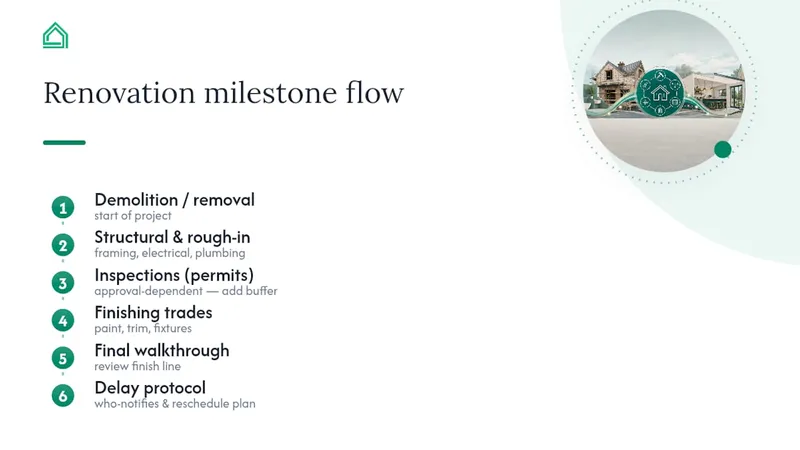
Pay particular attention to milestones that depend on external approval, permit sign-off, inspection scheduling, since these are outside the contractor's direct control and need buffer time built in. A detailed planning and timeline resource can help homeowners understand realistic sequencing if this is their first renovation.
Confirm at the kickoff what happens if a milestone slips: who gets notified, how quickly, and whether downstream trades need to be rescheduled. This single question, asked and answered before work starts, prevents the scramble that usually follows a delay. Reviewing a final walkthrough guide at this stage also helps everyone understand what the finish line actually looks like, which shapes how interim milestones get prioritised.
Discussing budget and financial considerations openly
Budget conversations at the kickoff need more precision than "we'll try to stay on target." Walk through the payment schedule line by line, confirming what triggers each payment, milestone completion, material delivery, or inspection sign-off, so nobody is surprised by an invoice.
Allowances deserve particular attention. If the kitchen countertop allowance is £3,000 and the homeowner's preferred stone costs £4,200, that gap needs resolving now, not discovered after the order is placed. Ask directly: "Which allowances are likely to be exceeded, and by roughly how much?"
Contingency budgets should also be discussed plainly. Renovation work, especially in older properties, often uncovers issues behind walls or under floors that weren't visible during quoting. Agree in advance how contingency spending gets approved, whether that requires a phone call, an email confirmation, or a formal change order, so a surprise doesn't halt work while everyone figures out the process.
Finally, confirm who holds financial authority for different spending thresholds. A £200 decision might not need the same sign-off as a £5,000 one. Document these thresholds in the recap so the project manager isn't guessing whose approval is needed for each change order that comes through later.
Three habits worth applying at every kickoff
The single habit that separates a productive kickoff from a wasted one is decision discipline: nothing leaves the room as "we'll figure it out later." Every open point gets an owner and a date, and the recap goes out within 24 hours while memory is still sharp.
Three checks worth running on every project: does every decision have a named owner, does every deadline have a consequence attached if it's missed, and has the recap actually been confirmed as received, not just sent. Skipping any one of these three is where most kickoff meetings quietly fail, even when the conversation in the room felt productive.
— Azai
A simpler way to keep kickoff decisions on track
Running a renovation kickoff well is one thing; keeping every decision, document, and budget line consistent for months afterwards is another challenge entirely, and it's where spreadsheets and scattered email threads tend to fall apart. Certain platforms provide a single place to hold your agenda, drawings, selections list, schedule, and decision log together, so nothing gets lost between meetings. Some include AI agents that flag budget conflicts and timeline risks based on your own numbers and preferences, helping to catch overlooked details and avoid costly errors. If you want to see how it works for your own project, visit the House A-Z agents page and start with the free plan to set up your first kickoff hub today.
Sources
For deeper agenda and payment templates, see House A-Z's guides on payment schedules and managing change orders. For site safety planning, SPEZ AG's safety guidance is a useful external reference.
- How to nail your project kickoff meeting | Atlassian
- Project kickoff meeting: 10-step guide for success | Asana
- Kickoff meeting agenda for construction project | Indeed
- What happens in a preconstruction meeting and who should attend? | Contractor Foreman
FAQ
What should be included in a kickoff meeting?
A renovation kickoff should cover scope confirmation, schedule and milestones, budget and payment terms, decision-making authority, communication protocols, and a change-order process, closing with a decision log distributed within 24 hours.
What are some good ideas for a kickoff meeting?
Split the session into a shorter client-facing meeting and a longer internal trade meeting, use a visible agenda with strict timeboxes, and assign a dedicated scribe to capture decisions in real time rather than relying on memory afterwards.
What are three key components of a project kickoff meeting?
The three essentials are a clear scope walk against the contract, confirmed schedule milestones with named owners, and a communication protocol covering point of contact and response times, all captured in a same-day or next-day recap.
How do you structure a project kickoff meeting?
Open with the meeting's purpose and expected outputs, work through a timed agenda covering scope, schedule, budget, and logistics, park unresolved technical disputes for a separate follow-up, and close by confirming next steps and the recap owner.
How long should a renovation kickoff meeting last?
Client-facing kickoffs typically run 1 to 2 hours, while internal or trade-focused kickoffs covering full scope and sequencing usually need 2 to 4 hours to cover everything properly.