A construction payment schedule is a written draw plan that ties each payment you make to verifiable work, a percentage of the contract sum, or a set date. For most residential renovations, the safest default structure runs in three parts:
- A modest deposit (typically 10 to 15%) to cover startup costs and materials.
- Milestone or progress draws released as inspectable stages are completed.
- A final retention (usually 5 to 10%) held back until the punch list is closed.
Use the free contractor payment schedule template as your starting point, then adjust the splits to match your project's size and risk.
Key Takeaways
A fair construction payment schedule ties every draw to verifiable milestones, keeps deposits modest, and holds a final retention until the punch list closes.
| Point | Details |
|---|---|
| Start with a template | Use a preset structure such as deposit, milestones, and retention rather than drafting from scratch. |
| Tie draws to proof | Require inspections, certificates, or photos before releasing any milestone payment. |
| Use an SOV on bigger jobs | Break the contract sum into line items to support accurate progress billing and avoid disputes. |
| Negotiate terms before signing | Push for milestone-based language in writing, since owners often have more leverage pre-contract. |
| Centralise tracking | Platforms like House A-Z keep draw schedules, approvals, and documents in one place instead of scattered spreadsheets. |
Table of Contents
- What is a construction payment schedule and why does it matter?
- What core elements must every payment schedule include?
- Which payment schedule type suits your project?
- How do you draft a payment schedule step by step?
- When should payments be made and what happens if one is late?
- What best practices keep payment schedules dispute-free?
- How House A-Z simplifies payment schedule management
- Where to find templates and further guidance
- Sources
- FAQ
What is a construction payment schedule and why does it matter?
A construction payment schedule sets out when payments happen, how much each one covers, and what work or documentation triggers it. Rather than paying on fixed calendar dates, most schedules tie money to milestones, a percentage of the contract, or agreed time intervals. Designing Buildings defines it as a list of dates or milestones showing when payments fall due under a construction contract.
Done well, a schedule gives you three things: predictable cash flow for both sides, leverage to enforce quality before money changes hands, and fewer disputes because everyone agreed the terms in advance.
Get it wrong, or skip it altogether, and you invite trouble. Front-loaded schedules let contractors take most of the money before most of the work is done. Vague trigger criteria breed arguments over whether a "milestone" was actually met. And in the worst cases, missed or contested payments stop work entirely or trigger liens against the property.
What core elements must every payment schedule include?
A schedule that holds up under pressure needs specific fields, not vague language. Build yours around these:
- Project and parties: project name, site address, contractor and client details, contract number and date.
- Payment rows: milestone name, verifiable completion criteria, percentage or fixed amount, running total, due date, and payment method.
- Supporting documents: invoices, inspection certificates, lien waivers, and named contacts responsible for approving each stage.
- Retention clause: the percentage withheld (commonly 5 to 10%) and the exact condition that releases it, usually a closed punch list.
- Change-order handling: how additional work is priced and approved before it's added as a new line item.
Skipping any of these leaves room for interpretation, and interpretation is where disputes start.
Pro Tip: Name a single approver for each payment row before work begins. When three people can sign off on a draw, none of them feels responsible for checking it properly.
Which payment schedule type suits your project?
The right structure depends on project size, duration, and how much uncertainty exists in the scope. There's no single correct model.
- Deposit plus final payment works for small, short jobs, such as a single-room repaint, where there's little risk in paying most of the balance on completion.
- Milestone-based draws suit medium projects with distinct phases, releasing money at points like foundation completion, framing, first fix, and final inspection.
- Progress payments against a Schedule of Values (SOV) fit larger or longer jobs. An SOV breaks the contract sum into individual line items, giving both sides a shared basis for billing and reducing arguments over what percentage of the work is actually done.
- Time and materials billing makes sense when scope is genuinely uncertain, such as repair work behind an opened wall where nobody knows what they'll find.
- Retainage withholds a slice of every draw, typically 5 to 10%, protecting the owner's leverage but tightening the contractor's cash flow. It works best on projects long enough to justify the administrative overhead.
How do you draft a payment schedule step by step?
Follow this sequence and you'll end up with a document both sides can actually use, rather than a boilerplate clause nobody reads:
- Write a clear scope of work so every milestone has something specific to measure against.
- Choose your structure (deposit and final, milestone, SOV, or time and materials) based on project size.
- Set a deposit tied to real startup costs, not an arbitrary round number.
- Break the remaining balance into milestones with objective completion criteria.
- Decide your retention percentage and the exact condition that releases it.
- Define what documentation triggers each payment and who signs off on it.
Your template needs these fields at minimum: milestone name, description of work, percentage of contract, dollar or pound amount, cumulative total paid, due date, required proof, and approver name.
Here's how one row might look on a £50,000 kitchen extension:
| Milestone | Description | % of Contract | Amount | Required Proof |
|---|---|---|---|---|
| Foundation and slab | Excavation, footings poured, slab cured | 20% | £5,000 | Building control sign-off, site photos |
Free generators such as Renopay's payment schedule tool offer preset UK-oriented splits if you'd rather start from a template than build one from scratch.
Pro Tip: Match your milestone wording to something a third party could verify without you present. "Kitchen looking finished" invites a dispute. "Units installed, worktops fitted, plumbing connected and tested" doesn't.
When should payments be made and what happens if one is late?
Most schedules follow the same operational rhythm, whether they're a homeowner renovation or a commercial contract:
- The contractor submits a payment application or invoice referencing the completed milestone.
- The owner or their agent verifies the work, often via site inspection or photographic evidence.
- Payment becomes due after an agreed period, commonly 14 to 30 days from approval.
- Funds are released, and retention is tracked separately until final completion.
Government contracts often formalise this further. The FAR progress payments clause caps certain progress payments at 80% of allowable costs and limits requests to once a month, a useful benchmark even outside public procurement.
When payments run late, you have options, though they vary by jurisdiction:
- Document every missed date and communication in writing.
- Understand your suspension rights before threatening to stop work.
- Know the lien filing deadlines in your area, since they're often shorter than people expect.
- Consider adjudication or mediation before litigation, particularly under statutory regimes like the UK's Construction Act.
Payment delays aren't a minor irritant. One industry report found that 37% of contractors experienced work delays or stoppages in the prior 12 months because of them.
Always check local law or speak to a construction solicitor before relying on statutory prompt-payment rules, since they differ sharply between countries and even between public and private contracts.
What best practices keep payment schedules dispute-free?
The schedules that avoid conflict share a handful of habits, and none of them are complicated:
- Tie every draw to objective, verifiable criteria such as inspections, certificates, or timestamped photos, not subjective judgement calls.
- Ask for lien waivers or receipts at each draw stage and keep every record, even the ones that feel unnecessary at the time.
- Standardise your template and route every approval through one person, not whoever happens to be available.
- Keep deposits modest and tied to real costs, then hold that final retention until the punch list is genuinely closed.
Negotiate these terms in writing before you sign the contract. Owners typically have more leverage at that stage than they realise, and pushing for milestone-based terms up front beats disputing boilerplate later.
Why we recommend a schedule of values and digital tracking
We favour Schedule of Values on anything beyond a small renovation, paired with a single digital record for approvals. It removes the guesswork over what's actually been paid, which is exactly the clarity House A-Z is built to give.
Where to find templates and further guidance
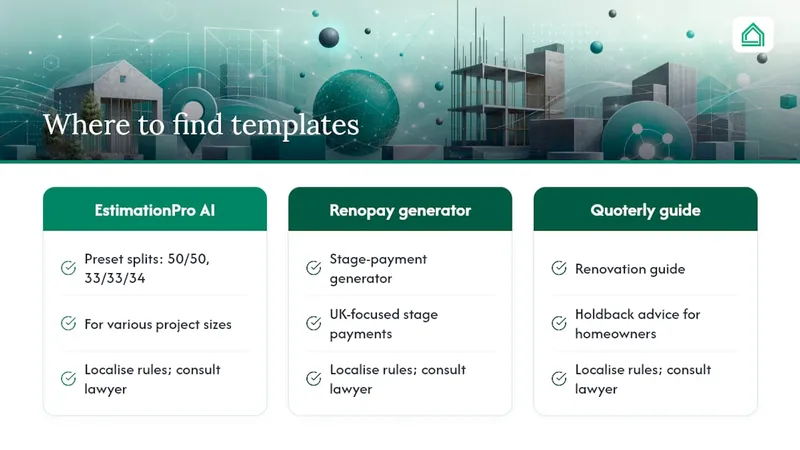
Several free tools can get you started faster than building a schedule from a blank page. The EstimationPro AI template offers preset splits like 50/50 and 33/33/34 for different project sizes, while Renopay's generator leans towards UK-specific stage payments. Quoterly's renovation guide covers practical holdback advice for homeowners specifically.
Always localise any statutory rules, filing deadlines, or prompt-payment clauses to your own country and contract type before relying on a template as-is.
This article is general information, not a substitute for advice from a qualified lawyer. Consult a qualified legal professional about your own circumstances before acting on anything here.
Sources
- Construction payment schedule — NetSuite resource
- FAR 52.232-16 Progress Payments
- Free payment schedule generator for building work — Renopay
- Free contractor payment schedule template (2026) — EstimationPro AI
- Payment schedule — Designing Buildings wiki
FAQ
What is the payment schedule under the Construction Act?
The UK Construction Act requires interim payments on construction contracts to follow a set process: a payment notice, an opportunity to issue a "pay less" notice, and a final date for payment, all specified in the contract terms rather than a single fixed schedule.
What is the standard payment format in construction?
Most contracts use one of a few formats: deposit plus final payment, milestone-based draws, progress payments against a Schedule of Values, or time and materials billing, chosen according to project size and scope certainty.
What is the payment schedule for a JCT contract?
JCT contracts typically use interim valuations at agreed intervals, with payment due a set number of days after each valuation date, plus retention withheld until practical completion and the defects period ends.
What does an example construction payment schedule look like?
Tools like House A-Z let you build this structure directly against your project budget rather than in a separate spreadsheet.