A turnkey build is defined as a construction delivery method where a single contractor manages every phase of a project, from initial design through to final finishing, and hands over a ready-to-occupy home. You, as the owner, have one job: turn the key and move in. This approach consolidates accountability, transfers project risk to the contractor, and removes the need for you to coordinate architects, builders, and subcontractors separately. For first-time builders and those planning major renovations, understanding the turnkey construction definition is the first step to choosing the right delivery model for your project.
What does a turnkey build actually cover?
A true turnkey contract covers the full project life cycle, from site preparation and planning permission through to MEP rough-in (mechanical, electrical, and plumbing services), finishing works, and the handover of a Code of Compliance certificate. The contractor manages every trade, every inspection, and every supplier relationship on your behalf.
The scope of a turnkey project varies significantly between contractors, and this is where many homeowners run into trouble. Many builders misuse 'turnkey' to mean only the physical structure has been completed, leaving you to arrange permits, utility connections, and compliance certificates separately. That is not a true turnkey arrangement. It is a partial build with a misleading label.
A genuine turnkey contract should include all of the following:
- Site works: Excavation, drainage, and ground preparation
- Planning and building permits: Submitted and approved before construction begins
- Utility connections: Water, gas, electricity, and telecommunications connected to the property
- All trades: Framing, roofing, insulation, plastering, tiling, and joinery
- Finishing works: Painting, flooring, kitchen and bathroom fit-out
- Compliance certificates: Code of Compliance or equivalent sign-off from the local authority
- Final handover: A completed, inspected, and habitable property
Pro Tip: Before signing any contract labelled "turnkey," ask your contractor to provide a written scope schedule listing every item included. If site works, utility connections, or compliance certificates are absent, negotiate their inclusion or adjust your budget to cover them separately.
| Scope element | Included in true turnkey? |
|---|---|
| Planning and building permits | Yes |
| Site preparation and earthworks | Yes |
| Structural framing and roofing | Yes |
| MEP rough-in and fit-out | Yes |
| Interior finishing and fit-out | Yes |
| Utility connections | Yes (verify in contract) |
| Code of Compliance certificate | Yes (verify in contract) |
| Landscaping and external works | Sometimes (confirm explicitly) |
Ensuring permits and utility connections are written into the contract prevents costly surprises after construction is complete. A missing line item in the scope schedule can translate into thousands of pounds of unplanned expenditure once the builder has left site.
How does a turnkey build compare to other delivery methods?
Three main delivery models exist in residential construction: traditional procurement, design-build, and turnkey. Each distributes responsibility, risk, and control differently.
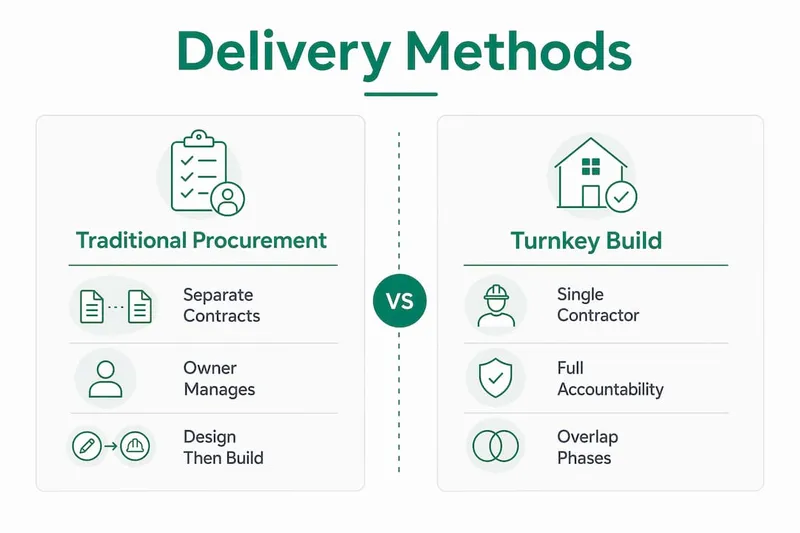
In traditional procurement, you appoint an architect separately, then tender the design to a builder. Accountability is split. If a defect arises, the architect and builder can dispute responsibility, leaving you in the middle. In a design-build arrangement, one firm handles both design and construction, but you typically retain more input during the design phase and may manage some procurement decisions yourself.
A turnkey build goes further. The contractor manages delivery, scheduling, and performance risks entirely, with no shared accountability between separate parties. Unlike traditional builds where architects and builders may shift blame for defects, turnkey contractors accept full liability and must fix errors at their own cost. That single-point accountability is the defining legal advantage of the turnkey model.

| Feature | Traditional | Design-build | Turnkey |
|---|---|---|---|
| Single point of contact | No | Partial | Yes |
| Owner involvement during build | High | Medium | Low |
| Risk held by owner | High | Medium | Low |
| Design flexibility mid-build | High | Medium | Low |
| Cost certainty at contract stage | Low | Medium | High |
| Accountability for defects | Split | Shared | Contractor only |
Advantages of a turnkey build:
- Reduced management burden for the owner
- Fixed-price contract provides cost certainty
- Faster timelines through overlapping design, procurement, and construction phases
- Single contractor liability for all defects and delays
Challenges of a turnkey build:
- Less control over material and design choices during construction
- Changes mid-build trigger costly change orders
- Quality depends entirely on the contractor you select
- Vague specifications at the outset can lead to disappointing results
Pro Tip: If design control matters to you, consider a design-build arrangement instead. Turnkey suits owners who prioritise a finished result over involvement in the process.
What are the benefits and challenges of turnkey builds?
The primary benefit of a turnkey build is cost predictability. Turnkey contracts typically operate on a fixed-price or lump-sum basis, meaning the contractor bears the risk of cost overruns. You agree a price, sign the contract, and the contractor is incentivised to deliver efficiently within that budget. For first-time builders without construction experience, this removes one of the most stressful variables in the entire process.
Timelines are also a clear advantage. Turnkey projects reduce delays by overlapping design, procurement, and construction phases under one coordinated programme. A traditional build, where the architect finishes the design before the builder even prices the work, can add months to the overall schedule. Reviewing your approach to construction delays is worthwhile regardless of which delivery model you choose.
The challenges are equally real. Turnkey contractors require significant autonomy, which limits your ability to alter design or materials during construction without triggering change orders. Those change orders can erode the cost certainty that made the model attractive in the first place. Understanding how to manage construction modifications before they arise will save you money and frustration.
The other challenge is specification quality. Success in turnkey projects depends heavily on clear upfront client requirements. A contractor has near-total autonomy once the contract is signed. If your brief is vague, the finished home may meet the contract but not your expectations. Spend time on your specification before you sign, not after.
How to protect yourself in a turnkey build contract
A well-drafted contract is the foundation of a successful turnkey project. Before signing, verify each of the following elements in writing.
- Full scope schedule. Confirm that site works, utility connections, all trade packages, and compliance certificates are explicitly listed. Anything absent from the schedule is your responsibility to arrange and fund.
- Fixed-price agreement. Confirm the contract price is lump-sum and that the conditions under which the contractor can raise a variation are clearly defined and limited.
- Programme of works. Request a construction programme showing key milestones, from groundworks through to practical completion. This gives you a reference point for monitoring progress.
- Defects liability period. Confirm the period during which the contractor must return to fix defects at no cost to you, typically 12 months after handover in the UK.
- Dispute resolution clause. Check that the contract includes a clear process for resolving disagreements, whether through adjudication, mediation, or arbitration.
- Insurance requirements. Confirm the contractor holds public liability insurance, employer's liability insurance, and contract works insurance for the duration of the build.
- Payment schedule. Agree a staged payment schedule tied to construction milestones, not arbitrary dates. Never pay in full upfront.
Monitoring quality during a turnkey build requires a different approach than a traditional project. You have less day-to-day involvement, so scheduling formal site inspections at key stages, such as after foundations, after framing, and before plastering, protects your interests without undermining the contractor's autonomy. A quality control checklist for each build phase gives you a structured way to do this. Before you accept handover, conduct a thorough final walkthrough and document any outstanding items in writing.
Consult a construction solicitor before signing any contract with a value above £100,000. The cost of legal review is small relative to the protection it provides.
Key takeaways
A turnkey build places full project responsibility with one contractor, delivering a completed home in exchange for reduced owner control and clear upfront specifications.
| Point | Details |
|---|---|
| Single contractor accountability | One party is liable for design, construction, defects, and compliance from start to finish. |
| Verify contract scope carefully | Confirm permits, utility connections, and compliance certificates are explicitly included in writing. |
| Fixed-price contracts protect you | Lump-sum agreements transfer cost overrun risk to the contractor, not the owner. |
| Upfront specifications are critical | Vague briefs lead to outcomes that meet the contract but miss your expectations. |
| Formal inspections remain your right | Schedule site visits at key milestones even within a turnkey arrangement to monitor quality. |
Why turnkey suits some owners more than others
I have worked with enough first-time builders to know that the appeal of turnkey is almost always the same: people want a finished home without having to become part-time project managers. That is a completely reasonable goal. But the owners who get the best results from turnkey builds are not the ones who hand over the brief and disappear. They are the ones who invest serious time upfront in writing a detailed specification, then trust the process.
The most common mistake I see is treating the turnkey label as a guarantee of completeness. It is not. Turnkey delivery describes the final project outcome, not a standardised scope. Two contracts can both be called "turnkey" and include entirely different items. The word is a commercial description, not a legal standard. Read the schedule of works as carefully as you read the price.
The other thing most articles do not tell you is that communication still matters enormously in a turnkey build. You have less formal involvement, but that does not mean silence is appropriate. Set a regular cadence with your contractor, whether weekly calls or fortnightly site visits, and document every conversation. Good contractor communication is the single most reliable predictor of a smooth handover, regardless of the contract model.
Turnkey is worth it when you choose the right contractor, write a thorough brief, and stay engaged without micromanaging. It is not worth it when you treat the fixed price as a reason to stop paying attention.
— Azai
FAQ
What does a turnkey build mean in simple terms?
A turnkey build is a construction arrangement where one contractor handles everything from design and permits to finishing and handover, delivering a fully completed, move-in-ready home. Your only task is to occupy the property once the key is handed over.
Is a turnkey build more expensive than a traditional build?
Turnkey builds often carry a higher upfront price because the contractor absorbs project risk and management costs. However, the fixed-price structure reduces the likelihood of budget overruns that frequently affect traditional builds.
What should I check before signing a turnkey contract?
Verify that the contract explicitly includes site works, planning permits, utility connections, all trade packages, and a Code of Compliance certificate. Any item absent from the written scope is your financial responsibility to arrange separately.
Can I make changes during a turnkey build?
Changes during construction are possible but trigger formal change orders, which add cost and can delay the programme. The most effective way to avoid this is to finalise your specification in full before the contract is signed.
What is the difference between turnkey and design-build?
A design-build contract gives you more input during the design phase and may involve shared procurement decisions. A turnkey contract transfers near-total control to the contractor from the outset, with the owner defining requirements upfront and receiving a completed property at handover.