A design decision matrix is a grid that scores your options against the things that matter to you, so a big choice (which kitchen layout, which flooring, which project first) rests on weighted evidence rather than on whoever argues loudest. You list the options, agree the criteria, give each criterion a weight, score every option and add it up. This guide walks through each step with a worked renovation example, shows how couples can use the grid without a standoff, and explains where the numbers should come from. We build House A-Z for first-time builders and renovators, so the focus is the practical, homeowner-sized version.
TL;DR
- A decision matrix compares options against weighted criteria. Weights are where your priorities enter, so fix them before you score anything.
- Keep must-have constraints (budget ceiling, safety, permits) as pass or fail filters, and score only the preferences.
- Use four to eight criteria and one consistent scale, such as 1 to 5, and score one criterion at a time across all options.
- Treat the total as a conversation starter. A close result is a lean, not proof, so test it by changing the weights.
- Couples should each weight and score separately, then compare the differences. Real prices and room layouts make the scores honest.
Table of Contents
- What a design decision matrix is
- Why it helps with a home project
- How to build your matrix, step by step
- A worked example: choosing a kitchen layout
- Using a matrix to rank projects, not just products
- Using the matrix as a couple or a team
- What a score cannot tell you
- Common mistakes to avoid
- Where the numbers should come from
- Our perspective
- Put your matrix to work with House A-Z
- FAQ
- Sources
What a design decision matrix is
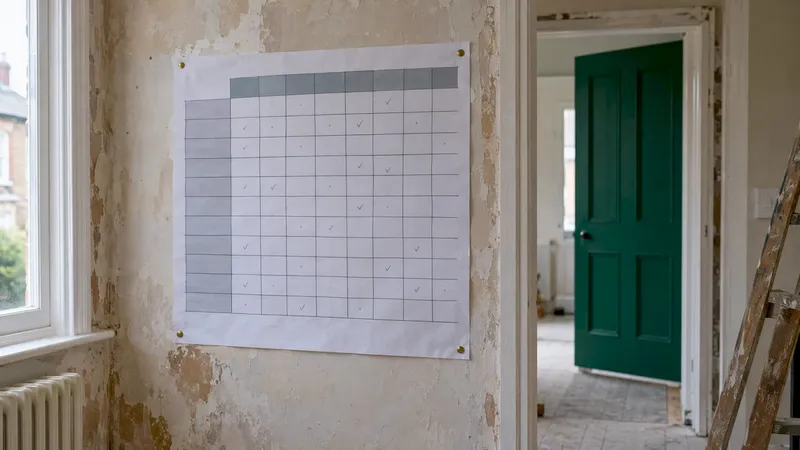
The American Society for Quality describes a decision matrix as a tool for evaluating and prioritising a list of options: you establish weighted criteria, then judge each option against them, laid out as an L-shaped grid with criteria and weights down one edge and options along the other. A pro and con list is the simplest relative. A matrix is the same idea with the importance of each point made explicit.
For a home project, this suits the moment when you have two to five credible answers to one question and a gut feeling that is pulling in several directions. Typical questions:
- Keep the kitchen where it is, or open it into the dining room?
- Which of three flooring materials suits a busy hallway?
- Which of six renovation projects should be done this year, and which can wait?
- Which of three contractor quotes is best value once everything is counted?
A matrix does not replace judgement. The same body notes that the highest score need not be the option you choose, because the relative scores are there to prompt discussion and lead people towards agreement. That framing is the healthiest way to use one at home.
Why it helps with a home project
Residential designer Kyle Callahan says the most daunting part of a new build or renovation is the sheer number of decisions. His remedy is to set an overriding theme first, boiled down to four considerations: design, maximum expense, future resale and environmental consciousness. Every later choice is then checked against that theme.
That is exactly what a matrix does in miniature. It writes your theme down as criteria and weights, so choice number 47 gets the same fair test as choice number 3. It also leaves a record. Engineers use matrices to show their work when someone asks why a decision was made, and that record is just as useful when a partner or contractor asks, three months on, why you chose the oak.
If decision overload is the real problem, our guide to renovation decision fatigue covers the wider habits that go with it.
How to build your matrix, step by step
Step 1: Define the decision and the options
Write the question in one line: "Which kitchen layout?" Then list the realistic options. Aim for two to five. If you have ten, remove the clearly inferior ones first. A useful trick from the consequences-table method is to write a few free-form sentences about each option and eliminate the clearly weaker ones before building the grid.
OwnerBuilder's guidance on the design and build process warns against finalising everything early. It describes progressive approximation: vague ideas become specific choices stage by stage. So do not build one giant matrix for the whole house. Build a small one for each decision when it is due.
Step 2: Separate the must-haves from the preferences
Some things are not up for scoring. The budget ceiling, a minimum number of bedrooms, a structural or safety requirement: these are pass or fail. The Strategy Toolkit's weighted-scoring guide advises keeping must-pass constraints separate from scoreable preferences, partly because averaging can hide a fatal flaw. An option that breaks your hard budget cap should be out, however well it scores on beauty.
In a house-hunting matrix, one couple set requirements such as a minimum number of bedrooms and bathrooms and a payment within budget as go or no-go filters, and only then scored the rest. The same logic works for a renovation.
Step 3: Choose four to eight criteria
Brainstorm freely, then cut. The same guide suggests four to eight criteria, each traceable to a stated objective. More than that and you start counting the same thing twice ("looks modern" and "feels contemporary" are one criterion, not two).
Good homeowner criteria often include:
- Cost, including fitting, delivery and anything you will need to replace.
- Daily use: how well it works on an ordinary Tuesday.
- Light and feel of the space.
- Disruption: weeks without a kitchen, noise, dust.
- Maintenance over the years.
- Resale appeal, if you may sell.
- Sustainability, if it matters to you.
The door, window and fixture choices that shape resale are worth a thought here. For instance, this piece on how doors affect property value is useful when you decide how much weight a resale criterion deserves.
Step 4: Weight the criteria before you see any scores
The simplest method is to share 10 or 15 points between your criteria. The Strategy Toolkit calls weights the place where values enter the analysis and where most of the honest disagreement lives. It recommends fixing them before any option is scored, so nobody can nudge the weights afterwards to rescue a favourite. If two people disagree about a weight, write the disagreement down rather than averaging it into silence.
Step 5: Pick a scale and score one criterion at a time

Use one scale throughout. A 1 to 5 scale is plenty for a home project. ASQ lists several workable options: 1 to 3, 1 to 5, 1-4-9, rank order, or Pugh scoring, where each option is marked better (+1), same (0) or worse (-1) than a baseline you already know.
Two habits keep scores fair:
- Score across, not down. Rate every option on cost, then every option on light, and so on. Scoring option by option invites a halo effect, where one great feature lifts all the other scores.
- Anchor the scale. Alec Morton of the University of Strathclyde explains that setting each scale so the worst option scores 0 and the best scores 100 makes differences meaningful: a 40-point gap means twice the preference of a 20-point gap. On a 1 to 5 scale, the same idea is to define in advance what a 1 and a 5 look like.
Wherever a criterion can be measured (price in pounds, floor area in square metres), measure it and convert it to the scale. Morton separates these measurable attributes from the criteria that reflect your aspirations. Leave judgement for the criteria that need it, and attach a note of evidence to each score, such as a quote, a spec sheet or a measurement.
Step 6: Multiply, add and read the result
Multiply each score by its weight and add up the column. Then, before you declare a winner, run the checks in the next sections.
A worked example: choosing a kitchen layout
This is an illustration with made-up scores, not a real project. Suppose a couple has three options and a hard budget cap that all three meet.
- A: keep the layout, replace the units and worktops.
- B: knock through into the dining room for an open-plan space.
- C: keep the footprint but move the sink and extend the run of units.
They share 15 points across five criteria: budget 5, daily workflow 4, natural light 3, disruption 2, resale 1. Each option is scored 1 to 5 (5 is best, so a cheaper or less disruptive option scores higher).
| Criterion | Weight | A: keep layout | B: open plan | C: extend run |
|---|---|---|---|---|
| Budget | 5 | 5 | 2 | 3 |
| Daily workflow | 4 | 3 | 5 | 4 |
| Natural light | 3 | 3 | 5 | 4 |
| Disruption | 2 | 5 | 2 | 3 |
| Resale | 1 | 3 | 5 | 4 |
| Unweighted total | 19 | 19 | 18 | |
| Weighted total | 59 | 54 | 53 |
Unweighted, A and B tie. Weighted, A leads, because this couple cares most about cost. That is the whole point of weights. A published example from the University of South Carolina shows the same effect with software options: unweighted totals of 16, 13 and 16 became 36, 33 and 45 once weights were applied, which changed the winner.
Stress-test the result
Now lower the budget weight from 5 to 2. A becomes 44, B becomes 48 and C becomes 44, so the open-plan option wins. The ranking depends on one weight, which is useful to know. The couple now has a sharper question: "How much do we really care about the budget margin compared with light and workflow?"
The Strategy Toolkit warns about "worshipping the decimal": a gap such as 3.9 against 3.6 on judgement-based inputs is a lean, not proof. It also lists double-counting correlated criteria and skipping sensitivity tests among the common pitfalls. Changing a weight and watching the ranking is the quickest sensitivity test, and it takes a minute.
Using a matrix to rank projects, not just products
If your question is "what do we do first?", the matrix changes shape. The PERC Program's worksheet for first-time homeowners scores each project from 1 to 3 on budget impact, urgency, timing, disruption and maintenance benefit. In its example, a deteriorating floor outranks a guest-room update because it scores higher on urgency and maintenance benefit.
The LUMA Institute offers a lighter alternative from human-centred design: a two-by-two grid of importance against difficulty or cost. You start with the Quick Wins and High ROI quadrants before moving on to the strategic and luxury projects. LUMA suggests judging difficulty by considering stakeholders, budget and your own DIY confidence.
For a full ranking of projects by value, see our renovation spending priorities list.
Using the matrix as a couple or a team
Most home decisions involve at least two people, and the matrix earns its keep here because it moves the argument from "I like it" to "which criteria matter more?"
A method worth borrowing comes from a City of Winston-Salem ranking example, which uses a family holiday choice. The first person scores the options with weights summing to 100, and each family member then repeats the exercise so everyone's opinion is considered equally. You can do the same:
- Each person sets their own weights privately, before seeing the other's.
- Each person scores the options separately.
- Compare the two grids. Where the weights differ, you have found the real disagreement. Where the scores differ on a measurable criterion, you have found a fact to check.
- Agree the shared weights, and record any dissent rather than burying it.
A multi-criteria framework published by buildingSMART for residential renovation follows the same pattern at larger scale: stakeholders choose objectives, a weighting method captures each person's preferences, and the results are combined into a ranking. It is a useful reminder that the process is a shared one.
If the grid still leaves you split, our guides to ways to compromise on home design and deciding together go further.
What a score cannot tell you
A grid captures what you thought to include. The consequences-table approach adds a step that scores miss: after drafting your options, imagine living in the finished house on a weekday, a weekend, with guests, and with children a few years older. Add anything that surfaces as a new criterion.
The PERC worksheet makes a similar point: no scoring system decides for every household, and a lower-scoring project may still be right if it fits your goals. It describes scores as conversation starters whose value lies in documenting assumptions and comparing options consistently. It also works best alongside basic budgeting and a review of estimates. Our step-by-step guide to tracking your renovation budget covers that side.
Common mistakes to avoid
- Changing the weights after you see the totals. Fix them first, or the matrix just confirms what you already wanted.
- Too many criteria. Past eight, the weights blur and the result gets less trustworthy.
- Scoring from memory. Attach a figure, a quote or a measurement to each score.
- Letting a must-have become a score. A deal-breaker should be a filter, not a 1 out of 5.
- Treating the total as the answer. It is a lean. If two options are close, decide on the criterion you care about most or run the sensitivity test.
- Building one huge matrix. Do a small one per decision, when the decision is due.
Where the numbers should come from
A matrix is only as good as its inputs. Cost scores need real prices, space scores need real dimensions, and "disruption" needs a realistic timeline. Most people gather these in scattered spreadsheets, screenshots and message threads, and then the grid drifts away from the facts.
One couple's account of using a matrix on a house search recommends a spreadsheet so you can go back and fiddle with the knobs as you learn what you want. Their final score was a relative figure in dollars rather than a measurement, and the house they bought was best overall without leading in any single category. Both points apply to renovation too: the matrix surfaces the balanced choice that a single favourite feature would otherwise hide.
When quotes are the inputs, compare them like for like first. Our renovation quotes comparison guide shows how to line them up before you score. For tools that help partners keep choices in one place, see our overview of shared renovation decision making tools.
Our perspective
A decision matrix is a brilliant idea that most people abandon after one attempt, because the hard part is not the grid. It is gathering honest inputs: the real price of each product, how each layout actually fits the room, what each choice does to the total budget.
That is why we built House A-Z around one connected workspace. Budget tracking, design suggestions, room mapping, product tracking and project management sit together, so when you score an option you are scoring against your own figures and your own room, not a guess. Our AI agents work in plain language and take your budget, preferences and timeline into account, and our positioning is simple: help first-time builders avoid costly mistakes and the chaos of juggling spreadsheets and apps.
The matrix then becomes a living part of the project, shared with your partner and your contractor, rather than a spreadsheet nobody opens again. Decide the weights together, keep the evidence beside the scores, and let the plan move forward with confidence.
Azai
FAQ
What is a design decision matrix?
It is a grid that scores several design options against weighted criteria such as cost, light, disruption and resale appeal. You multiply each score by its weight and add the results to see how the options compare. The total is a guide for discussion, not an automatic verdict.
How do I use a decision matrix step by step?
Define the decision and list two to five options. Set must-haves as pass or fail filters, choose four to eight criteria, fix weights, then score one criterion at a time across all options. Multiply, add, and finish by changing a weight to see whether the ranking holds.
How many criteria and what scale should I use?
Four to eight criteria is a sensible range, and a 1 to 5 scale is enough for most home decisions. Use the same scale for every criterion and define in advance what a 1 and a 5 mean. Measurable items such as price are best converted from real figures.
What if my partner and I weight things differently?
That is useful information, not a failure. Each of you sets weights and scores separately, then you compare the two grids to find where you truly differ. Agree shared weights and note any remaining disagreement instead of averaging it away.
Should I always pick the highest score?
Not necessarily. The scores are there to structure the discussion, and a small gap on judgement-based scores is a lean rather than proof. If the top two are close, run a sensitivity test or imagine daily life with each option before deciding.
Sources
- What is a Decision Matrix? Pugh, Problem, or Selection Grid (ASQ)
- Decision Matrix (Weighted Scoring), The Strategy Toolkit
- Multiattribute value elicitation, Alec Morton, University of Strathclyde
- Decision Matrix, University of South Carolina
- Renovation Decision-Making Worksheet for First-Time Homeowners, PERC Program
- Home improvement meets human-centered design, LUMA Institute
- Selections & Decisions, Kyle Callahan
- Design/Build Matrix, OwnerBuilder
- House project blog: the matrix, Eric Makes Everything
- Consequences Tables, WisdomFromExperts
- Project Ranking Method Example, City of Winston-Salem
- Use Case: Decision-making for residential building renovation, buildingSMART