
The strongest contractor selection criteria combine a pass/fail prequalification stage with a best-value weighted scorecard, one that scores methodology, team competence, past performance, safety, and financial soundness alongside price. Shortlist only bidders who clear the prequalification thresholds, then score the survivors against weights you set before a single bid arrives. The sections below show exactly how to check each criterion, from bonding capacity to reference calls, so the decision holds up under scrutiny.
TL;DR:
- Contractors must demonstrate financial stability with audited statements and bonding capacity aligned with project size, or face red flags before bidding.
- The selection process should involve sequential stages, including prequalification, technical proposals, clarification, and scoring to prevent biased or hasty decisions.
- Best-value scoring should weight methodology, team expertise, and past performance more heavily than price, especially on complex or time-sensitive projects.
- Verify safety records with three-year EMR and TRIR trends, and confirm site safety plans and regulatory compliance before final award.
- Conduct interviews to assess communication skills, scope understanding, and past dispute handling, as these reveal how contractors address issues during construction.
Table of Contents
- What are the essential contractor selection criteria?
- How should you structure the selection process from prequalification to award?
- How do you weight and score bids using a best-value approach?
- What financial checks, bonding and insurance evidence should you require?
- Which safety and compliance checks actually predict problems on site?
- What interview questions and red flags should change a bidder's score?
- How do you turn post-award performance into a usable procurement record?
- How should you handle dispute resolution and claims history?
- Why do communication skills and responsiveness matter so much in scoring?
- How do you check a contractor's understanding of project specifications and scope?
- How do you assess capacity and availability to meet your timeline?
- What legal and regulatory compliance should you confirm before award?
- Publisher perspective: practical lessons from owners and renovators
- How House A-Z supports the selection process you've just built
- Templates and primary sources to download
- Sources
- FAQ
What are the essential contractor selection criteria?
Every bidder worth shortlisting should clear the same set of checks, backed by paperwork rather than promises. Think of this as your baseline scorecard, the categories a best-value evaluation will later weight and rank.
- Financial soundness and bonding capacity: request reviewed or audited financial statements, a bank reference, and evidence of available bonding capacity relative to your project's value. A contractor whose bonding line is already stretched thin across other jobs is a red flag worth addressing before it becomes your problem.
- Safety performance: ask for Experience Modification Rate (EMR) and Total Recordable Incident Rate (TRIR) figures, plus a written site safety plan. A single low EMR year tells you less than a three-year trend.
- Relevant completed projects: look for jobs of comparable scale, complexity, and building type, not just a long client list.
- Project team continuity: request CVs for the site superintendent and project manager, and confirm they will actually be on your site rather than a rotating substitute.
- Methodology and quality assurance: a written approach to sequencing, inspections, and defect management shows whether the firm has a repeatable process.
- References: verified, not just supplied, with specific questions about schedule adherence and communication.
How should you structure the selection process from prequalification to award?
A defensible process runs in clear, sequential stages rather than one sprawling comparison of every bidder on every criterion at once.
- Set pass/fail thresholds before you issue the RFQ or RFP. Insurance limits, bonding capacity, licensing, and any disqualifying safety incidents belong here, not later.
- Run firm-level prequalification first. Screen out anyone who fails the baseline before spending time on detailed technical proposals. Qualifications-based selection guidance from the AGC treats this separation as essential to a fair process.
- Invite project-specific technical proposals from the survivors only, covering methodology, team, and programme.
- Hold a structured clarification stage so scope ambiguities get resolved on the record, not assumed by either side.
- Assign committee roles in advance and, where practical, score technical proposals blind of price to limit anchoring bias.
Skipping straight from advertisement to price comparison is how owners end up locked into a contractor who never had the capacity to deliver.
How do you weight and score bids using a best-value approach?
Best-value scoring beats low-bid selection whenever the work carries design complexity, tight sequencing, or heavy coordination risk, because price alone tells you nothing about whether a contractor can actually execute. Selection method guidance lists six common approaches, from least-cost to qualifications-only, and best-value sits between them by blending price with everything price can't show.
A workable weighting split for a mid-complexity renovation or build might look like this:
- Methodology and programme: 25%
- Team expertise and continuity: 20%
- Past performance and references: 25%
- Price: 30%
Riskier projects, ones with heavy structural work or a compressed timeline, should push the price weight down and methodology up. Publish the weighting scheme in your tender documents before bids land, not after, so no one can accuse you of moving goalposts once you see the numbers.
Pro Tip: Ask yourself what would justify paying 5 to 10% more for one contractor over another. Whichever criterion answers that question honestly should carry your heaviest weight, not the one that's easiest to score.
Score each category on a consistent scale, 0 to 100 or 1 to 5, with a written legend for what each band means, and set a tie-breaker rule (usually price) before scoring begins.
What financial checks, bonding and insurance evidence should you require?
Financial red flags rarely show up in a glossy proposal. They show up in the numbers a contractor would rather you didn't ask for.
- Reviewed or audited financial statements from the last two years, not a one-page summary.
- A bank reference confirming access to working capital, plus a basic credit check.
- Performance and payment bonds sized to your contract value, with confirmation the bonding capacity isn't already committed elsewhere.
- General liability, workers' compensation, and umbrella insurance, verified against your project's minimum limits, not just a certificate on file.
Slow or evasive responses to any of these requests usually mean cashflow trouble, and cashflow trouble on your job shows up as missed supplier payments and stalled schedules.
Which safety and compliance checks actually predict problems on site?
Safety metrics matter because they predict behaviour, not just paperwork. Here's what to request and how to read it.
- EMR and TRIR figures over a three-year window, since a single good year can mask a chronic pattern.
- A site-specific safety plan naming who supervises subcontractor safety, not just the prime contractor's own crew.
- Statutory payroll compliance, current licences, and any local certifications your jurisdiction requires.
- A frank account of any lost-time incidents, treated differently depending on cause. One incident tied to an unusual event is not the same as a pattern of repeated near-misses across multiple sites.
What interview questions and red flags should change a bidder's score?
A face-to-face session with the site manager and project director reveals far more than a written proposal ever will.
- Ask how they've recovered a slipping schedule on a past project, and listen for a specific method rather than a vague reassurance.
- Ask how they manage underperforming subcontractors, and whether they've ever replaced one mid-project.
- Ask directly about any past claims or disputes, and how they were resolved.
- Probe any bid that looks unusually low by asking what's included and what assumptions it rests on.
Evasive answers on past claims, an inability to produce named CVs, or reluctance to clarify scope are all reasons to mark a proposal down, whatever the price says.
Pro Tip: Build a short scope-gap checklist before interviews, covering items owners commonly forget to specify (site access, waste removal, temporary power). Bidders who've priced these correctly will answer without hesitation; bidders who haven't will ask you to define them on the spot, a sign the low number hides a change order waiting to happen.
How do you turn post-award performance into a usable procurement record?
Selection doesn't end at contract signature. Interim evaluations, typically around the 50% completion mark, give you documented leverage if performance slips, according to procurement guidance from Mass.
- Use a standard weighted evaluation form at interim and final stages, not an informal email.
- Log corrective actions, key communications, and scoring evidence in one centralised record.
- Set a passing score, often around 80 out of 100, for future prequalification eligibility.
- Feed each project's outcomes back into your next tender's criteria and bidder shortlist.
How should you handle dispute resolution and claims history?
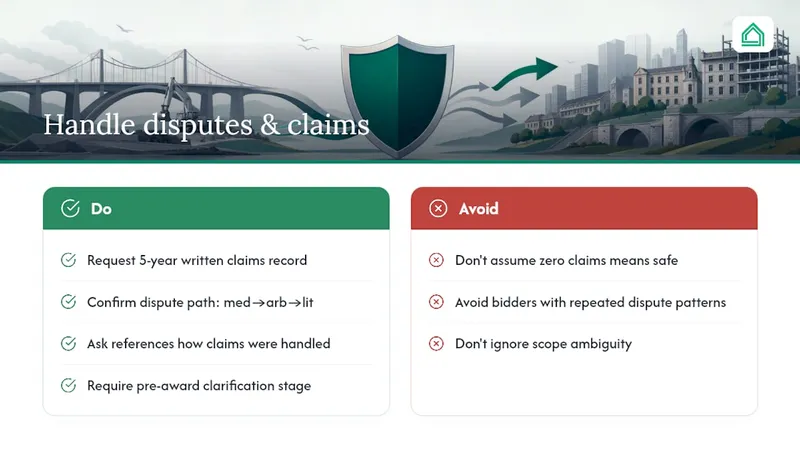
A contractor's claims history tells you more about future risk than almost any other document in the file. Ask every shortlisted bidder for a written account of disputes or claims from the last five years, including how each was resolved and whether it went to formal adjudication, arbitration, or litigation.
A firm with zero claims across dozens of projects isn't necessarily the safest choice. It might mean they've never pushed back on a legitimate cost issue, which can cut both ways. What matters more is the pattern: repeated disputes over scope interpretation, chronic late payment claims against subcontractors, or a habit of walking away from jobs mid-contract are all signals worth weighting heavily against a bidder, whatever their price looks like.
Build a specific question into your reference calls: "Did this contractor ever raise a claim, and how was it handled?" Past clients will often be candid in a phone conversation in ways they'd never put in writing. Ask, too, how the contractor's contract documents define the dispute resolution path, mediation first, then arbitration, or straight to litigation, because that clause shapes how painful any future disagreement becomes.
Scope ambiguity is the single most common root cause of disputes on renovation and construction projects, according to bidder selection guidance from Procore, which points to underpriced bids and unclear specifications as the usual triggers for later claims. A structured clarification stage before award, the same one covered in the prequalification process above, does more to prevent disputes than any contract clause written after the fact.
Why do communication skills and responsiveness matter so much in scoring?
Watch how a bidder communicates during the tender process, because it's the clearest preview you'll get of how they'll communicate once the job is under way. A contractor who answers clarification questions promptly, in writing, and with specific detail is telling you something about how they'll handle a change order request six months into the build.
Slow or vague responses during bidding rarely improve once a contract is signed. If a firm takes two weeks to answer a straightforward question about site access during tender, expect the same lag when you need an urgent decision about a structural surprise behind a wall.
Responsiveness also reveals who you'll actually be dealing with day to day. Ask directly who handles routine queries, who escalates issues, and how quickly you can expect a reply during an active build. Firms that route everything through a single overstretched project manager tend to bottleneck exactly when speed matters most.
Score this criterion using concrete evidence rather than impressions: response time during the clarification stage, clarity of written proposals, and whether the contractor proactively flagged issues in your drawings rather than waiting to be asked. A contractor who raises a scope concern unprompted during tender is showing you the kind of partner they'll be once problems, inevitable on any renovation, actually arise.
How do you check a contractor's understanding of project specifications and scope?
A bid that matches your budget but misreads your scope is worse than a bid that's honestly too expensive. The clearest test is the clarification stage itself: does the contractor ask sharp, specific questions about your drawings, or do they submit a generic proposal that could apply to any job of similar size?
Compare each bidder's written scope breakdown against your own specification line by line. Discrepancies, an omitted allowance for site drainage, a missing line for permit fees, a vague reference to "standard finishes" where you specified a particular material, are the clearest early warning of a change order coming later. Practitioner guidance from Procore treats this scope review as one of the highest-value steps in the entire selection process, precisely because it catches gaps before they become disputes.
During interviews, ask each contractor to walk you through how they priced a specific, tricky element of your project, whether that's a structural alteration, an awkward extension junction, or a heritage constraint. Their answer will tell you quickly whether they've genuinely studied your drawings or skimmed them to produce a number.
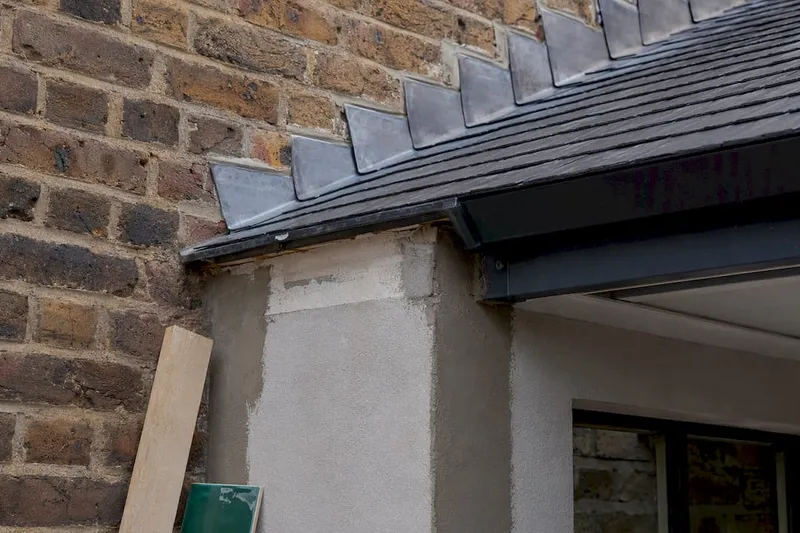
Score this criterion by comparing each bidder's assumptions list against your actual specification, not by trusting the total figure alone. A contractor who flags three scope questions you hadn't considered is showing more genuine engagement than one who submits a suspiciously smooth, question-free bid.
How do you assess capacity and availability to meet your timeline?
Ask every shortlisted contractor directly how many active projects their proposed team is currently running, and what their crew's realistic start date actually is, not the optimistic one in the proposal.
A contractor stretched across five simultaneous jobs will rarely admit it outright, but the signs show up in specifics: a superintendent who can't commit to being on your site full-time, subcontractors who are "usually available", or a start date that keeps sliding during negotiation. Cross-check the proposed schedule against their current workload by asking what else their crew is committed to over your build's timeframe.
Request a resource-loaded programme, one that names which trades and personnel are assigned to which weeks, rather than a generic bar chart. This is where team continuity, covered earlier as part of the core selection checklist, becomes a scheduling question as much as a competence one: a firm can have brilliant staff on paper and still fail you if none of them are actually free when your project needs them.
Weight this criterion more heavily on time-sensitive projects, a renovation where you're paying rent elsewhere, or a build tied to a fixed move-in date, than on projects with more schedule flexibility. A contractor with slightly weaker past performance but genuine, verified availability can be the better-value choice over a highly rated firm that can't start for four months.
What legal and regulatory compliance should you confirm before award?
Compliance checks are where prequalification earns its keep, because these are pass/fail items that shouldn't need scoring at all: a contractor either holds the right licence or they don't.
Confirm current business licensing for your jurisdiction, any trade-specific certifications the work requires, and statutory payroll compliance covering the contractor's direct employees. Where the project touches heritage restrictions, environmental permits, or local zoning conditions, verify the contractor has handled comparable regulatory approvals before, not just that they say they can.
Insurance and bonding, covered earlier in the financial checks, sit alongside licensing as foundational compliance items. The AGC's qualifications-based selection guidance is explicit that these belong at the prequalification gate, checked once and cleared, rather than re-litigated during comparative scoring. Duplicating them at both stages wastes evaluation time on items that were never meant to differentiate bidders in the first place.
Where your jurisdiction requires specific permits for the work itself, confirm who holds responsibility for pulling them, you or the contractor, before the contract is signed. Ambiguity here is a common source of delay once work starts, and it belongs in your contract language rather than left as an assumption on either side.
Publisher perspective: practical lessons from owners and renovators
First-time builders usually make the same mistake: they compare price before they've verified anything else, then discover the gaps once work has started. Centralised, dated records, scorecards, clarification notes, reference call summaries, do more to prevent disputes than any clause buried in a contract. The single habit worth adopting today is writing down every clarification answer in one place, the moment you get it.
— Azai
Templates and primary sources to download
Standard evaluation form guidance is available from Mass.gov, sample selection methods from ProjectEngineer, and QBS criteria from the AGC. For a broader look at procurement approaches, see this guide to private versus public construction contracts.
Sources
Claims of experience only mean something once you've checked them against what actually happened on site.
- Contractor selection methods | ProjectEngineer
- Qualifications based selection of contractors | AGC
- Mass
- Bidder selection guidance | Procore
FAQ
What are tier 1, 2, and 3 contractors?
Tier 1 contractors hold the direct contract with the owner, Tier 2 are subcontractors engaged by the Tier 1 firm, and Tier 3 covers sub-subcontractors or specialist suppliers further down the chain, each with different reporting lines, as explained by World Bank procurement guidance.
What are the essential elements of a construction contract?
Most construction contracts need a clear scope of work, an agreed price and payment schedule, a project timeline with milestones, defined responsibilities for permits and insurance, and a dispute resolution clause specifying how disagreements get resolved.
What are the requirements for prequalifying contractors?
Prequalification typically checks insurance coverage, bonding capacity, current licensing, financial stability, and any history of major safety incidents, all scored pass/fail before a contractor is invited to bid, according to AGC guidance on qualifications-based selection.
Should you always choose the lowest bid?
No. Low-bid selection ignores methodology, team quality, and past performance, which is why best-value weighted scoring, balancing price against these factors, tends to produce better outcomes on complex or schedule-sensitive projects.
How many contractors should you shortlist before final scoring?
Three to five prequalified bidders is typical, enough to allow meaningful comparison without spending disproportionate evaluation time on firms unlikely to win.