
A construction change order is a formal, mutually signed amendment that changes scope, price or time on a project — and it only becomes legally binding once both parties execute it. Until that signature is in place, you're working outside the contract, which means neither side has a firm obligation to pay for the extra work or honour a new deadline.
That distinction shapes every decision that follows. If a contractor starts work on a verbal instruction, you may be building a payment dispute into the foundations before the concrete even cures.
- A change order alters scope, cost, or schedule (sometimes all three).
- It takes effect only when signed by the authorised parties on both sides.
- If work must start before pricing is agreed, use a written change directive and reserve your position on time and cost in writing.
Change orders can represent 10–15% of total contract value on major projects, which is exactly why treating each one as a proper contract amendment, rather than a casual site conversation, protects your budget.
Key Takeaways
A construction change order only protects your budget and schedule when it is written, priced with entitlement and quantum evidence, and executed before work proceeds.
| Point | Details |
|---|---|
| Definition matters | A change order alters scope, cost or time and takes legal effect only once signed by both parties. |
| Know your instruments | Distinguish a change directive (proceed now, price later) from an RFI (clarification only) and a claim (disputed demand). |
| Capture triggers immediately | Photograph, timestamp and tag to a drawing reference the moment a trigger like a hidden condition or design error appears. |
| Price with entitlement, causation, quantum | State why you're entitled, what caused the cost, then quantify it, separating direct costs from prolongation. |
| Update the schedule of values | Give every signed change order its own SOV line to avoid underbilling and cashflow strain. |
Table of Contents
- Construction change order vs directive vs RFI: what's the difference?
- Common triggers for a change order — and how to catch them early
- Additive, deductive and constructive changes: know your risk
- What every change order document needs to include
- The change order process, step by step
- Pricing a change order correctly: entitlement, causation, quantum
- How a change order flows into billing and payment
- How to speed up approvals without losing leverage
- Keeping records and knowing when to escalate
- How House A-Z helps first-time builders manage change orders
- What the conventional advice on change orders gets wrong
- Sources
- FAQ
Construction change order vs directive vs RFI: what's the difference?
A change order (sometimes called a variation or amendment) is the executed document: both parties have agreed the scope, price and time impact and signed off. It's the only one of these three instruments that actually modifies the contract.

A construction change directive is different. It lets the owner instruct the contractor to proceed with work before price and time are finalised, usually when a delay would cost more than the uncertainty of an unagreed rate. AACE International's RP 100R-19 recommends this route only with a provisional valuation attached and an explicit reservation of rights, so entitlement isn't lost while the numbers get worked out.
A request for information (RFI) is neither of these. It's a clarification question, nothing more. An RFI response that reveals a design error or a scope gap often triggers a change order, but the RFI itself changes nothing contractually.
- Change order = executed, binding, alters the contract.
- Change directive = owner-issued instruction to proceed, pricing pending.
- RFI = clarification request, no contractual effect on its own.
- Claim = a formal demand for time or money the other party disputes or hasn't yet approved, often what an unresolved change directive becomes.
Common triggers for a change order — and how to catch them early
Most change orders trace back to one of four sources, and spotting them early is what separates a smooth adjustment from a drawn-out argument.
- Unforeseen physical conditions — hidden services, rock, contaminated soil, or structural issues behind a wall that nobody could see at tender stage.
- Design errors or omissions — often surfaced through an RFI when a detail doesn't buildable as drawn.
- Owner-requested changes — a homeowner deciding mid-build that the kitchen island needs to move, or a finish needs upgrading.
- Regulatory or inspection-driven changes — a building inspector requiring an unanticipated fire-rated assembly or accessibility feature.
The moment any of these appears on site, capture it before memory fades. Photograph the condition, tag it to the relevant drawing sheet or detail number, and log a timestamped note describing exactly what was found and when.
Pro Tip: Photograph the issue before anyone touches it, and note the date, time and drawing reference in the same breath. A dispute six months from now is won or lost on whether you did this on day one.
Additive, deductive and constructive changes: know your risk
Not every change order carries the same commercial weight. Additive change orders add scope and cost. Deductive ones remove scope and reduce the contract sum, which matters if you're managing a fixed renovation budget and need to offset an overrun elsewhere. Substitution orders swap one material or method for another, often at a similar cost but with implications for warranty or lead time.
Then there's the trickier category: the constructive change. This happens when an owner's action, an instruction, a delay, or even an omission effectively forces the contractor to do something different from the original scope, without anyone formally calling it a "change order" at the time. AACEI's RP 100R-19 treats constructive changes as a distinct category precisely because they're where most disputes originate, since neither party documented the shift as it happened.
- Additive — adds work and cost.
- Deductive — removes work and reduces cost.
- Substitution — swaps materials or methods, similar value.
- Constructive change — an undocumented shift in scope caused by conduct or delay, high dispute risk.
- Unilateral or provisional order — issued by one party alone to keep work moving; carries real risk if the other side later refuses to ratify the pricing.
What every change order document needs to include
Procore's guidance lists six elements every change order should contain, and skipping any one of them is how a seemingly minor variation turns into a six-month argument.
- A unique identifier number so it can be tracked against the project log.
- Parties and dates — who's issuing it, who's approving it, and when.
- A precise description of the scope change, including location on site and the relevant drawing or specification reference.
- Contract references tying the change back to the original agreement clause it modifies.
- A price breakdown, separating labour, materials, indirect costs and mark-up rather than a single lump figure.
- A clear statement on time, whether a specific extension is agreed now or explicitly reserved for later valuation.
Attach supporting documents rather than relying on the narrative alone:
- Marked-up drawings showing exactly what's changing.
- Dated photographs of the condition that triggered the change.
- A measurement or quantity worksheet backing the price.
- A short note on assumptions, so if conditions shift again, everyone can see what the original pricing was based on.
The change order process, step by step
Here's the sequence that keeps a change order moving without losing your entitlement along the way.
- Log it the moment it's identified. Timestamp the entry, note who spotted it and attach a photo or drawing reference immediately. Waiting even a few days weakens your position if the issue is disputed later.
- Issue a preliminary change request if clarification is needed. This might be an RFI to the designer, or a quick site note to the owner describing the apparent issue before formal pricing begins.
- Define the scope with the designer or engineer. Get the technical description locked down before anyone builds a price around it, since a vague scope produces a vague, arguable number.
- Build the price. Break out labour, materials, equipment, subcontractor quotes, overhead and mark-up as separate line items rather than one bundled figure.
- Negotiate. This is where most of the friction lives; come prepared with your assumptions stated plainly so the other side isn't guessing at your logic.
- Sign and execute. No work proceeds on the new scope, and no pricing becomes binding, until this happens (unless a change directive is already in force).
- Update the schedule of values. The change order becomes its own line item, not an addition buried inside an existing one.
- Monitor execution and close out. Confirm the work matches what was priced, then formally close the change order in your log once payment clears.
AACEI's stepped process mirrors this sequence closely, and Matterport's nine-step guide makes the same point about capturing evidence immediately rather than reconstructing it from memory weeks later.
Pro Tip: Keep a single running change order log, even on a small renovation. A spreadsheet with columns for date identified, description, status, and value takes ten minutes to set up and saves hours of arguing about what was agreed and when.
Pricing a change order correctly: entitlement, causation, quantum
Getting a change order paid isn't just about naming a number, it's about proving three things: entitlement (do you have a contractual right to be compensated), causation (did this specific event cause the extra cost or time), and quantum (how much is that actually worth). AACEI's RP 100R-19 frames valuation around exactly these three elements, and skipping straight to a dollar figure without the first two is a common reason change orders get rejected or delayed.
Price the work in categories rather than a single sum: direct labour and materials, indirect costs (site supervision, temporary works), prolongation costs if the schedule extends, and mark-up on the whole package.
- State entitlement and causation before quoting a price.
- Separate direct costs from time-related costs; folding them together invites challenge.
- Quantify prolongation (extended overhead, idle plant, inefficiency) rather than assuming it's covered by the base rate.
The most common valuation error is failing to price the schedule impact at all, then trying to fold the change order into an existing schedule-of-values line rather than giving it its own entry. Both mistakes cost money later, usually far more than the original variation was worth.
How a change order flows into billing and payment
Once signed, a change order should become its own new line on the schedule of values (SOV), not an adjustment buried inside an existing item. Corpay's analysis of the payment workflow makes this the single most reliable safeguard for cashflow: a discrete SOV line means the changed work can be billed and tracked cleanly through each pay application.
Retainage typically applies to change order work the same way it applies to the base contract, though some owners negotiate a reduced or zero retainage rate on smaller variations to keep subcontractors willing to proceed quickly. Joint checks may come into play if a supplier or subcontractor's payment on the changed scope needs extra assurance.
The real danger comes from starting work before execution. Doing so creates underbilling, meaning you've spent money and labour hours that haven't yet been formally recognised in your SOV, which strains working capital until the paperwork catches up. A well-organised construction payment schedule makes this gap far easier to spot before it becomes a real problem.
How to speed up approvals without losing leverage
Slow change order approvals are one of the most persistent complaints in the industry. AGC's commentary and related federal oversight work point to inconsistent processing and delayed payments as recurring problems, particularly for smaller contractors who can't absorb a long cashflow gap.
- Present a transparent cost build-up. Show labour, materials, overhead and mark-up as separate lines with the assumptions behind each figure stated plainly, so the reviewer isn't left guessing.
- Confirm who actually needs to sign before you submit. On a homeowner project, that might just be you and the contractor; on a larger job, it could involve a lender, architect or project manager, and finding this out mid-negotiation wastes days.
- Use staged or interim approvals when the full price isn't ready. Agreeing the scope and issuing a provisional payment keeps the crew working while the final number gets finalised, rather than stalling the whole project over one disputed line item.
Good communication habits with your contractor early in the relationship make every one of these steps faster, because expectations around pricing transparency and sign-off authority are already established before the first change order lands.
Keeping records and knowing when to escalate
Your change order log, photographs, RFIs, site memoranda and pricing backups together form the evidence trail that decides most disputes long before anyone mentions the word "claim". Keep them organised from day one rather than assembling them retrospectively when a disagreement flares up.
- Maintain a single change order log with dates, status and value for every item.
- File photographs and RFIs against the same reference numbers used in the log.
- Preserve every notice of delay or cost impact in writing, and link it to a time-impact analysis if the schedule effect is significant.
- Keep pricing backups (quotes, worksheets, assumptions) attached to each entry, not stored separately.
Pro Tip: If a disagreement isn't resolved after one round of negotiation, don't let it drift. Escalate formally to a claim, adjudication or mediation process named in your contract while your records are still fresh, rather than waiting months and hoping it resolves itself.
Solid document control practices make this entire process far less stressful when you need to pull evidence together quickly.
How House A-Z helps first-time builders manage change orders
House A-Z's platform centralises every piece of a change order package (photos, drawings, pricing worksheets and approval status) in one place, so nothing gets lost in a text thread or a folder of loose PDFs.
- Attach photographs directly to the relevant drawing sheet, timestamped automatically as evidence.
- Let the AI agents propose cost buckets for labour, materials and mark-up based on your project's budget and timeline, flagging when a request looks likely to push the schedule.
- Track every change order against your live schedule of values, so underbilling risk is visible before it becomes a cashflow problem.
- Share the full package with contractors and partners for faster sign-off, rather than chasing signatures over email.
Users have reported catching costly errors, in some cases avoiding roughly £20,000 in mistakes, simply by having every scope change documented and reviewed before money changed hands. That kind of visibility is what turns a change order from a source of anxiety into a routine part of the build.
What the conventional advice on change orders gets wrong
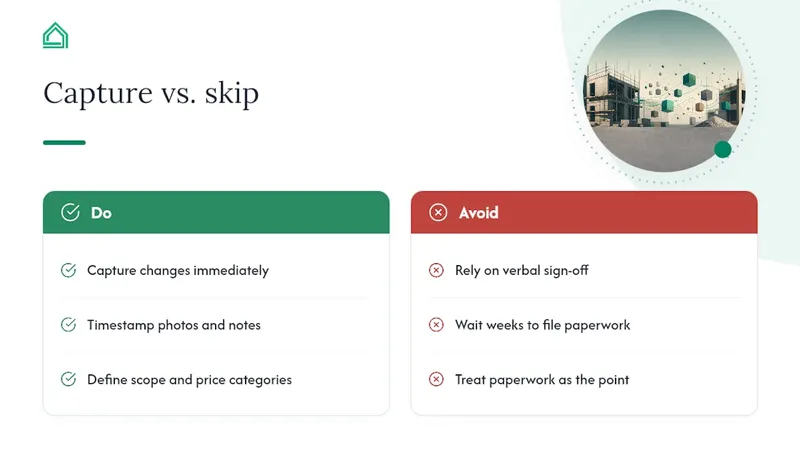
Most guidance on change orders treats the paperwork as the point. It isn't. The document matters only because of what it protects, which is your entitlement to be paid and your right to more time, and too many first-time builders sign off on scope changes verbally because the contractor "seems trustworthy" or the change "seems minor."
The pattern worth noticing in the research is how often disputes trace back to constructive changes, the ones nobody formally called a change order at the time. That's not a documentation failure so much as a recognition failure. People don't spot the trigger, so they never start the log.
Prioritise capture over paperwork polish. A phone photo with a timestamp and a scrawled note beats a beautifully formatted change order filed three weeks after the fact, because entitlement is won on contemporaneous evidence, not tidy formatting. Get the scope defined and the price broken into real categories before you negotiate, and reserve your position on time explicitly if a change directive lets work proceed before pricing is settled. A platform like House A-Z earns its place here precisely because it removes the excuse for skipping that first, unglamorous step of writing it down the moment it happens.
Sources
For deeper procedural detail, Caltrans' construction manual sets out required content and approval routing, including its Form DOT CEM-4900. AACE International's RP 100R-19 remains the standard reference for the stepped change management process and valuation framework. Standard forms are available through ConsensusDocs 202 and the AIA's G701 series, both widely used templates for wording an executed change order. Procore's technical library and AGC's change order resources round out practical guidance on documentation and approval timelines.
- Contract change management – AACE International RP 100R-19
- How change orders work in construction — Procore
- Construction change orders: the payment workflow behind a signed CO — Corpay
FAQ
What is considered a change order in construction?
A change order is any formal, signed amendment to a construction contract that alters scope, price or time, whether that's added work, removed work, or a substituted material or method.
What is the difference between an RFI and a change order?
An RFI is a clarification question that changes nothing contractually on its own, while a change order is the executed document that actually modifies the contract once both parties sign it.
Who pays for a change order?
Responsibility depends on the cause: owner-requested changes and unforeseen conditions are typically billed to the owner, while changes caused by a contractor's error or omission are usually absorbed by the contractor.
How do I raise a change order on a construction project?
Log the trigger immediately with photos and notes, define the scope with the designer, build a priced breakdown separating labour, materials and time impact, then negotiate and get it signed before the new work proceeds.
Recommended
- Construction document control for project managers | House A-Z Blog - House A-Z
- Construction payment schedule: templates for a fair plan | House A-Z Blog - House A-Z
- What does novation of contract mean for builders? | House A-Z Blog
- Construction draw schedule setup: a first-time builder's guide | House A-Z Blog