
A punch list and a snag list are the same document wearing two different regional names: a record of defects and incomplete work compiled near the end of a build, before final payment or handover. The real distinction is not in the definition but in the contract. Depending on your jurisdiction and the wording your agreement uses, that list can gate retainage, trigger practical or substantial completion, or simply sit as good practice with no legal teeth at all. The sections below unpack the terminology, the contractual mechanics, and the workflow that keeps either list under control.
TL;DR:
- The contractual significance of punch or snag lists varies by region, affecting payment release, project milestones, and dispute risks.
- Most lists are created after pre-final inspections, with retainage often withheld until all items are verified as closed.
- Detailed, photo-backed entries with clear location, responsibility, and verification are crucial to avoid disputes and ensure proper closure.
- Managing these lists with digital tools streamlines tracking, assigns responsibilities, and maintains an auditable record to prevent last-minute overloads.
- Clear, consistent terminology and proper documentation prevent costly cross-jurisdiction misunderstandings and scope disputes.
Table of Contents
- Punch list vs snag list: origins, regions and contractual weight
- Where the list sits in your programme and your cashflow
- What to record during the walk-through
- Who manages the list and how it actually gets closed
- Preventing the end-stage pile-up before it happens
- Why terminology discipline matters more than people think
- Capture, assign and close snag items without the spreadsheet chaos
- Sources
- FAQ
Punch list vs snag list: origins, regions and contractual weight
Both terms point to the same underlying document, but their history explains why professionals still argue about which one to use. "Punch list" is believed to originate from the American practice of physically punching holes next to completed items on a paper list, a habit that stuck long after the paper disappeared. "Snag" is more straightforward: a snag is a small obstacle or defect, and a snag list simply records where those obstacles are.
Geography decides which word you will hear on site. In the UK, Ireland, Australia and New Zealand, "snag list" is the standard term, while the United States and Canada default to "punch list." That split holds fairly consistently within domestic projects, but it breaks down fast on anything international. A UK contractor working under a US-drafted agreement, or an American project manager parachuted into a Gulf development built on English legal precedent, will often find both terms used interchangeably in the same set of documents.
Sector habits add another layer. Snagging tends to dominate residential new-build contexts, where homeowners or independent snagging surveyors compile the list after keys are handed over but before final sign-off. Punch lists, by contrast, are more often a formal contractual milestone on commercial jobs, raised by an architect or the owner's representative and tied directly to project close-out procedures.
The contractual consequences are where things actually matter:
- Payment gating: on many commercial contracts, punch list completion is a precondition for releasing final payment or retainage.
- Completion certificates: the list can be linked to substantial completion (common in North American contracts) or practical completion (the equivalent concept in UK and Commonwealth contracts).
- Buyer versus contractual inspection: a UK snagging list compiled by a homeowner's surveyor may carry no formal contractual force at all, whereas a US punch list referenced directly in a general conditions clause absolutely does.
- Dispute risk: using the wrong term or assuming the wrong legal weight on a cross-jurisdiction project is a genuine source of scope disputes, particularly when subcontractors and owners are working from different national conventions.
None of this changes what actually goes on the list. It changes what happens if the list doesn't get cleared.
Where the list sits in your programme and your cashflow
The list appears at a specific, predictable point in most construction programmes: after pre-final inspections, once the works are visibly close to done, and typically anchored to substantial completion (North America) or practical completion (UK and Commonwealth). That moment matters because it usually starts the clock on a defects liability period, during which the contractor remains obligated to fix anything that surfaces.
Retainage, sometimes called retention, is the financial lever most commonly attached to this process. Contracts frequently withhold 5 to 10% of the contract value until punch list or snag items are verified as closed. That means an unresolved list of minor items can hold up a payment far larger than the cost of fixing them, which is exactly the leverage retainage clauses are designed to create.
The specific mechanics depend entirely on which standard form your contract borrows from. AIA general conditions in the US, JCT contracts in the UK, and NEC contracts used widely on UK and international infrastructure work each define completion, defects periods, and payment release slightly differently. None of this is something to guess at. Before you rely on assumptions from a previous project, check:
- The definition of substantial or practical completion in your specific contract, not the industry-standard version.
- Whether retainage release is tied to a percentage of items closed, or to 100% closure.
- The length of the defects liability or rectification period and what triggers its start date.
- Who has authority to certify the list as complete, and whether that authority sits with the architect, the contract administrator, or the owner directly.
Reviewing your own payment schedule against these clauses before the walk-through, rather than after a dispute starts, saves weeks of avoidable back-and-forth.
What to record during the walk-through
A punch list or snag list is only as useful as the detail captured against each item. Vague entries like "bathroom needs attention" create arguments later about whether the item was ever actually fixed.
Common items that show up on almost every list:
- Doors and windows that do not close, latch, or align correctly.
- Scuffed, chipped, or unpainted skirtings and architraves.
- Loose or incorrectly wired sockets and switches.
- Paint defects: missed coats, drips, colour mismatches between rooms.
- HVAC systems that fail commissioning checks or run at the wrong temperature.
- Leaking taps, fittings, or waste connections.
- Flooring gaps, uneven tiling, or damaged finishes from other trades.
Residential snagging lists tend to skew towards cosmetic and finishing items, since homeowners are inspecting a space they will live in day to day. Commercial punch lists lean harder into functional testing: fire alarm commissioning, HVAC balancing, lift certification, and life-safety systems that need documented proof of performance, not just a visual check.
Whatever the sector, a usable entry needs the same core fields:
- Location: room, floor, or grid reference, specific enough that nobody has to guess.
- Description: a short, unambiguous statement of the defect.
- Photo: timestamped evidence of the issue as found.
- Assignee: the named trade or subcontractor responsible for the fix.
- Priority: whether it blocks handover or can wait.
- Target date: a real deadline, not "soon."
- Verification evidence: what proof will be required to mark it closed.
Pro Tip: Photograph every item from a fixed reference point (a doorframe, a light switch, a numbered grid line) so the "before" and "after" shots line up. It sounds trivial until you're in a dispute six weeks later trying to prove the tile really was cracked.
Who manages the list and how it actually gets closed
Responsibility for the list shifts depending on who commissioned the build and what the contract specifies. On commercial projects, the architect or contract administrator typically compiles and certifies the punch list, with the general contractor responsible for assigning items to the relevant subcontractors. On residential new-build projects, the homeowner or an independent snagging surveyor often raises the list directly, since buyers want an impartial record before they accept practical completion.
The workflow that actually closes items reliably follows a consistent pattern regardless of who is running it:
- Raise: the defect is logged with full detail at the point it's found, not weeks later from memory.
- Assign: a specific person or trade takes ownership, with a deadline attached.
- Action: the fix happens, ideally against a documented method rather than a rushed patch.
- Verify: someone other than the person who did the fix checks it against the original description and photo.
- Close: the item is signed off with evidence attached, not just marked "done."
The single biggest efficiency gain in this process is running it as a rolling punch list rather than saving everything for one final inspection. Verifying items throughout the programme, as trades finish their sections, spreads the workload and avoids the classic end-stage crunch where two hundred items land on a project manager's desk in the final week.
Closure evidence should include photos, a verifying signature, and a closure date, since disputes almost always centre on whether an item was genuinely fixed or just marked complete. Repeated defects, or disagreements about whether an item counts as resolved, need an escalation path defined in advance: usually a re-inspection by the architect or contract administrator, with documented sign-off that survives scrutiny later.

Preventing the end-stage pile-up before it happens
The teams who avoid a brutal final walk-through are the ones who stopped treating quality control as a last-minute event. Staged inspections at key construction milestones, drawing-stage QC reviews, and commissioning checks run in parallel with the build rather than after it, catch defects while they're cheap and quick to fix, not after finishes have gone in on top of them.
Best-practice close-out cadence tends to follow a simple rhythm: weekly clearance targets against the rolling list, a mid-programme review to catch systemic issues before they repeat across every unit, and a final verification run that should confirm closure rather than discover new problems. Industry guidance consistently backs staged inspections over end-loaded reviews as the more reliable route to a clean handover.
Digital tools have changed what "good enough" looks like here. A defect-tracking platform worth using should offer:
- On-site capture from a phone or tablet, not a clipboard that gets left in a site cabin.
- Photo attachment tied directly to each logged item.
- Assignable tasks with deadlines and named responsibility.
- Reporting that shows open versus closed items at a glance.
- An exportable audit trail for certificates, disputes, or retainage release.
Retainage of 5 to 10% of contract value is common practice tied to punch-list completion, which is exactly why an auditable, timestamped record matters more than a tidy spreadsheet. Centralised platforms remove the gap between what happened on site and what the paperwork says happened, without naming any particular vendor as the only route to get there.
Why terminology discipline matters more than people think
Miscommunication over punch lists and snag lists rarely comes from anyone misunderstanding the concept. It comes from two parties assuming their regional term carries the same contractual weight as the other's, and only discovering the gap when retainage is due. On international projects, that assumption is expensive.
Timestamped photographic evidence and consistent contract language do more to prevent disputes than any amount of goodwill on site. If a defect's status depends on someone's memory of a walk-through three weeks ago, you've already lost the argument before it starts. Structured tools that force a location, a photo, an assignee, and a verification step onto every item aren't bureaucracy for its own sake. They're what turns "I thought that was fixed" into a documented fact either way.
— Azai
Capture, assign and close snag items without the spreadsheet chaos
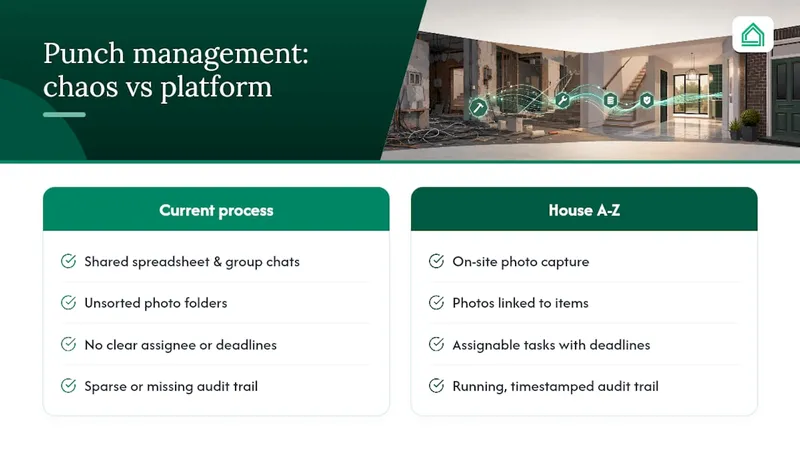
Chasing a punch list across a shared spreadsheet, three group chats, and a folder of unsorted photos is how items get missed and disputes drag on. House A-Z brings snag and punch list management into one place: on-site photo capture, assignable tasks with deadlines, a running audit trail, and a shared record that owners, contractors, and subcontractors can all see at once. Instead of reconstructing what happened after the fact, you have timestamped evidence from the moment an item was raised through to the moment it was verified closed.
For anyone managing a first-time build or a full renovation, that kind of clarity around retainage and final sign-off is worth having before the final walk-through, not after. Start exploring House A-Z to see how the platform handles project tracking, contractor collaboration, and close-out documentation in one interface.
Sources
- Punch list — Wikipedia
- Snag Lists in Construction: Getting to zero — Procore
- Snag list vs punch list: UK vs US guide — Archi
- Snag lists vs punch lists: what's the difference? — Sitemate
- Punch list — Cambridge Dictionary
FAQ
Is a snag list the same as a punch list?
Yes, functionally. Both describe a record of defects and incomplete work compiled near project completion; the difference is regional naming and, sometimes, the contractual weight attached to the term.
Do builders have to fix snags?
Usually, yes, if the item is a genuine defect against the contract drawings and specifications and falls within the defects liability or rectification period. Whether it's a legal obligation depends on the specific contract wording, so checking your agreement rather than assuming is essential.
Why do they call it a punch list?
The term is generally believed to come from the older practice of physically punching a hole next to each completed item on a paper list, a habit that outlasted the paper itself.
What is a punch list example?
Typical entries include doors that won't latch properly, unfinished paint coats, loose electrical sockets, and HVAC systems failing commissioning tests, each logged with a location, description, photo, and assigned trade.
Does using the wrong term cause real problems?
It can, particularly on international projects where a US-drafted contract and a UK-based team may attach different legal consequences to the same document, which is a documented source of scope disputes.