Renovation meeting minutes are a short written record of what you, your builder and your designer decided at a site or progress meeting: the decisions, the actions, who owns each one and by when. Send them within a day or two, ask everyone to correct anything wrong, and carry every open action into the next agenda until it is closed. Do that and you have a dated trail you can point to when a price, a finish or a deadline is questioned.
This guide is for homeowners and first-time builders. It covers what to put in, who should write them, how to circulate them, how to fix errors and how to turn the minutes into budget control.
TL;DR
- Minutes are not a transcript. Record decisions, actions (what, who, when), cost and schedule impacts, and open questions.
- The builder or project manager usually runs the meeting and writes the minutes, but you should be in the room and read them.
- Send minutes within 24 to 48 hours, invite corrections, and log any fixes in the next set.
- Carry open actions forward on every agenda until someone explicitly closes them.
- Give each decision a number, so any change to cost or timing traces back to a single approval.
Table of Contents
- What construction and site meeting minutes actually are
- Why minutes are worth the effort on a home project
- What to include in renovation meeting minutes
- Who writes the minutes, and who attends
- How to prepare, take and circulate minutes
- Can minutes be changed? How to record corrections
- Using minutes to control budget, design and deadlines
- Closeout and handover minutes
- Our perspective
- Put your minutes to work with House A-Z
- FAQ
- Sources
What construction and site meeting minutes actually are
People use "construction meeting minutes" and "site meeting minutes" almost interchangeably, and on a home project the difference is small. Professional guidance describes construction meetings and site meetings as the same kind of occasion: a chance for the architect to establish a presence and keep communication open between all project parties, according to the Ontario Association of Architects' practice advisory. That advisory is Canadian, but the logic travels well to a UK kitchen extension or loft conversion.
In practice, the labels tend to mean this:
- Site meeting: held on site, often weekly or fortnightly, to walk the work, check progress and settle practical questions.
- Construction or progress meeting: the same rhythm, sometimes held in an office or on a call, with a longer agenda covering programme, cost and information still outstanding.
- Minutes: the written record of either, produced afterwards.
A board meeting template will not help you here. Most of what ranks for this topic is about company boards, with motions and quorums. A renovation needs something lighter and more practical: a one-to-two page record that a plasterer, a homeowner and a designer can all read in three minutes.
Why minutes are worth the effort on a home project
A renovation produces hundreds of small decisions. Which tile, which door height, whether the electrician moves a socket, whether the extra steel is included. Memory is a poor filing system. Three weeks later, two sensible people recall the same conversation differently, and the difference is usually priced in pounds.
Minutes fix that. Project management guidance notes that recording decision IDs, the rationale and any cost or schedule impact creates a traceable audit trail for approvals. Home-building writers make a similar point from the builder's side: accurate minutes let the builder control the narrative and memorialise discussions. As the homeowner, you want the same document, because it protects you as well.
Minutes also keep couples aligned. When two people share a project, a written line saying "oak veneer approved, £X over allowance, both partners agreed" ends many a late-night debate before it begins.
What to include in renovation meeting minutes
Keep the structure the same every time. Readers learn where to look, and you can compare week to week at a glance. A solid set of minutes has these parts:
- Header. Project address, meeting number, date, time, location (or call link).
- Attendees and apologies. Names, roles, and who was absent. If the electrician was not there, the electrical decisions need a follow-up.
- Previous actions. Each open action from the last minutes with its status: done, in progress, blocked.
- Progress. What was completed since last time and what is planned next, in plain sentences, against the programme.
- Decisions. Numbered, with a short reason and the cost or time impact stated, even if it is "nil".
- Actions. Each one states what must be done, who is responsible and the deadline. One construction guide puts it bluntly: vague minutes produce vague outcomes.
- Information requested. Drawings, selections, quotes or approvals someone is waiting for, and from whom.
- Variations and costs. Any change to the agreed price, the allowance used and the running total.
- Health, safety and access. Anything about site access, protection of finished areas, noise hours or neighbours.
- Next meeting. Date, time and the main topics.
A decision and action line that works
Compare these two entries.
Vague: Kitchen worktop discussed. Joiner to sort.
Useful: D-14. Worktop: homeowners approve the quartz option. Cost impact: £380 above allowance, to be added as a variation. Action: builder to confirm the template date with the fabricator by Friday. Action: homeowners to sign off the sink model by Monday.
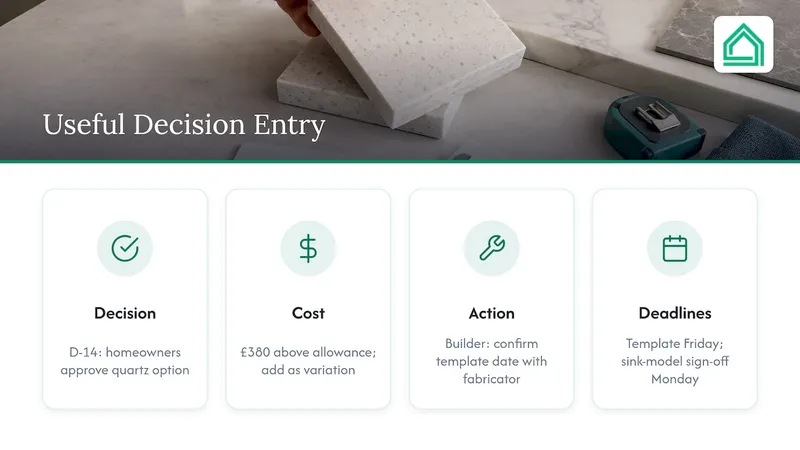
The second one names the decision, the money, the owners and the dates. Nobody has to ask what was meant.
A simple template to copy
| Item | What to write |
|---|---|
| Ref | D-number for decisions, A-number for actions |
| Topic | Room or trade, in a few words |
| Outcome | The decision or the update |
| Cost / time impact | Amount in £ and days added or saved, or "nil" |
| Owner | One named person |
| Due | A date, not "soon" |
| Status | Open, done, blocked |
Paste that table into a shared document and the minutes more or less write themselves.
Who writes the minutes, and who attends
On home-building and renovation jobs, it is best practice for the builder or project manager to run the meeting and document it, with the homeowner involved so that design choices and product deliveries stay clear, as Fine Homebuilding's guidance on project communication explains.
That works well, with one addition from us: if you are managing the job yourself, or you do not fully trust your memory of a conversation, take your own notes and compare. Two sets of notes that match are reassuring. Two that differ show you exactly what to clarify while it is still cheap.
Who to invite depends on the stage:
- Kickoff: you, your partner if you have one, the main contractor, and the designer or architect. Our guide to two timed renovation kickoff agendas shows how to structure it.
- Regular progress meetings: you, the site supervisor, and whichever trade leads are working that fortnight.
- Selections meetings: you, your partner and the designer, with the materials selections schedule open so nothing is ordered late.
- Closeout: everyone, covered below.
And name one person who has the final say on your side. When two partners give two answers, the builder cannot act. Our piece on naming one decision authority explains how to set this up before the first meeting.
How to prepare, take and circulate minutes
Before the meeting
Review the previous minutes, check in with the design team and the site supervisor, and work from a written agenda, which is the preparation Fine Homebuilding recommends. A good agenda is built from the open actions plus the next two weeks of work. If you want ideas for what goes on it, here are eight contractor meeting agenda items homeowners can copy. Planning a bathroom? A bathroom renovation checklist is a handy source of agenda topics such as layout, waterproofing and fixtures.
A preconstruction meeting deserves special care. Contractor Tyler Tranni suggests treating it as an operating plan that links the signed contract to daily life on site, confirming access, protection and decision processes before work starts. Record those agreements in your first set of minutes.
During the meeting
- Write decisions and actions as they are agreed, not afterwards.
- Read each decision aloud before moving on: "So we are going with the grey grout, no extra cost?"
- Stay objective. Record what was said and agreed, not who sounded annoyed.
- Photograph anything you point at, and reference the photo in the notes.
After the meeting
Speed matters more than polish. Published guidance varies a little: one home-building source recommends circulating minutes within 24 hours, while the architects' advisory says as soon as possible, preferably within 48 hours, so participants can review and respond to action items. Aim for the next working day and you satisfy both.
Send the minutes to everyone who attended and to anyone who owns an action but was absent. Say in the covering message: "Please reply with any corrections by Thursday. If I hear nothing, I will treat these as agreed."
Can minutes be changed? How to record corrections
Yes, with care. The key question is whether the minutes have been accepted yet.
- Before anyone has approved them: fix the draft and recirculate. General guidance on corporate minutes says that minutes can be changed at any time before they are reviewed and approved.
- After they have been accepted: do not quietly overwrite the old version. The architects' advisory recommends that participants be invited to identify errors or omissions, and that identified errors are noted and corrected in the subsequent meeting minutes.
On a renovation, a simple routine works:
- Open the next meeting with "Matters arising from the previous minutes".
- State the correction aloud, for example "Item D-9 said the budget was £1,200; it should read £1,800."
- Everyone agrees, and the correction is logged under the new date.
- Keep the old version in the folder, marked superseded.
That way the history stays honest, and nobody can say a figure was changed in secret.
Using minutes to control budget, design and deadlines
Minutes become powerful when you treat them as inputs to your tracking, not as paperwork.
Budget
Every decision with a cost impact goes into your budget the same day. If the minutes say a variation is £380, your running total should show it before the invoice does. A habit worth building: ask for a cost impact on every decision, even a nil one.
Design decisions
Log each selection with the room, product, supplier and lead time. Our renovation procurement log shows how to track order dates so that the tile you approved in week three actually arrives before the tiler does.
Actions and deadlines
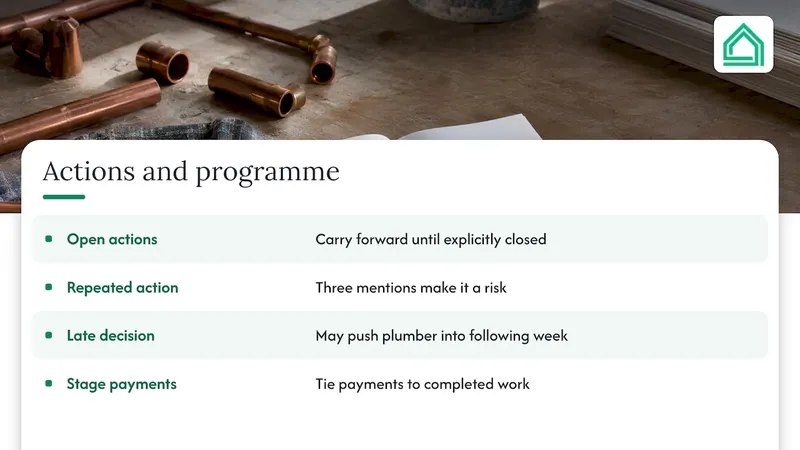
Continuity comes from carrying forward open action items from previous meetings into the new agenda until they are explicitly closed, so that tasks are not dropped or forgotten. When the same action appears three times, it is no longer a task; it is a risk, and it deserves a sentence of its own.
Pair the minutes with a programme. A renovation Gantt chart that syncs with your budget lets you see at once whether a late decision pushes the plumber into the following week. If you are paying in stages, the construction draw schedule guide shows how to tie payments to what the minutes say is finished.
Closeout and handover minutes
The last meeting is the one people skip, and it is where minutes earn their keep. Closeout meetings cover snagging, handover documentation and the defects liability period. Record the snag list item by item, with an owner and a date for each fix, and note what documents were handed over. Keep that set of minutes with your warranties; our renovation handover checklist lists the four documents worth filing.
Our perspective
We built House A-Z for people who are doing this for the first time and who do not want to run a renovation from spreadsheets, message threads and half-remembered phone calls.
Here is what we see again and again: the meeting itself goes well, and then the decisions evaporate. The budget lives in one place, the selections in another, the deadlines in a third. A minute-taker's best work gets lost in a folder nobody opens.
That is why our platform keeps budget tracking, design suggestions, room mapping, product tracking and project management together, so a decision recorded on Tuesday shows up in your budget and your timeline on Wednesday. Our AI agents work in plain language and are designed to give personalised insights based on your budget, preferences and timeline, so you can spot a costly mistake while it is still a line in the notes and not a line on an invoice. Some of our users tell us they have avoided around €20K in potential errors this way.
Minutes are the heartbeat of a well-run project. We want them to be effortless, shareable with your contractor and partner, and always connected to the numbers.
Azai
FAQ
What are meeting minutes in construction?
They are the written record of a construction or site meeting: who attended, what was decided, which actions were agreed, who owns them and when they are due. On a home project, they also capture cost and schedule impacts so that changes can be traced to an approval.
Who should take the minutes at a renovation meeting?
Usually the builder or project manager runs the meeting and documents it, with the homeowner involved, as Fine Homebuilding advises. If you want a second record, keep your own short notes and compare them when the official minutes arrive.
How soon should minutes be sent out?
As soon as possible. Guidance ranges from within 24 hours to preferably within 48 hours. Sending them the next working day gives everyone time to review the actions and flag errors before work moves on.
Can the minutes of a meeting be changed afterwards?
Drafts can be edited freely before they are accepted. Once accepted, record the correction in the next set of minutes and keep the earlier version marked as superseded, so the paper trail stays clear.
Can AI write meeting minutes for me?
AI can help structure notes, pull out actions and draft a summary, but you still need to check names, figures and deadlines against what was actually agreed. Our own AI agents are designed to help with budget and planning insights, and the minutes you circulate should always be reviewed by a person who was in the room.
Sources
- Practice Advisory Knowledge Base: Construction Meetings Minutes, Ontario Association of Architects
- Best Practices for Home-Building Project Communication, Fine Homebuilding
- Site Meeting Procedures in Construction Projects, Structrum
- Home Remodel Preconstruction Meeting Checklist, Tranni Home Remodeling
- Standardized Meeting Minutes: The Requirements Every SoCal Project Manager Must Follow, AIPM
- How to Make a Correction to Corporate Board Minutes, Chron