
Bid leveling is the process of normalising contractor proposals so you compare equivalent scope and identify the true lowest evaluated cost. Owners, general contractors and project managers use it before signing anything, because a headline price means little until every bidder has priced the same work. The outcome is a set of apples-to-apples totals, built on the same drawings and assumptions, that you can defend when the final decision is questioned.
TL;DR:
- Bid normalization reveals hidden scope exclusions, preventing costly change orders and ensuring a fair comparison based on actual work scope.
- Adjustments such as imputing missing items at the highest observed unit rate and redistributing bundled rates are essential for accurate bid ranking.
- Automated tools speed up large-bill normalization but still require human review for bundled rates and ambiguous line items.
- Meticulous documentation of assumptions, clarifications, and imputed items creates a defensible audit trail for bid evaluation decisions.
- Small projects with few bidders can be leveled manually by owners or managers, but larger, multi-package bids should involve a quantity surveyor for accuracy.
Table of Contents
- What is bid leveling in construction?
- Why bid leveling matters: the benefits
- How to level bids: step-by-step process you can use
- Worked example: normalising three subcontractor bids
- Tools, automation and evolution: what's changing in bid leveling
- Practical tips from House A-Z on levelling bids without errors
- When to call in a quantity surveyor and when to level it yourself
- Another option: House A-Z tools for comparing bids and tracking clarifications
- FAQ
- Sources
What is bid leveling in construction?
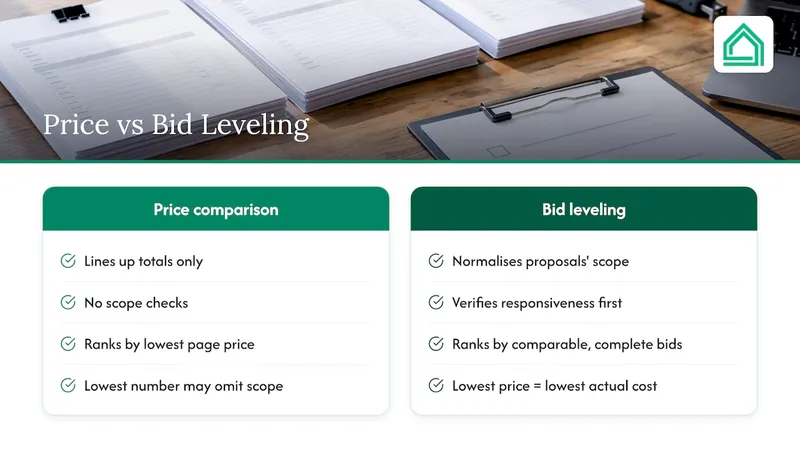
Bid leveling sits inside procurement, not alongside it. It is the step that turns a stack of differently formatted proposals into a single comparison, so the lowest number on the page and the lowest actual cost of the work become the same thing.
In formal procurement, a bid also has to be responsive before price even enters the conversation. The Federal Acquisition Regulation describes sealed bidding as awarding to the bidder whose bid conforms to the invitation and is most advantageous on price and price-related factors, a bidder often shorthanded as the "L1 bidder," the lowest-priced, responsive, responsible submission. A bid that skips required scope cannot win simply because its number is smallest.
That distinction separates a simple price comparison, which just lines up totals, from full bid normalisation, which checks what sits behind each total before any ranking happens.
Why bid leveling matters: the benefits
A low bid that is missing scope is not a bargain, it is a change order waiting to happen. Change orders tend to surface exactly where a bid quietly excluded something, and by then you are negotiating from a weaker position than you had before the contract was signed.
Levelling the bids first gives you three practical advantages:
- It surfaces hidden exclusions before award, rather than three weeks into demolition.
- It stops the "lowest bid wins, then fails" pattern, where the cheapest number on paper becomes the most expensive project in practice.
- It creates a written record of assumptions and clarifications that holds up if a bidder later disputes what was included.
AGC's best-value selection guidance makes a related point: criteria defined and prioritised early, rather than left generic, protect the integrity of the whole selection, levelling included.
How to level bids: step-by-step process you can use
Levelling works best as a fixed sequence, repeated the same way for every project. Skipping a step is usually where the comparison quietly breaks.
- Collect consistent documents. Confirm every bidder priced the same drawing set, addenda and specification version before you compare a single number.
- Build a comparison sheet. Key it to the same divisions or bill-of-quantities lines across all bids, so every row lines up.
- Classify each line item. Mark it as valued, included within a bundled rate, or missing entirely from that bidder's submission.
- Impute missing items conservatively. Academic research into automated bid normalisation recommends pricing a missing item using the highest unit rate observed among the other responsive bidders, rather than guessing or averaging, which stops a bidder from winning simply by leaving something out.
- Redistribute bundled items. When one bidder quotes a composite rate for several items, split it using the division-level ratios the other bidders' itemisation gives you, which preserves the total value while exposing the per-item cost.
- Adjust allowances, contingencies and alternates. Apply the same treatment to every bid, so one bidder's generous allowance does not mask a thinner one elsewhere.
- Record every assumption, clarification and bidder query. Note the source, the rule applied and who signed off on it.
- Produce the normalised total. This is the number you actually rank bidders on, not the cover-page figure.
A spreadsheet-based comparison approach works for most residential and small commercial projects; larger bids may need a dedicated comparison sheet keyed to full bill-of-quantities divisions.
Pro Tip: Log every clarification the moment a bidder sends it, not at the end of the process, because the fifth version of the plans is where memory of the second query usually goes missing.
Worked example: normalising three subcontractor bids
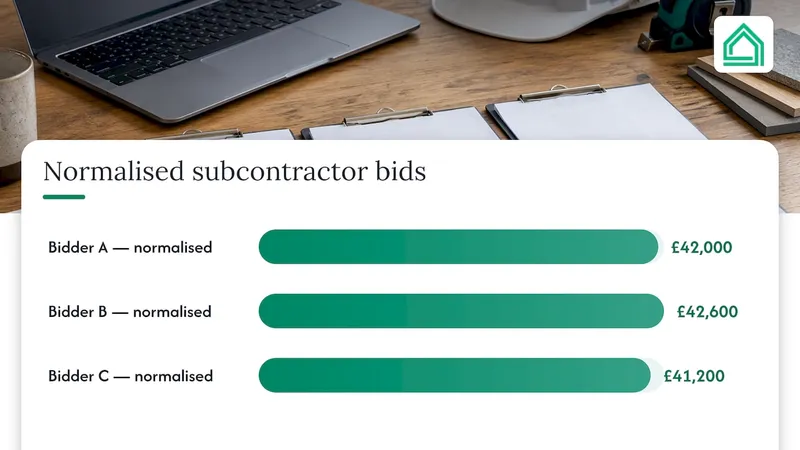
Say three subcontractors bid a kitchen renovation package. Bidder A quotes £42,000, Bidder B quotes £39,500 and Bidder C quotes £41,200. On headline price, Bidder B looks cheapest.
Two adjustments change that picture:
- Bidder B omitted electrical rough-in entirely. Using the highest observed unit rate for that line across the other bids, imputing the missing item adds £3,100 to Bidder B's normalised total, bringing it to £42,600.
- Bidder C bundled tiling and waterproofing into one composite rate. Redistributing that rate using the other bidders' division ratios reveals no hidden shortfall, so Bidder C's normalised total stays at £41,200.
After normalisation, Bidder C is the true lowest evaluated bid, not Bidder B. The audit trail, which line was imputed, which rate was used and who approved it, is what makes that ranking defensible if anyone questions it later. The same logic applies to any trade package, including the exclusions and allowances worth checking on roofing bids specifically.
Tools, automation and evolution: what's changing in bid leveling
Manual levelling on a large bill of quantities is slow, and that is exactly where automation is starting to help. Research into extracting quantities from .ifc building information models combines that data with text analysis to classify bid line items automatically as valued, included, or missing—the same categories a quantity surveyor would use by hand.
- Automated extraction speeds up normalisation considerably on large bills of quantities, where manual line-matching would take days.
- It struggles with bundled rates and ambiguous item matches, which still need a human to interpret.
- The sensible workflow uses automation for the heavy extraction and keeps a quantity surveyor or project manager reviewing anything disputed or unclear.
ADB's bid evaluation guidance reinforces the same point for any method, manual or automated: every step, from responsiveness checks through to price evaluation, needs documentation that survives scrutiny after award.
Practical tips from House A-Z on levelling bids without errors
A short checklist catches most levelling mistakes before they cost you: confirm every bidder used the same plan version, capture every allowance explicitly, and log every clarification as it arrives, not from memory a month later.
Users managing assumptions and clarifications in a single place instead of scattered across emails and spreadsheets can catch errors before signing. The same discipline, one record, one version of the plans, one running list of queries, works whether or not you use a platform to hold it.
Pro Tip: Keep your normalised comparison sheet and your clarification log side by side. The moment they disagree, you have found your next change order before it happens.
When to call in a quantity surveyor and when to level it yourself
Small residential packages, a handful of bidders and a simple scope are well within reach for an owner or project manager using the steps above. Once you are past perhaps six figures in contract value, multiple trade packages, or bundled composite rates across several bidders, a quantity surveyor earns their fee quickly. Ask any specialist you engage how they will document imputed items and who signs off on each adjustment, that answer tells you more about their process than their hourly rate does.
— Azai
FAQ
What is bid leveling in construction?
Bid leveling is the process of adjusting contractor bids onto a common basis, same scope, same drawings and same assumptions, so you can compare true evaluated cost rather than headline price. It typically involves classifying items as valued, included or missing and adjusting the totals accordingly.
What are the 7 stages of a construction project?
Most construction projects move through initiation, planning, procurement (including bidding and bid leveling), execution, monitoring, closeout and post-occupancy review. The exact labels vary by organisation, but procurement and bid evaluation always sit between planning and execution.
What does "L1 Bidder" mean?
Under the Federal Acquisition Regulation, an L1 bidder is the lowest-priced bidder whose submission is also responsive to the invitation for bid. A non-responsive bid cannot win the award even if its price is the lowest on the table.
What are the 5 steps in the bidding process?
A typical bidding process runs through solicitation, bid submission, bid opening and responsiveness checks, evaluation and levelling, and award. ADB's procurement guidance sets out a similar stepwise sequence for public procurement, ending in a documented determination of the lowest evaluated bid.
How does House A-Z help with comparing contractor bids?
House A-Z keeps budget figures, clarifications and contractor messages together in one interface, which makes it easier to spot gaps between bids as they come in. Its AI-driven insights flag potential issues against your budget and timeline before you sign a contract.
Sources
- Federal Acquisition Regulation (FAR) 14.101
- AGC best-value selection guidance
- A framework for automated quantity extraction from .ifc models and normalised bid comparison
- ADB bid evaluation: procurement guidance note