
The fastest way to collaborate with contractors is to open with a kickoff that produces a partnering charter, agrees a single source of truth for documents, and sets an issue resolution ladder before work starts. The AIA/AGC framework points to shared goals and clear roles as the foundation. Success looks like a signed charter, a chosen tool such as House A-Z, and a first meeting already on the calendar.
TL;DR:
- Establishing a signed partnering charter, clear roles, and dispute resolution processes during kickoff significantly reduces misunderstandings and conflicts later in the project.
- Using a responsibility matrix like RACI on critical packages clarifies who approves changes, inspects, and signs off, preventing project delays caused by role ambiguity.
- Setting up a well-structured issue escalation ladder with time targets and documented resolutions helps catch problems early and avoids prolonged disputes.
- Maintaining a single, well-organized source of truth for documents, drawings, RFIs, and change requests through consistent naming and version control minimizes communication errors.
- Implementing shared digital tools like House A-Z enables real-time collaboration on budgets and schedules, especially benefiting projects with multiple contractors and complex coordination.
Table of Contents
- Running a kickoff partnering workshop that actually sticks
- Who decides what: building a simple RACI for your project
- Setting the rhythm: communication protocols that prevent rework
- Building an issue resolution ladder before you need one
- Keeping one version of the truth as documents multiply
- Getting contractors productive from day one
- Choosing a tech stack that helps rather than fragments
- Measuring whether the partnership is actually working
- How House A-Z fits into a partnering workflow
- Why early partnering saves more than it costs
- Try House A-Z as your collaboration hub
- Sources
- FAQ
Running a kickoff partnering workshop that actually sticks
A good kickoff feels less like a meeting and more like a pact. Everyone who touches a decision, from the lead contractor to the architect to the owner, sits in the same room and leaves with shared language for what success looks like. The AIA guide to collaborative project documents frames this early involvement as the moment governance and communication habits get set for the rest of the build.
Structure the session around three moves:
- Name the mutual goals: timeline, budget guardrails and quality standards everyone signs up to.
- Map the critical interfaces: where trades hand off to each other and where delays tend to hide.
- Draft the charter: a one-page document capturing commitments, a maintenance plan and how disputes get resolved.
Invite the right people and the workshop earns its time:
- The lead contractor and any subcontractors managing their own crews.
- The architect or designer, when the project has one.
- The owner or project manager, plus anyone handling permits or inspections.
Agency partnering guides, including the Caltrans field guide, recommend documenting a maintenance plan and dispute resolution ladder inside the charter itself, not as an afterthought. For projects with several contractors and a tense history, a professional facilitator earns their fee by keeping the room honest. Smaller renovations with one main contractor rarely need more than an experienced project manager running the agenda.
Pro Tip: Print the charter and get physical signatures at the table. A document people signed in person gets referenced far more often than one buried in an inbox.
Who decides what: building a simple RACI for your project
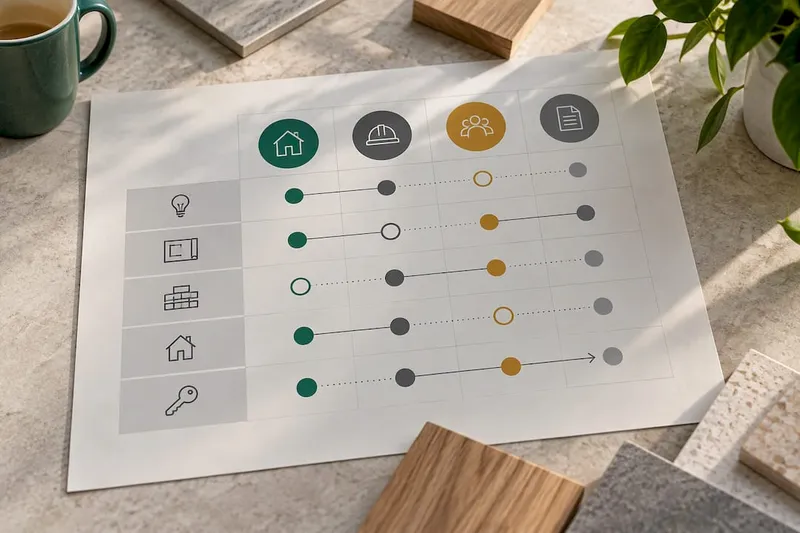
Ambiguity about who approves a change order or signs off a finish is where projects quietly bleed time. A responsibility matrix, commonly called a RACI (who is Responsible, Accountable, Consulted, Informed), removes the guessing.
Start with the packages that carry the most risk of confusion:
- Design changes and material substitutions.
- Site inspections and regulatory sign-offs.
- Payment approvals and milestone acceptance.
- Handover points between trades, such as framing to electrical.
Map who is Accountable (usually one person, often the owner or project manager) separately from who is Consulted or Informed, since collapsing those roles is what causes double approvals or missed ones. The ECITB Project Collaboration Toolkit treats this kind of governance as a living document, reviewed rather than filed away once written.
Revisit the matrix at every phase transition, and always after a significant change order reshuffles scope. Roles that made sense at framing rarely still fit once you're into finishes.
Pro Tip: Keep the RACI to one page. If it needs a second page, the packages are too granular to manage day to day.
Setting the rhythm: communication protocols that prevent rework
Contractors don't need more meetings. They need the right meetings at the right cadence, with clear ownership of what gets recorded. The AIA guide lists established communication protocols and meeting schedules among the habits that keep information moving and disputes down.
A workable cadence for most residential and small commercial jobs:
- A short daily stand-up on site during active phases, five to ten minutes, covering what's happening and what's blocking it.
- A weekly coordination call with the project manager, lead contractor and any active subcontractors.
- A monthly partnering review that steps back from the daily noise to check the relationship, not just the schedule.
Every meeting needs three artefacts to be worth holding:
- An agenda circulated beforehand, even a brief one.
- A decisions log capturing what was agreed and by whom.
- An action register with owners and dates, reviewed at the start of the next meeting.
Agree response time expectations up front, such as a same-day reply on site issues and 48 hours on non-urgent requests. Vague expectations are what turn a missed message into a missed deadline.
Building an issue resolution ladder before you need one
Every project hits a disagreement: a delayed delivery, a quality dispute, a scope interpretation nobody anticipated. What separates a partnership that survives that moment from one that doesn't is whether an escalation path already exists.
Build the ladder with three or four rungs:
- Site level: the contractor and site supervisor resolve it within 24 to 48 hours.
- Project management level: unresolved issues move to the project manager and lead contractor within a set number of days.
- Owner or sponsor level: anything still open escalates to whoever holds final decision authority.
Every escalation should carry the same three things: the facts of the situation, its impact on cost or schedule, and at least two proposed options for resolving it. That discipline turns a complaint into something a manager can act on immediately, rather than a vague grievance that sits unresolved.
- Set a time target for each rung, so issues can't drift indefinitely.
- Require a short written record of what was escalated and how it closed.
- Review the ladder itself at project milestones, not just the issues that passed through it.
Escalation isn't a sign the partnership has failed. Agencies including Caltrans and the Department of Water Resources build it into standard partnering practice precisely because catching problems early prevents formal claims later.
Pro Tip: Log every escalation, even the ones resolved in five minutes. A pattern of small ladder climbs is often the earliest warning sign of a bigger structural problem.
Keeping one version of the truth as documents multiply
Drawings get revised, quotes get updated, and change requests pile up fast once a project is under way. A 2025 study in ITcon identifies unreliable information about changes and risks as a persistent problem in construction contract administration, and points to collaborative information structures as the fix.
Your single source of truth should hold:
- Current drawings and specifications, with clear version numbers.
- Open and closed RFIs, with dates and who answered them.
- Approvals and inspection sign-offs, timestamped.
- Change requests, linked to their cost and schedule impact.
Simple naming conventions do more work than expensive software: date-stamped file names, one folder per trade or phase, and a rule that superseded documents get archived rather than deleted. A short construction document control guide can help set these conventions before the paperwork multiplies past the point of easy fixing.
A change log needs only four columns to work: what changed, why, the cost impact, and who signed off. No cost variation should move forward without that last box filled in.
Pro Tip: Assign one person as the document gatekeeper. Shared ownership of version control usually means nobody actually owns it.
Getting contractors productive from day one
The first two weeks with a new contractor set the tone for the whole build. A compact onboarding checklist prevents the early misunderstandings that cost far more time to unwind later than they would to prevent.
- Confirm scope in writing, described as outcomes rather than dictated methods, so contractors retain professional discretion over how they work.
- Share contact details for every decision maker, including who approves what.
- Grant site and document access, along with any safety induction the job requires.
- Agree payment terms and milestone definitions before the first invoice is due.
The AIA/AGC framework draws a clear line between collaboration and micromanagement: set acceptance criteria and decision rights, then let the contractor decide how to meet them. Photograph or document evidence at each milestone before approving payment. A shared record of what was actually delivered heads off the disputes that arise when memory alone has to settle an invoice.
Choosing a tech stack that helps rather than fragments
More tools rarely means better collaboration. The ITcon study's proposed minimum stack is worth borrowing: a document control or BIM hub for drawings and versions, a lightweight issue or RFI tracker with an audit trail, and a shared calendar with task tracking. Anything more exotic, such as blockchain-based record keeping, remains exploratory rather than something most residential or small commercial projects need.
When comparing options, weigh:
- Whether external contractors can be granted access without a steep learning curve.
- Whether the tool keeps an audit trail of who approved what and when.
- Whether it connects to your budget and schedule data, or sits apart from it.
Roll a new tool out gradually. Introducing three platforms in one week creates more confusion than the fragmented spreadsheets it was meant to replace. A short overview of shared renovation decision tools is useful groundwork before settling on one.
Pro Tip: Pilot any new tool on one trade or one phase before rolling it out across the whole project. Problems surface faster in a smaller test.
Measuring whether the partnership is actually working
Partnering isn't a one-off event at kickoff. It needs the same upkeep as the schedule itself, with a handful of measures tracked regularly rather than assumed.
- Schedule adherence against the plan agreed at kickoff.
- Number and severity of quality issues logged per phase.
- How many issues reached each rung of the escalation ladder.
- Scores from periodic partnering surveys, where teams rate the health of the working relationship itself.
Agency partnering guides recommend follow-up partnering workshops and periodic evaluation surveys as the mechanism for catching drift before it becomes a dispute. A monthly scorecard reviewed against the charter keeps that intention concrete rather than aspirational.
A structured partnering approach with a signed charter and defined escalation path is what agency guidance points to as the foundation of fewer disputes on complex builds, according to the AIA/AGC framework. At close-out, capture what worked and what didn't in a short debrief. That record is what makes the next contractor relationship start faster than this one did.
How House A-Z fits into a partnering workflow
House A-Z was built around the same problem this article addresses: too many spreadsheets, too many apps, and no shared record everyone trusts. The platform brings budget tracking, project management and collaborator access into one interface, illustrating how L'IA pour le BTP can help contractors and owners look at the same numbers without a side conversation to reconcile them.
- Shared access lets contractors and owners view the same budget and timeline data in real time.
- AI-driven suggestions flag potential budget mistakes based on the project's own numbers, preferences and timeline.
- Exports support the kind of single-source documentation a partnering charter depends on.
It suits first-time builders juggling several contractors and a budget that needs constant tracking most, since that's where scattered tools tend to fail first.
Pro Tip: Export your project data before a kickoff workshop. Walking into the room with shared numbers already visible speeds up the charter conversation considerably.
Why early partnering saves more than it costs
The projects that avoid formal disputes are rarely the ones with the most detailed contracts. They're the ones where the people involved agreed, early and in writing, how they'd handle disagreement before one occurred. A workshop that produces a signed charter and a clear escalation path tends to resolve small issues at the site level, long before they become change-order arguments.
That habit costs an afternoon at the start of a project and saves considerably more than an afternoon later.
— Azai
Sources
- Project collaboration toolkit | ECITB
- Guide to AIA collaborative project documents
- Decentralized and Collaborative Information Management System in Construction Contract Administration: a change management case study (ITcon, 2025)
FAQ
What are collaborative contracts?
Collaborative contracts are agreements structured around shared goals, open information exchange and joint decision-making rather than strict transactional terms. The AIA guide to collaborative project documents frames them around early participant involvement and project-level governance that supports faster, better-informed decisions.
What not to say to your contractor?
Avoid vague instructions that dictate methods rather than outcomes, since this can undermine the professional discretion contractors need to do their job well. The AIA/AGC framework draws a clear line between setting acceptance criteria and decision rights, which supports collaboration, and micromanaging methods, which erodes it.
What are some examples of companies collaborating?
Industry frameworks such as the joint guidance from architecture and contractor associations describe collaboration built around shared goals, defined roles and open communication rather than naming specific company partnerships. The pattern that recurs across sectors is early alignment at kickoff, followed by structured communication and a shared escalation process throughout the project.
What does it mean to collaborate on a project?
Collaborating on a project means aligning around shared goals, clearly assigned roles and open communication from the outset, rather than each party working in isolation and coordinating only when problems arise. Structured practices, including a partnering charter and defined escalation paths, are what turn that intention into a working routine rather than a one-off promise.