A homeowner-facing contractor meeting agenda needs eight things on the table every time: budget, scope, timeline, selections, permits, responsibilities, communication rules, and action items. Invite the contractor, the site supervisor if there is one, and anyone paying the bills, and keep the sit-down to 30 to 45 minutes. Fillable templates for kickoff, progress, and selections meetings follow below, ready to copy into a calendar invite tonight.
TL;DR:
- Homeowners should verify that change orders are documented in writing and signed off before work proceeds to avoid scope creep and disputes.
- Contingency budgets of around 10% are advisable to handle unexpected issues like material delays or hidden damages without immediate financial strain.
- Checking that the contractor holds proper insurance and manages site safety protocols, including hazards and fencing, minimizes liability and injury risks.
- Regularly capturing site photos and maintaining detailed records of decisions, invoices, and communications helps resolve disputes and facilitate warranties later.
- Confirming subcontractors' licensing and insurance during the initial meeting prevents cost overruns and workmanship issues stemming from unqualified hired help.
Table of Contents
- A copyable one-page agenda for your calendar invite
- Choosing the right meeting type: kickoff, progress, selections, sign-off
- What to cover under each agenda item: exact homeowner questions and what to record
- Three fillable sample agendas for homeowners
- Safety protocols and hazard management
- Risk management and contingency planning
- Quality control and standards
- Dispute resolution procedures
- Documentation and record-keeping practices
- Review of contractor qualifications and subcontractors
- Why a written agenda changes the outcome of a build
- How House A-Z keeps your agenda, budget, and contractor in one place
- Checklists and guides worth keeping close
- Sources
- FAQ
A copyable one-page agenda for your calendar invite
Paste this straight into a meeting invite or print it and bring it to the site. Each line has a suggested time, an owner, and a short script so you are never guessing what to say next.
- Welcome and roles (2 minutes, homeowner leads): confirm who is in the room and who is missing.
- Budget and payments (8 minutes, homeowner leads): "Can you walk me through the payment schedule and what triggers each instalment?"
- Scope and change orders (8 minutes, contractor leads): "How will you document any changes we agree on today?"
- Timeline and milestones (7 minutes, contractor leads): "What is the next milestone, and what could push it back?"
- Selections and allowances (7 minutes, homeowner leads): "Which decisions do you need from us before the end of this week?"
- Permits and inspections (5 minutes, contractor leads): "Who is booking the next inspection, and when?"
- Roles and supervision (3 minutes, contractor leads): "Who do we call if something looks wrong on site while you are not there?"
- Communication and next actions (5 minutes, homeowner leads): agree on the channel, response time, and who owns each open item.
Keep a simple sign-off block at the bottom of the page, with a line for homeowner initials and one for the contractor's, dated on the day. It takes seconds and it turns a chat into a record you can point back to later.
- Bring a notepad or a phone note app open before the meeting starts.
- Photograph the site before and after, and attach the images to your notes.
- Send a written summary within 24 hours so everyone is working from the same page.
Choosing the right meeting type: kickoff, progress, selections, sign-off
Not every contractor conversation needs the same format. Matching the meeting to its purpose keeps things short and useful rather than a rehash of the last one.
- Kickoff meeting: sets the project charter, budget ceiling, and start date; invite the contractor, project manager if separate, and both paying homeowners; allow 45 to 60 minutes and prepare your wish list and must-haves beforehand.
- Progress or site visit: checks milestones against reality and flags quality issues early; invite the site supervisor and contractor; 20 to 30 minutes on site, with photos taken before you arrive.
- Selections meeting: locks in finishes, fixtures, and allowances before ordering; invite the contractor and, where relevant, the supplier or showroom contact; 30 minutes, with samples or catalogue pages ready.
- Sign-off meeting: confirms completion, releases the final payment, and closes the paper trail; invite the contractor and anyone holding the retained payment; 30 minutes, with the handover checklist and punch list in hand.
What to cover under each agenda item: exact homeowner questions and what to record
Government and consumer guidance is consistent on one point: written detail protects everyone, including the contractor. Here is what to ask and note under each heading.
- Budget and payments: ask about allowances built into the quote, the staged payment schedule, and whether a lien waiver is provided at each payment. The CSLB's homeowner and construction checklists recommend limiting the down payment and tying every later payment to completed work rather than a calendar date.
- Scope and change orders: confirm who is responsible for what, and get agreement that any change, however small, is priced and signed off in writing before work continues. The FTC's contractor hiring guide treats a written change order process as one of the basics of a sound contract.
- Timeline and milestones: ask for the confirmed start date, the two or three milestones that matter most to you, and how the contractor will tell you about a delay before it happens rather than after.
- Selections and allowances: settle who makes the final call on finishes, how allowance overspend is handled, and the deadline for each decision so ordering is not held up.
- Permits and inspections: ask directly who obtains the permits and when each inspection is booked, and say you would like to be there for at least the key ones.
- Roles and supervision: get a name and phone number for the person on site day to day, plus who to escalate to if that person is unavailable.
- Communication protocol: agree the channel you will actually use, whether that is text, email, or a shared app, and how quickly each side will respond.
- Decisions and actions: write down every decision made in the meeting, who owns the next step, and the date it is due.
Pro Tip: Read every question back to the contractor in your own words before the meeting ends. If they hesitate on any answer, that is the one to put in writing first.
Negotiating these points is a normal part of hiring a contractor, and a contractor may decline a job if the terms do not work for them, so treat a firm but fair back-and-forth as assessing fit rather than a personal test.
Three fillable sample agendas for homeowners
Adapt these directly. Each one assumes a 30 to 60 minute slot and a small number of attendees.
- Kickoff agenda: welcome and introductions (5 minutes), project charter review including budget ceiling and priorities (15 minutes), timeline and start date (10 minutes), communication rules (5 minutes), sign-off on the charter with homeowner and contractor initials. See a fuller kickoff meeting template for two ready-to-use versions.
- Progress or site visit agenda: walk the site and photograph completed work (10 minutes), compare progress against the milestone schedule (10 minutes), flag quality concerns on the spot (5 minutes), confirm next visit date (5 minutes).
- Selections meeting agenda: review the allowance list item by item (10 minutes), examine samples brought by the contractor or supplier (10 minutes), record decisions and deadlines (5 minutes), confirm who places the order (5 minutes).
Keep a running Gantt-style timeline alongside these agendas so milestone dates in the progress meeting always match the master schedule rather than a separate mental note.
Safety protocols and hazard management
Ask at the kickoff meeting how the contractor manages site safety day to day: fencing, signage, and whether children or pets need to be kept out of specific zones. This matters as much for your own visits as for the crew, since an uninsured injury on an unsecured site can become your problem as much as theirs.
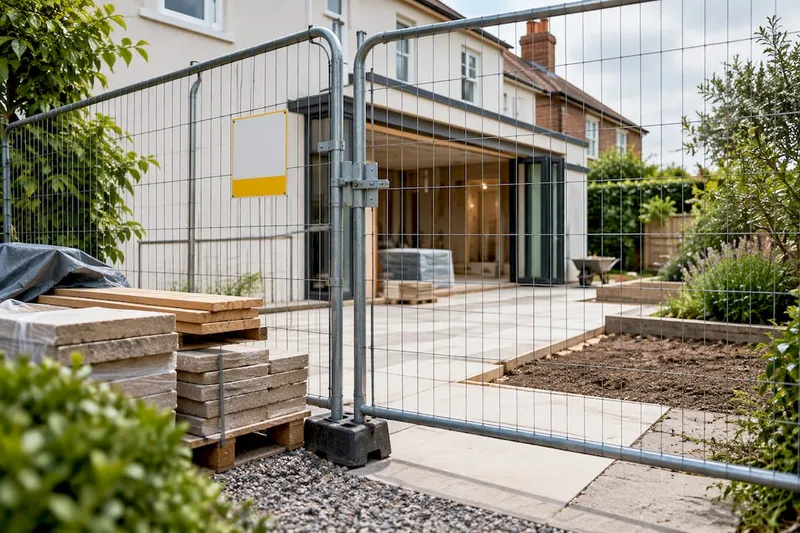
Confirm who holds general liability insurance and ask to see proof, a step FEMA's general contractor checklist treats as a basic before work starts. Ask about hazardous materials too, particularly in older properties where asbestos or lead paint may be present, and get in writing how they will be handled if found.
Set a simple rule for site visits: no unaccompanied walk-throughs while work is active, and always check in with the supervisor first. Revisit safety briefly at every progress meeting rather than only at kickoff, since new hazards appear as work moves from framing to finishing.
Risk management and contingency planning
Every project has a moment where something does not go to plan: a hidden pipe, a material delay, a weather week. Ask your contractor at kickoff what contingency they have built into the budget and the timeline, and get a number rather than a vague reassurance.
A sensible working assumption is to hold back a portion of your own budget as a buffer rather than spending to the last pound on the initial quote. Ask how the contractor typically handles a surprise, whether that means pausing for your sign-off or proceeding and billing you afterwards, because the two approaches carry very different risks for your wallet.
Write the agreed contingency process into your meeting notes so that if a surprise does show up, nobody is improvising the rules on the spot.
Quality control and standards
Ask what standard the contractor is building to, whether that is local building code minimums or something higher, and get it named rather than assumed. Agree at the outset how you will check quality: a walk-through at each milestone, photos at each stage, or a third-party inspection at key points.
Raise concerns as soon as you see them rather than waiting for the next scheduled meeting. A progress or site visit meeting is the natural place to compare finished work against the plans and flag anything that looks off before it is covered up by the next stage.
Keep a simple punch list running from the first site visit rather than starting one only at the end, so small issues get fixed while the relevant trade is still on site.
Dispute resolution procedures
Most disagreements are small and solvable if they are raised early and in writing rather than left to fester. Agree in the kickoff meeting how a disagreement will be handled: a cooling-off conversation first, then a written notice if that fails, then mediation or a small claims route as a last resort.
Put this in writing as part of your contract rather than relying on goodwill alone. The FTC's hiring guide recommends a written contract that spells out responsibilities clearly precisely because vague verbal agreements are where most disputes start.
Keeping the decision log described earlier means that if a dispute does arise, you have dated evidence of what was agreed rather than two conflicting memories of the same conversation.
Documentation and record-keeping practices
Keep a single job file for the whole project: the signed contract, every change order, every invoice, and every email or text exchange that touches money or scope. Georgia's consumer education guidance recommends exactly this kind of file and suggests withholding a small share of the final payment until the work has passed inspection.
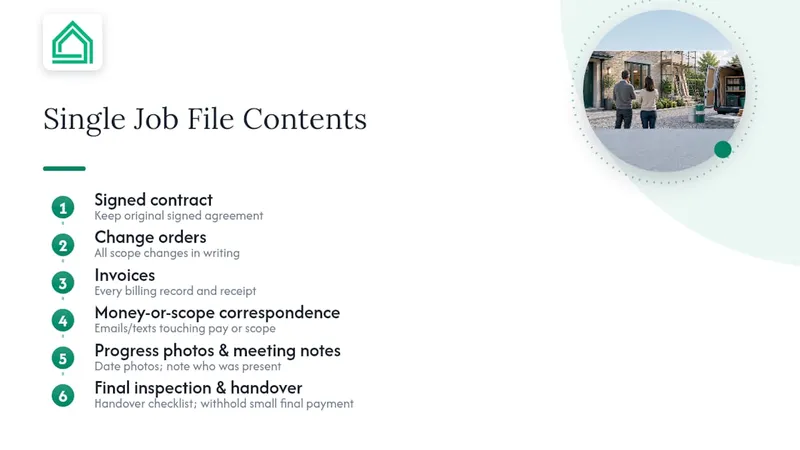
Photograph the site regularly, not only when something goes wrong, since progress photos are useful evidence if a dispute or warranty question ever comes up later. Note the date and who was present every time you make a decision in a meeting, even a small one.
A handover checklist at project completion gives you a final place to gather every document before you release the last payment.
Review of contractor qualifications and subcontractors
Before the first agenda item is ever discussed, confirm the basics: current licence, insurance, and recent references you can actually call. FEMA's contractor checklist lists licensing, insurance, and local permit experience as the starting point for any vetting conversation.
Ask which parts of the job will be subcontracted and to whom, and whether those subcontractors carry their own insurance or fall under the main contractor's policy. A short checklist of selection criteria covering licence, insurance, references, and payment terms addresses the complaints homeowners raise most often: cost overruns, missed deadlines, and poor workmanship.
Raise subcontractor questions again at the kickoff meeting rather than assuming the answers given during quoting still hold once work begins.
Why a written agenda changes the outcome of a build
Most disputes I have seen traced back to one thing: a decision made in conversation that nobody wrote down. A one-page agenda with owners and dates against each item removes that ambiguity before it has a chance to cost you money.
Homeowners who run structured meetings from the start tend to avoid the expensive surprises that come from assumptions nobody checked, whether that is a change order priced after the fact or a permit nobody actually booked.
— Azai
Checklists and guides worth keeping close
Alongside your own agenda, the CSLB construction checklist, the FTC's hiring guide, and a property viewing checklist are worth bookmarking for the questions they raise before you sign anything.
Sources
- University of Florida IFAS guidance on hiring contractors
- CSLB construction checklist 2025
- FTC: Hiring a contractor
FAQ
What should be on a contractor meeting agenda for homeowners?
Cover eight items every time: budget and payments, scope and change orders, timeline and milestones, selections and allowances, permits and inspections, roles and supervision, communication rules, and action items. Writing these down in advance keeps the meeting to under an hour and avoids revisiting the same questions twice.
Who should attend a contractor kickoff meeting?
Invite the contractor, the site supervisor if that is a separate person, and every homeowner responsible for paying or approving decisions. Keeping the group small, usually three or four people, makes it easier to reach clear decisions rather than open-ended discussion.
How often should homeowners meet with their contractor?
A kickoff meeting at the start, then a shorter progress or site visit meeting at each major milestone, is a workable rhythm for most projects. Selections meetings happen separately whenever finishes or fixtures need locking in ahead of ordering.
Who is responsible for pulling permits, the homeowner or the contractor?
A competent contractor typically manages the permit process and books inspections as part of the job, and homeowners who pull permits themselves risk losing that layer of oversight. Confirm this directly in your first meeting rather than assuming it is included.
What should I do if my contractor and I disagree during a project?
Raise the issue as soon as you notice it, in writing, rather than waiting for the next scheduled meeting. Agreeing on a dispute process at kickoff, starting with a direct conversation and escalating to mediation only if needed, gives both sides a clear next step instead of a stand-off.