Use the jurisdiction's published median initial review time as your baseline, then apply a complexity multiplier of 1× for simple trade permits, up to 4× for commercial or discretionary projects. Published first-review figures rarely capture intake queues or resubmittal cycles, so the true lived timeline almost always runs longer. Building that buffer into your schedule, the way House A-Z encourages within its own planning tools, is the single most reliable safeguard against a stalled start date.
TL;DR:
- Simple permits like electrical or plumbing often clear in one day, but complex projects such as new builds or commercial projects can take several months due to multiple review stages.
- The median initial review time across U.S. cities is typically around two weeks, but delays from backlog or resubmittals may extend this period significantly.
- Understanding the permit process stages and tracking local queue sizes helps set more accurate project schedules and buffers.
- Submitting complete applications, using expedited review options, and responding promptly to reviewer comments can substantially reduce overall permit timelines.
- Always verify whether your local permit data reflects median or average times and measure current backlog before planning your project start date.
Table of Contents
- What are typical permit lead times by project type?
- Where does the time actually go? The stage-by-stage breakdown
- What actually lengthens permit lead times?
- How do you turn a published timeline into your own project schedule?
- What are the highest-impact ways to shorten permit lead times?
- What House A-Z has learned from watching permit timelines derail projects
- How should you think about permit risk when you set a schedule?
- House A-Z: a different way to manage permit timelines
- Where to check current permit timelines for your own jurisdiction
- Sources
- FAQ
What are typical permit lead times by project type?
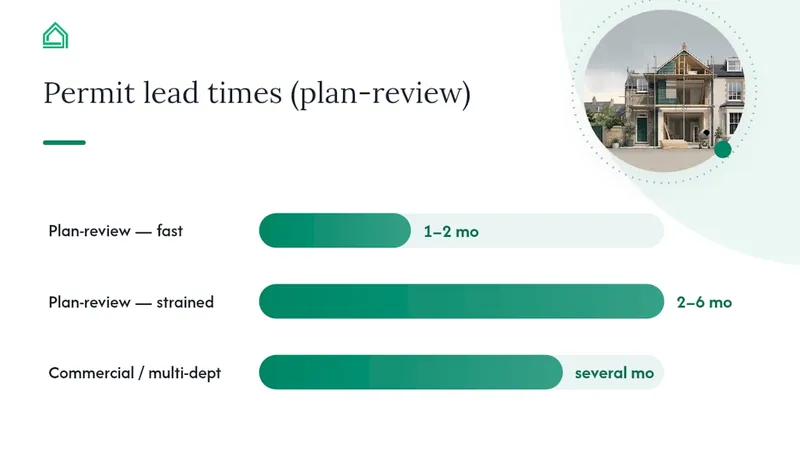
Permit lead times swing wildly depending on what you're building, and pretending otherwise is how schedules unravel. The friendliest end of the spectrum belongs to over-the-counter and trade permits: simple electrical, plumbing, or mechanical work often clears in a single day and rarely takes longer than a week, because these applications skip full plan review entirely.
Standard residential jobs sit in the middle. A straightforward remodel, a bathroom reconfiguration, or a modest kitchen extension typically takes one to three weeks to clear first review, though this varies sharply by jurisdiction and by how busy the local building department is that month.
Plan-review projects are where timelines stretch. Additions, accessory dwelling units, and new builds commonly take four to eight weeks at the fast end, and two to six months (or longer) where departments are under strain or where multiple discretionary approvals stack up. Commercial and multi-department projects often run into several months once mechanical, electrical, fire, and structural reviews all queue separately.
Here's the number that catches most first-time renovators off guard: PermitPlace's analysis of 741 U.S. cities found a national average initial review time of 22.9 days, but a median of just 14 days. That gap between mean and median matters. It tells you a small number of exceptionally slow, complex, or under-resourced jurisdictions are dragging the average upward, while most straightforward applications clear closer to two weeks for that first cycle alone.
Why the median beats the average for planning purposes:
- The median reflects what a typical applicant experiences, unskewed by outlier delays
- The mean gets inflated by a handful of severely backlogged departments or unusually complex cases
- Neither figure includes resubmittal cycles, so both understate total time to issuance
- Your local dashboard, not a national statistic, is the number that actually governs your project
Pro Tip: When a municipal page quotes "average processing time," check whether it means mean or median. If it doesn't say, assume mean and add a week or two of margin.
Where does the time actually go? The stage-by-stage breakdown
Every permit application moves through a sequence of discrete stages, and understanding which ones the authority controls versus which ones you control changes how you read a timeline.
- Intake and prescreen. Staff check your submission for completeness before it even reaches a reviewer. Washington County, Oregon publishes a prescreen target of 3–5 business days, and a rejected prescreen resets your place in the queue.
- First plan review. The substantive check. The same Washington County data shows simple residential review running 5–7 business days, while commercial projects take around 20 business days.
- Recheck and resubmittal. If corrections are needed, you revise and resubmit, and the reviewer checks your changes against their original comments.
- File check. A final administrative pass confirming all conditions and required documents are in order before issuance.
- Permit issuance. The permit is granted and fees are settled.
- Inspections and final occupancy. Field inspections at defined construction milestones, ending in a final sign-off.
Seattle's construction permit timeline tool is worth studying even if you're nowhere near Seattle, because it visually separates time the city controls from time the applicant controls. Multiple review cycles (city issues correction, applicant resubmits, city rechecks) are the norm rather than the exception, and each one adds days you won't see in a single "average review time" headline. San Diego's permit dashboard works the same way, publishing weekly snapshots so you can see exactly where your file sits in the queue rather than guessing.
What actually lengthens permit lead times?
Six recurring problems explain most of the gap between a published target and a real-world wait, and analysis across multiple jurisdictions points to the same patterns repeatedly.
- Incomplete submissions. Missing plans, unsigned forms, or absent supporting calculations trigger an intake bounce before review even starts.
- Discretionary reviews. Historic district approval, design review boards, and environmental assessments run on their own calendars, entirely outside the statutory review clock.
- Resubmittal cycles. Each correction round can add the full plan-review period again if comments aren't addressed thoroughly the first time.
- Staffing and seasonality. Departments with vacant reviewer positions, or a spring rush of applications, slow every file in the queue, not just yours.
- External agency sign-off. Utility companies, environmental agencies, and fire departments each add their own review window, often running in parallel but sometimes creating a bottleneck.
Pro Tip: Before you submit, cross-check your drawing set against your jurisdiction's published submittal checklist line by line. Most rejected intakes fail on missing sheet callouts or an unsigned engineer's stamp, not on the design itself.
How do you turn a published timeline into your own project schedule?
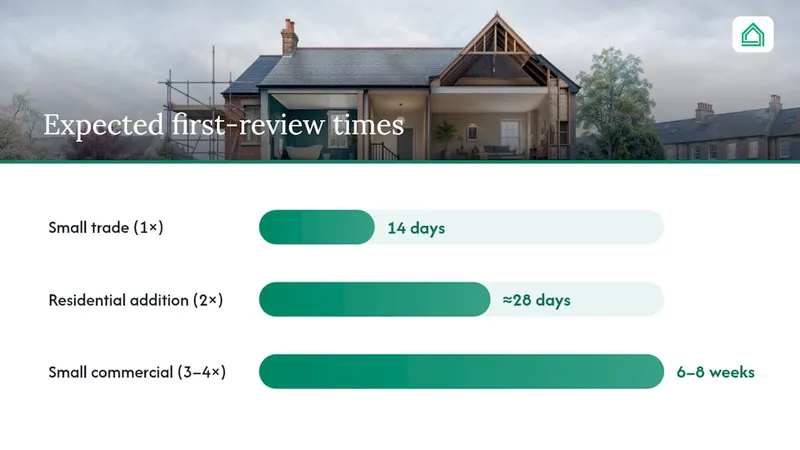
Start with your jurisdiction's published median initial review time, then multiply by a factor that matches your project's complexity. Simple, prescriptive jobs warrant a 1× to 1.5× multiplier. Additions and accessory dwelling units call for roughly 2×. Complex or commercial work, especially anything touching discretionary review, deserves 3× to 4×, a range consistent with the guidance from Permittable's cross-jurisdiction study.
Before you commit to a number, check four things on your local dashboard:
- Whether the published figure is a median or a mean
- The percentage of applications actually meeting the stated target
- The current queue size or backlog, not just the historic average
- How recently the dashboard was updated, since a report from eighteen months ago tells you little about this quarter
Statistic callout: With a national median first-review of 14 days, a small trade permit (1× multiplier) might realistically clear in two weeks; a residential addition (2×) could take closer to a month for the first cycle alone; a small commercial fit-out (3× to 4×) might reasonably run six to eight weeks before issuance, before any inspections begin.
Whatever number that maths produces, build it into your contract milestones as float, not as a fixed date. A contractor who prices a start date the day after expected issuance, with zero buffer, is pricing against a best case that San Francisco's own permit performance data suggests won't hold for every application.
What are the highest-impact ways to shorten permit lead times?
- Get a pre-submittal completeness check done, or pay for a formal pre-review. Catching a missing sheet before intake is far cheaper than discovering it after a three-week wait.
- Use express or rapid review tracks where your jurisdiction offers them. San Diego's expedited processing options exist specifically for schedule-sensitive applicants.
- Split trade permits where it makes sense. Separating electrical, plumbing, and mechanical from a full building permit can let the simpler ones clear in days while the main review continues.
- Book inspections early and respond to reviewer comments within 24 to 72 hours, as recommended in the guide to vetting contractors before signing. Slow turnaround on corrections is one of the most avoidable causes of a stretched timeline.
- Use virtual appointments and intake help where available, and reserve paid expediter services for projects where schedule risk genuinely outweighs the cost.
Pro Tip: Package your drawing set with a clear index, sheet cross-references, and a cover letter summarising code compliance points. Reviewers who can find what they're checking for on the first pass generate far fewer correction comments.
How should you think about permit risk when you set a schedule?
The rule of thumb holds: take the published median, multiply for complexity, and never book a contractor start date against the fast-case scenario. This week, check your local dashboard, confirm whether it quotes median or mean, and review your drawing set against the submittal checklist before you file anything.
Consider a paid expediter or formal pre-review only when the cost of a delay (idle contractor time, a lease running out, a weather window closing) exceeds the expediter's fee. Keep a written record of every communication with the reviewing authority. It's the only evidence you'll have if a resubmittal clock is disputed later.
— Azai
Where to check current permit timelines for your own jurisdiction
For real numbers, go directly to your local authority's dashboard. San Diego's permit timeline page and Winnipeg's processing time tables both separate intake, review, and issuance stages, showing exactly where queues are building and how current the data actually is.
Sources
- 2026 State of Building Permits Across America | PermitPlace
- Building permit timeline | Washington County, OR
- Construction permit timeline | Seattle SDCI
- Permit timeline and processing (City of San Diego)
- Permit performance metrics | San Francisco
FAQ
How long does work permit processing typically take?
It depends heavily on permit type and jurisdiction, but a national median for initial review sits around 14 days, covering only the first review cycle. Resubmittals, discretionary reviews, and inspection scheduling routinely add several more weeks on top.
When can you expect to receive a permit approval?
Simple, over-the-counter permits can clear in a day to a week, while plan-review projects such as additions or new builds often take four to eight weeks at the fast end, stretching to several months in busier departments. Checking your local authority's own dashboard for current queue sizes gives a far more accurate answer than any national figure.
How long does it take for a work permit to get approved once submitted?
Approval time depends on whether the first submission is complete. A clean, well-documented application can clear first review in the jurisdiction's published median timeframe, but a single resubmittal cycle can add that entire review period again. Tools like House A-Z's checklist prompts are designed specifically to catch the gaps that trigger those extra cycles.
Who issues a permit to dig or excavate?
Excavation and utility-related digging permits are typically issued by the local building or public works department, sometimes in coordination with utility companies who must sign off separately. Because this involves an external agency approval, it's one of the categories most likely to need the longer end of your complexity multiplier.
What's the difference between a target processing time and the real timeline?
A published target, like San Francisco's per-step review metrics, usually covers a single review cycle only, not the full application-to-issuance journey. The real timeline includes intake, any resubmittals, and inspection scheduling, which is why applying a multiplier to the published figure gives a far more realistic schedule.