The honest answer to "DIY or contractor?" is rarely one or the other. Painting, flooring and simple fitting jobs are realistic for a patient first-timer. Structural, gas, electrical and anything that needs a permit usually belongs to a qualified professional. Most good projects split the work: you take the jobs where skill matters less than time, and you hire for the jobs where a mistake is expensive, unsafe or hard to undo.
This guide shows you how to make that split job by job. We cover the real cost of each route, the time you will need, where the law and safety draw the line, and how to hire well if you decide to. We also give you a scoring method you can run on your own project in an evening.
TL;DR
- DIY saves on labour, but only if you can finish the job safely and correctly. The "damage factor", paying a professional to repair a botched job, can wipe out the saving.
- Double or triple your time estimate for any DIY task, and ask whether you can afford to redo it if it goes wrong.
- Hand over electrical, gas, structural and lead-risk work to qualified people. Check permit and regulation rules with your local building department before you start.
- If you hire, get at least three written estimates, check licences and insurance, and never sign a contract with blank sections.
- Split the project: DIY the low-risk, high-patience jobs and hire for the rest. Write your plan down first so every quote covers the same scope.
Table of Contents
- What DIY and hiring a contractor really mean
- The cost question: what DIY really saves
- The time question: double it, then add patience
- Safety and the law: where the line is drawn
- Which jobs suit DIY, and which do not
- Run the decision on your own project
- Perspective: why we think the plan matters more than the route
- How to hire a contractor well
- Paying for it: financing the choice
- A hybrid plan that often works best
- Plan it in one place with House A-Z
- FAQ
- Sources
What DIY and hiring a contractor really mean
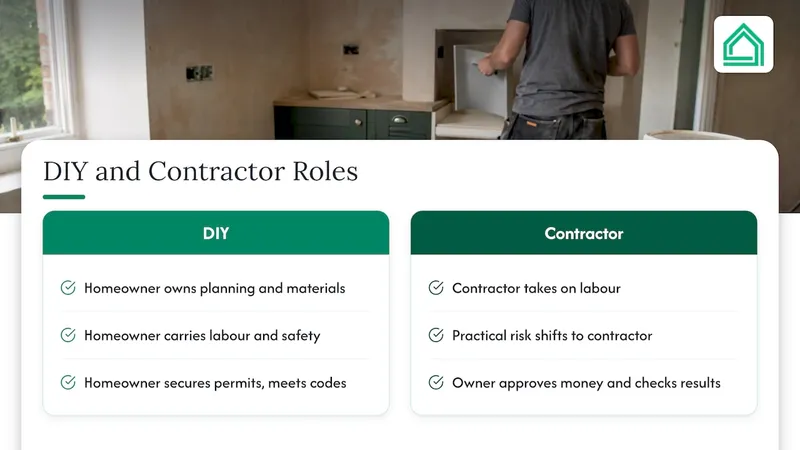
DIY in construction is not just "doing the work with your own hands". When you take a project on yourself, you take responsibility for the planning, the materials, the labour and the safety. According to British Columbia's building permit guidance, homeowners doing their own work carry the same legal and safety obligations as a professional. That includes getting the necessary permits and making sure the work meets local building codes. The consequences of falling short can include fines, mandatory rework, or notices on the property title that complicate resale, financing and insurance claims.
That guidance is Canadian, and the details differ in the UK, where Building Regulations and planning permission are separate systems run by your local authority. The principle travels well, though: the person who commissions the work owns the compliance.
Hiring a contractor shifts the labour and much of the practical risk to someone else. It does not remove your role. You still define the vision, approve the money, make selections and check the result. A contractor is only as good as the brief you give them.
There is also a middle road that many people forget: acting as your own project manager while tradespeople do the skilled work. We look at that in more detail in our guide on when to hire a contractor, a project manager or a platform.
The cost question: what DIY really saves
The pitch for DIY is simple. Without paying for labour, you have more money for better materials. That is true on paper. In practice, three things eat into the saving.
The damage factor
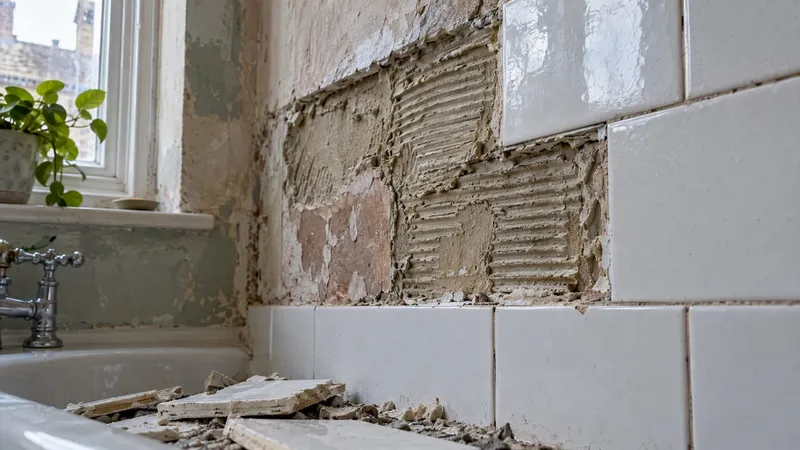
The NARI guidance on DIY versus hiring a professional points to a hidden cost: the expense of hiring a professional to fix a project that has gone wrong, which many contractors are reluctant to take on. A tiling job that has to be ripped out and redone costs you the first set of materials, the second set, the removal and the professional's price, often at a premium.
Tools, hire and waste
Skilled people own the right tools and waste less material. You will either buy or hire equipment you use once, and you will probably over-order or mis-cut. Put these on the budget line, not in the "miscellaneous" pile.
Your time has a price
If you are taking unpaid leave or giving up weekends for months, that is a cost. It also lengthens the period you live in a half-finished home. Our guide to living at home during a renovation is worth reading before you commit to a long DIY stretch.
A simple worked comparison
Here is the shape of the calculation, with deliberately round placeholder numbers so you can swap in your own quotes:
| Line | DIY | Contractor |
|---|---|---|
| Labour | £0 (but your time) | Quoted price |
| Materials | Retail prices, plus waste | Often trade pricing, less waste |
| Tools and hire | Your cost | Included |
| Risk of redoing | Yours entirely | Usually covered by warranty terms in the contract |
| Contingency | Add generously | Ask what the price includes |
The point is not that one column always wins. It is that the labour line is the only one that shrinks for DIY, and every other line may grow. If you want to see how surprises appear in the other direction too, read how hidden costs emerge in renovations.
The time question: double it, then add patience
The same NARI material has blunt advice: realistically estimate the time you need, then double or triple it. Skill gaps and missing specialist tools create delays you cannot see at the start.
Two questions from NARI's homeowner guidance are worth writing on a sticky note:
- If this goes wrong, can I afford to redo it?
- Is this a project I can finish, or will it sit unfinished for months?
A half-finished bathroom is not a hobby gone slow. It is a bathroom you cannot use. When the room is essential, such as the only kitchen or the only bathroom, the cost of delay is higher and the case for a contractor stronger.
A contractor works to a programme, but not all programmes are equal. Ask for a timeline in the contract, with the scope and costs, so that delay has a written definition.
Safety and the law: where the line is drawn
This is the part of the DIY versus contractor decision that is not a matter of taste.
Jobs that carry real danger
NARI recommends putting safety above everything else when you choose. Complex work such as electrical wiring or structural repairs can be fatal if done incorrectly. These are the jobs where a confident amateur is most at risk, because the failure is often invisible until it matters.
Gas
In Great Britain, gas work is regulated. The Gas Safe Register is the official gas registration body, and by law gas businesses must be on it. If your project touches a boiler, a hob supply or a gas fire, hire a registered engineer and ask to see their ID card. This is not a job to learn on.
Electrics and Building Regulations
Electrical work in homes in England and Wales falls under Building Regulations, and some work must be notified or certified. Rules vary by nation and by room, and they change, so confirm the current position with your local authority's building control team before you touch a new circuit. If you are unsure, assume you need a registered electrician.
Older homes and lead paint
The US EPA explains that renovating a pre-1978 home with lead-based paint can easily create dangerous lead dust, and it recommends that homeowners hire a lead-safe certified contractor. Those rules are American, but the health point is not: disturbing old paint creates dust that your household breathes whoever holds the sander. In the UK, homes built before the late 1970s may have old lead paint under newer layers, so find out what you are dealing with before sanding or stripping. Hire a specialist if in doubt, or follow proper lead-safe work practices if you do it yourself.
Permits and consents
The most expensive DIY mistake is often paperwork, not carpentry. The guidance from Aurora's DIY home improvement handbook says to verify permit requirements directly with the local building department. Acting without a permit, or relying on a contractor who says none is needed, can mean fines, court appearances and, in the worst case, forced removal of completed work at the owner's expense. That is a US city's advice, but the lesson applies in the UK as well: ask your council, and get the answer in writing. Your project may need planning permission, Building Regulations approval, or both. Listed buildings and conservation areas add further rules.
Which jobs suit DIY, and which do not
Use this as a starting point, then check against your own skills and local rules.
| Job | Typical verdict | Why |
|---|---|---|
| Interior painting and decorating | Good DIY | Low risk, forgiving, easy to redo (check for old lead paint first) |
| Laying flooring | Good DIY with practice | Time-heavy, precision matters at edges |
| Demolition of non-structural elements | Possible DIY | Check for hidden services and hazardous materials first |
| Tiling | Mixed | Looks easy, unforgiving when substrate is wrong |
| Plumbing changes | Usually hire | Hidden leaks cause damage over time |
| Electrical work | Hire a registered electrician | Safety risk and regulatory requirements |
| Gas appliances | Always hire a Gas Safe engineer | Legal requirement and fatal risk |
| Structural changes | Hire, with engineer input | Failure can be catastrophic |
| Windows and doors | Often hire | Compliance certificates matter at resale |
The pattern is clear. DIY works when the task is reversible, visible and low-consequence. Hiring works when the task is hidden, regulated or dangerous. For real-life examples of homeowners who planned DIY well, see these examples of successful DIY project plans.
Run the decision on your own project
Scoring each job beats a general feeling. Take every task in your project, from stripping wallpaper to moving a wall, and score it from 1 to 3 on each of the following.
- Skill. Have you done this before, or can you learn it from a reliable source and practise somewhere forgiving? 1 is no, 3 is yes.
- Consequence. If it goes wrong, how bad is it? 1 is dangerous or expensive, 3 is cosmetic.
- Time. Can you do it in the time you have, even if the estimate doubles? 1 is no, 3 is yes.
- Regulation. Is there a legal requirement, permit or certificate involved? 1 is yes, 3 is none.
- Redo cost. Can you afford to do it again? 1 is no, 3 is yes.
Add the scores. A task with 13 to 15 is a strong DIY candidate. Between 9 and 12, think hard, or DIY part of it with professional checks. Below 9, hire. Any single 1 on consequence or regulation should be treated as a hard stop until you have spoken to a professional.
This is the same thinking NARI's quiz encourages, but doing it per task gives you a mixed plan rather than an all-or-nothing choice.
Perspective: why we think the plan matters more than the route
We built House A-Z because we kept seeing the same pattern. People did not get into trouble because they chose DIY or chose a contractor. They got into trouble because they started without a clear plan, tracked costs in a spreadsheet that went stale, and made decisions under pressure. The decision between DIY and hiring is much easier when the budget, the room layouts, the product choices and the timeline sit in one place.
Our view is simple. First, define the job in plain language before anyone picks up a tool or a phone. Professionals consistently stress that homeowners should create sketches, collect inspiration and set out specific expectations before calling a contractor, because that preparation lets you judge bids properly and becomes the foundation of the contract. Second, treat the DIY choice as a budget decision, not an identity. Third, make any contractor relationship transparent: shared plans, shared costs, shared timeline.
That is why our platform brings budget tracking, design suggestions, project management and collaboration with partners and contractors into one interface. Our AI agents work from your budget, preferences and timeline, so a DIY-versus-hire question for a particular room is answered with your numbers rather than generic advice.
— Azai
How to hire a contractor well
If your scoring points to hiring, the next risk is choosing the wrong person. The research is consistent on the basics.
Before you ask for quotes
Write a clear brief. Include room-by-room scope, the finishes you want, any fixed dates and your budget range. Quotes only compare fairly when everyone prices the same thing. Our guide to comparing renovation quotes walks through how to line them up.
Get at least three written estimates
NARI recommends getting at least three written estimates, verifying that the contractor holds a valid local licence and insurance, and demanding a contract that sets out the scope of work, the timeline and all costs. In the UK, where there is no single licence for builders, the equivalent checks are insurance, references, relevant trade registrations such as Gas Safe for gas work, and proof of previous work.
For a practical list of questions to ask, see this reliable contractor checklist, and our own contractor onboarding checklist, which covers verifying three references.
Read the contract like a sceptic
The NAR consumer guide to hiring a remodelling contractor and the Aurora handbook agree on several points:
- Never sign a contract with blank sections.
- A complete contract details warranties, financial terms, payment schedules and debris removal.
- Allowances, which are line items where the cost is not yet fixed, are highly variable and can bloat a budget. Ask for a detailed breakdown of material and product selections before you agree.
- Do not pay the full balance until every inspection has passed and you are satisfied. Money is your leverage.
Insurance and who carries the risk
Ask what insurance the contractor holds, and tell your own home insurer about the work. We cover this in do you need insurance during renovation.
Paying for it: financing the choice
DIY often feels cheaper because the money leaves in small chunks, while a contractor quote lands as a single number. Neither is automatically better. If you need to borrow, compare options before you commit. Our renovation financing options guide outlines the main routes. Whatever you choose, keep a contingency fund. A reserve is what turns a surprise from a crisis into an inconvenience.
A hybrid plan that often works best
Many first-time builders end up with a mix. A realistic example of how that might look for a bathroom refit:
- You: strip the old decor, clear the room, paint, fit accessories, choose and order the products.
- Hire: plumber, electrician, tiler and anyone handling waterproofing or structural alterations.
- Coordinate: you keep the schedule, so the plumber is not waiting for the tiler, and the tiler is not waiting for a delivery.
This approach captures much of the saving without gambling on the high-consequence work. It also makes you a more informed client, because you understand the sequence of the project. Our planning and timelines section goes deeper on sequencing, and the renovation topic hub collects the rest.
FAQ
Is it better to DIY or hire a contractor?
It depends on the task, not the project. DIY suits reversible, low-risk jobs such as decorating, where the worst outcome is cosmetic. Hire for gas, electrical, structural and regulated work, where mistakes are dangerous or costly to correct. Scoring each job on skill, consequence, time, regulation and redo cost gives you a clear answer.
What is DIY in construction?
It means the homeowner takes responsibility for the planning, materials, labour and safety of a project. That includes obtaining permits and meeting local building rules, as in British Columbia's guidance. Doing it yourself does not reduce your legal obligations. It places them on you.
How much can I really save by doing it myself?
You save the labour cost, but only if the work is finished correctly. Extra costs come from tools, wasted materials, your own time and, in the worst case, paying a professional to repair mistakes. Compare real quotes against a realistic DIY budget with a generous contingency before deciding.
How many quotes should I get from contractors?
At least three written estimates, according to NARI. Give each contractor the same written scope so the prices are comparable. Check insurance and references, and make sure the final contract has no blank sections.
Sources
- British Columbia Building Permit Hub
- NARI: DIY or Hire a pro?
- US EPA: Lead-Safe Renovations for DIYers
- Gas Safe Register: Competent Person schemes
- Aurora DIY Home Improvement Handbook
- NAR: Consumer Guide to Hiring a Remodeling Contractor
- Find a Reliable HVAC Contractor: Local Homeowner Checklist