
A materials selections schedule is the project's shared register of every finish, fixture and decision, and the single rule that makes it work is simple: build it backwards from the usable-on-site date, never forwards from today. Set three decision flags ahead of that date, roughly one month, two weeks and one week out, so a slipping choice gets caught long before it threatens the build.
TL;DR:
- Setting decision flags at three intervals before the usable-on-site date helps prevent delays even if procurement or approvals slip.
- Long-lead items such as bespoke joinery or specialized equipment must be ordered early based on their specific start points, which can vary by weeks.
- Confirming delivery windows and purchase orders with suppliers is essential and should be completed at least two weeks before the item is needed on-site.
- A well-structured selections schedule includes detailed specifications, approval owners, decision deadlines, and realistic lead times linked to the project timeline.
- Regular weekly coordination meetings and strict version control minimize the risk of miscommunication and help keep material decisions on track.
Table of Contents
- 1. What a materials selections schedule contains and who uses it
- 2. Set the material need date and handle long-lead items
- 3. Lookahead planning: six-week breakdown and constraint log
- 4. A practical template and quick checklist for selections schedules
- 5. Coordination practices and tools to reduce selection delays
- How House A-Z helps first-time builders keep selections on time
- Author perspective: prioritise 'usable-on-site' dates and constraint removal
- House A-Z: a practical tool to manage selections schedules
- FAQ
- Sources
1. What a materials selections schedule contains and who uses it
A selections schedule earns its keep only when its fields answer a question someone will actually ask on site. Each line needs the item itself, its full specification, who approves it, the decision deadline, the order-by date, the supplier's lead time, the delivery window and the usable-on-site date that everything else works back from.
- Item and spec: the product, finish or fixture and its exact specification, cross-referenced to drawings rather than re-described.
- Approval owner: the single person who signs off, so a decision never stalls between client, designer and contractor.
- Decision deadline and order-by date: two separate dates, because approval and purchase rarely happen on the same day.
- Lead time and delivery window: the supplier's quoted time and the realistic arrival slot once transit is added.
- Usable-on-site date: the date the trade actually needs the item in hand, which the whole line is built around.
Keep the schedule pointing at the finish schedule and drawing set rather than duplicating their content. A finish schedule template can help structure that cross-referencing if you are starting from scratch. Updating is a shared job: the designer flags new selections, procurement confirms lead times, the contractor confirms site sequencing and the owner approves. One missed update anywhere in that chain is usually where delays begin.
2. Set the material need date and handle long-lead items
The usable-on-site date is not the install date. It sits earlier, because fabrication, quality inspection, transit and, for imported goods, customs clearance all have to happen first, and every one of those steps can slip. Work backwards from the day the trade needs the item in hand, subtract the realistic delivery window, then subtract the supplier's lead time measured from a clearly defined start point.
That start point matters more than it seems. A lead time quoted as "approximately eight weeks" could begin at order acknowledgement, at deposit receipt or at approved shop drawings, and each start point changes your order-by date by weeks. The PMI guidance on procurement strategies recommends confirming that start point explicitly and adding separate buffers for transit, inspection and staging rather than folding them into the quoted lead time.
Long-lead items tend to cluster in a few predictable categories:
- Fabricated steel, millwork or bespoke joinery built to custom dimensions.
- Specialist mechanical or electrical equipment ordered to project-specific specification.
- Stone countertops, which depend on a template taken after prior installations are finished.
Material procurement delays carry a real cost. Industry studies estimate that 10 to 12% of construction labour costs could be saved if materials and equipment simply arrived when needed, which is the entire case for treating long-lead items differently from everything else. Mitigation tactics worth building into the schedule include placing early purchase orders with partial funding, novating a long-lead supplier into the main contract, keeping a regulated vendor list for repeat categories, applying focused expediting to the few items actually at risk, and reviewing alternative transport modes when a single shipment threatens the critical path.
3. Lookahead planning: six-week breakdown and constraint log
Selections only belong on a weekly work plan once every prerequisite behind them is actually satisfied, which is the whole point of lookahead planning. The Last Planner System structures this through make-ready work that strips constraints out of tasks before they reach the crew, and a six-week lookahead gives selections enough runway to clear that process properly.
- WK6, entry: the item enters the lookahead window and its decision deadline, order-by date and lead time are confirmed against the master schedule.
- WK3, screening: outstanding constraints are identified, samples chased and any approval gaps flagged to the owner.
- WK2, make-ready: the constraint is actively being cleared, purchase order issued where approval exists.
- WK1, confirm: delivery window confirmed with the supplier and the item is declared genuinely "can-do".
A material decision counts as resolved only when the sample is approved, the purchase order is issued and the delivery window is confirmed. Anything short of all three stays in the constraint log, not the weekly plan. Daily huddles are the moment to surface a slipping approval before it becomes next week's problem, and a short selections item on the weekly work plan agenda, open constraints, new entries, anything due to flip to "can-do", keeps the lookahead honest.
Pro Tip: Never let an item onto the weekly work plan on the strength of a verbal confirmation alone, insist on the purchase order number or the carrier's estimated arrival before it counts as resolved.
4. A practical template and quick checklist for selections schedules
A workable template fits in a spreadsheet with ten columns: item, specification, drawing reference, approval owner, decision deadline, order-by date, supplier, lead time, delivery window and usable-on-site date. One illustrative row might read: kitchen stone countertop, honed quartz 20mm, cross-referenced to the kitchen elevation drawing, approved by the homeowner, decision due 1 October 2026, ordered by 8 October 2026, eight-week lead time from template date, delivery window 3 to 7 December 2026, usable-on-site 10 December 2026.
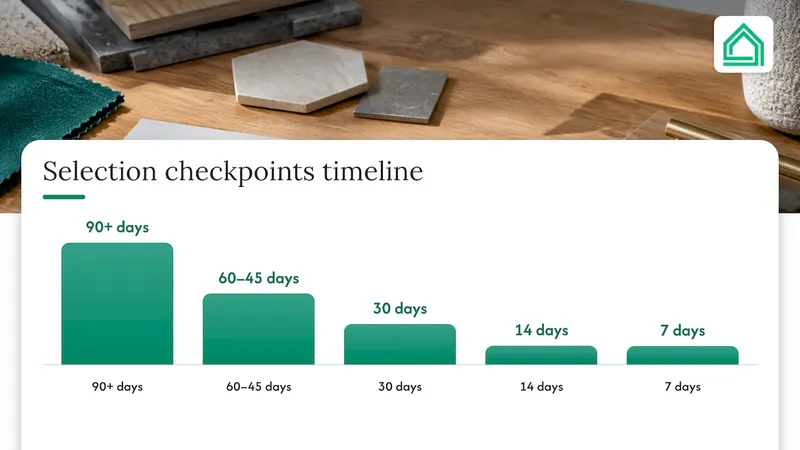
Checkpoints work best tied to the usable-on-site date rather than the calendar:
- 90+ days out: confirm the item is on the schedule with a drawing reference and an identified approval owner.
- 60 to 45 days: chase samples and lock the specification so pricing and lead time quotes are accurate.
- 30 days: decision deadline, approval owner must sign off or the item moves to a default choice.
- 14 days: order-by date, purchase order issued and lead time clock confirmed to have started.
- 7 days: delivery window confirmed directly with the supplier or carrier.
For allowances, set a client default choice in advance for every allowance line, so a missed 30-day deadline triggers the default automatically rather than stalling the whole schedule.
5. Coordination practices and tools to reduce selection delays
A weekly selections coordination meeting, designer, procurement lead and site contact, with a short agenda, new entries, items due to flip stage, anything red-flagged, keeps the schedule from drifting out of sync with the site.
- Treat the schedule as the single source of truth and cross-reference it from the finish schedule and drawings rather than keeping parallel copies.
- Version control matters more than it seems, label every revision with a date and circulate it the same day it changes.
- Red flags worth escalating immediately: a supplier that cannot confirm a start point for its lead time, a sample that has not arrived by the 60-day mark, or a decision owner who has gone quiet past the 30-day flag.
Our guide to document control covers version control practices in more depth for teams juggling several live schedules at once.
Author perspective: prioritise 'usable-on-site' dates and constraint removal
The habit that saves the most grief is boring: work backwards from the date the item must be on site, and keep a constraint log so nothing gets marked resolved on a hope. Two mistakes recur constantly. Planners confuse the install date with the need date, missing the inspection and transit time stacked before it. Fix that by adding buffers explicitly. Planners also accept verbal confirmation as resolution, fix that by requiring a purchase order number or a carrier's confirmed ETA before anything moves off the constraint log.
— Azai
FAQ
What is a schedule for materials?
A materials schedule is a shared register listing every finish, fixture and fitting against its specification, approval owner, order-by date and the date it must be usable on site. It is built backwards from that usable-on-site date rather than forwards from the order date, which is what keeps long-lead items from catching a project out.
How to make a simple construction schedule?
Start with the master schedule's key milestones, then work backwards to set a usable-on-site date for every major material category. Layer in a six-week lookahead so decisions clear their constraints in stages rather than all at once near the deadline.
What are the different types of construction schedules?
Construction scheduling typically spans a master schedule covering the whole programme, a lookahead schedule covering the coming weeks, and a weekly work plan covering only tasks confirmed as genuinely "can-do". A materials selections schedule sits alongside these, tracking decisions and deliveries rather than site activities directly.
How far ahead should long-lead items be ordered?
Long-lead items such as bespoke joinery or fabricated equipment should be ordered as soon as the specification is locked, often many weeks before standard materials. Confirm exactly when the supplier's lead-time clock starts, since quotes given as "approximately eight weeks" can begin at order, deposit or approved drawings, and that difference changes your order-by date significantly.
Sources
- Last Planner System® | Lean Construction Institute
- Schedule improvement through innovative procurement strategies (PMI)