
What is a project register in home building?
A project register is a centralised document that records, tracks, and manages essential information about a construction project's lifecycle. Think of it as your single source of truth: one place where every key decision, milestone, and budget figure lives, accessible to everyone who needs it.
For first-time builders and renovators in the UK, this matters enormously. Without a register, critical details scatter across emails, text messages, and memory. With one, you and your contractors are always working from the same picture.
A well-structured project register typically includes:
- Project title and unique ID — so every document and conversation references the same job
- Project manager and key contacts — names, roles, and responsibilities clearly assigned
- Current status — whether the project is in planning, under construction, or nearing completion
- Key milestone dates — planning permission granted, groundworks start, roof completion, final sign-off
- High-level budget summary — approved budget, spend to date, and any approved variations
- Stakeholder list — contractors, architects, structural engineers, and building control officers
Its primary purpose is to provide oversight, improve transparency, and support informed decision-making throughout the project.
Table of Contents
- The main types of project registers you should know
- Why a project register benefits first-time builders
- How to create and maintain a project register for your UK build
- Common challenges and how to overcome them
- Project register templates for UK building and renovation projects
- House A-Z gives you a smarter way to manage your project
- Key takeaways
The main types of project registers you should know
A master project register covers the high-level summary, but most builds benefit from several specialised registers running alongside it. Each one focuses on a specific area without cluttering the master document.
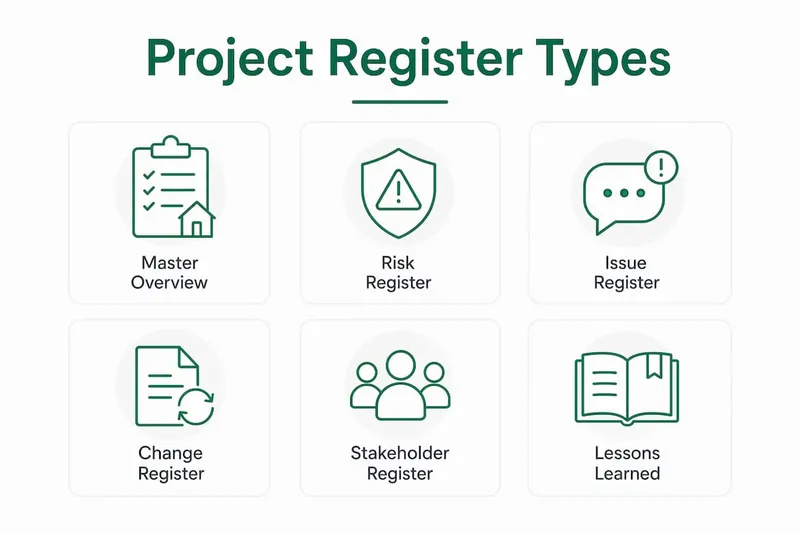
1. Master project register The top-level overview: project details, contacts, milestones, and budget. Updated regularly and shared with all key stakeholders.
2. Risk register Records potential risks — material delays, adverse weather, planning objections — along with their likelihood, impact, and planned response. A proactive risk register helps first-time builders identify problems early and plan contingencies before costs spiral.

3. Issue register Captures problems that have already occurred: a subcontractor who missed a deadline, a delivery of incorrect materials, a dispute over specifications. Each issue gets a status and an owner.
4. Change register Tracks every approved modification to scope, design, or budget. Managing construction modifications through a formal change register prevents the common situation where a verbal agreement is later disputed.
5. Stakeholder register Lists everyone with an interest in the project: their contact details, level of influence, and communication preferences. Particularly useful when your build involves neighbours, local planning authorities, or multiple trade contractors.
6. Lessons learned register Captures what went well and what did not, updated throughout the project. For a first-time builder, this becomes a personal reference for any future renovation work.
Why a project register benefits first-time builders
The clearest benefit is accountability. Documenting changes, risks, and stakeholder interests keeps everyone aligned and reduces misunderstandings over scope and budget. When a contractor queries what was agreed three months ago, the register provides the answer immediately.
For complex renovations involving multiple trades, a central register reduces duplication and clarifies responsibilities. Knowing which contractor owns which task prevents gaps and avoids two trades arriving on the same day to do conflicting work.
Key advantages for UK home builders and renovators include:
- Fewer costly errors — documented decisions are harder to misinterpret or ignore
- Better budget control — a live budget summary flags overspend before it becomes a crisis
- Stronger contractor coordination — clear responsibility assignments reduce delays
- Audit trail for disputes — a written record protects you if a contractor or supplier challenges an agreement
- Long-term reference value — a completed project register serves as a permanent history file, useful for retrieving design specifications or resolving warranty queries years after completion
A note on savings: House A-Z users have reported avoiding significant financial errors through better project oversight. Keeping a structured register, supported by the right tools, is one of the most direct ways to protect your budget.
How to create and maintain a project register for your UK build
Setting up a register before a single wall goes up gives you the strongest foundation. Here is a practical sequence to follow.
Step 1: Define your master register fields Start with project title, unique reference number, your name as project owner, your main contractor's details, planning permission reference, build start date, target completion date, and approved budget.
Step 2: Create your specialised registers Set up separate tabs or documents for risks, issues, changes, and stakeholders. Separating these from the master register keeps each document readable and focused.
Step 3: Assign ownership Every register needs someone responsible for updating it. On a self-build, that is usually you. On a managed build, your project manager or main contractor should share this responsibility.
Step 4: Update at every site meeting Treat the register as a living document, updated at every site meeting or weekly review. A register that is not current is not useful. Scheduling a short review at the end of each site visit takes less than ten minutes and keeps everything accurate.
Step 5: Share access with key stakeholders Your architect, main contractor, and building control officer should all be able to view the relevant sections. Transparency prevents surprises.
Pro Tip: Do not try to capture every detail in one document. A master register with five to eight core fields, supported by focused specialist registers, is far more useful than a single sprawling spreadsheet that nobody reads.
For construction delays and programme changes, your risk and issue registers become your first line of defence. Review them whenever site conditions change.
Common challenges and how to overcome them
Registers becoming outdated. The most frequent problem is neglect after the initial setup. Fix this by tying updates to a recurring event, such as your weekly site meeting, so it becomes habit rather than an afterthought.
Too much detail in one document. A master register that tries to capture everything becomes unreadable. Keep the master document high-level and use specialist registers for granular tracking.
No clear ownership. If nobody is assigned responsibility for maintaining the register, it drifts. Name one person per register and confirm this in writing with your contractor.
Resistance from contractors. Some tradespeople are unfamiliar with formal registers. Frame it as a shared benefit: a clear record protects them as much as it protects you. Good compliance documentation supports everyone on site.
Project register templates for UK building and renovation projects
A practical UK home build register does not need to be complex. A simple spreadsheet with the following structure covers most self-builds and renovations:
| Field | Example entry |
|---|---|
| Project title | Two-storey rear extension, London |
| Project reference | HAZ-— |
| Project owner | Jane Smith |
| Main contractor | ABC Building Ltd |
| Build start date | A scheduled start date |
| Target completion | A projected completion date |
| Approved budget | An approved budget sum |
| Current spend | The current amount spent |
| Current status | Groundworks complete |
Alongside this master sheet, create a risk register tab listing each identified risk, its likelihood (high/medium/low), potential impact, and your planned response. A change register tab should log every approved variation with its date, description, cost impact, and the name of the person who authorised it.
For a complete home building timeline, your milestone column should reflect each phase: planning permission, groundworks, superstructure, weathertight, first fix, second fix, and final completion.
Key takeaways
A project register is the single most effective tool for keeping a UK home build or renovation on track, on budget, and clearly documented from start to finish.
| Point | Details |
|---|---|
| Single source of truth | A project register centralises all key project data, reducing miscommunication between you and your contractors. |
| Use specialist registers | Separate risk, issue, change, and stakeholder registers from the master document to keep each one readable. |
| Keep it live | Update your register at every site meeting; an outdated register provides no protection. |
| Long-term value | A completed register serves as a permanent record for warranties, disputes, and future renovation reference. |
| House A-Z | House A-Z consolidates project management, budget tracking, and AI-driven insights into one platform for UK builders. |