
Novation replaces one contracting party with another. The incoming party takes on both the rights and future obligations of the outgoing party, and the outgoing party is fully released from the contract going forward. For first-time builders and renovators, this most commonly arises when you need to swap your main contractor mid-project and want the replacement to step into full legal responsibility.
Three things to know immediately:
- All three parties (outgoing contractor, incoming contractor, and you as the client) must give written consent. Without it, the novation cannot proceed.
- The original contract is extinguished and replaced by a new one. The incoming party assumes future obligations; the outgoing party remains liable for any breaches or liabilities that arose before the novation date unless an express release is agreed.
- Novation is an opportunity to renegotiate terms, not just a straight swap of names.
Table of Contents
- A plain-English example: swapping a contractor mid-build
- How does novation differ from assignment and variation?
- How to novate a construction contract in the UK: step by step
- What should a novation agreement include?
- Common pitfalls when novating a building contract
- When is novation the right choice for your project?
- Post-novation admin: what to update immediately
- Key takeaways
- Why novation admin deserves more attention than it usually gets
- How House A-Z helps you manage novation admin
- Useful sources
A plain-English example: swapping a contractor mid-build
Imagine you are halfway through a rear extension. Your main contractor becomes insolvent and a new firm agrees to take over the same scope of works. Rather than cancelling the contract and starting again, you novate it. The incoming contractor steps into the contract, assuming responsibility for completing the works, honouring the programme, and maintaining the warranties going forward.
In practice, three things shift immediately: payment is routed to the new firm, the programme becomes their responsibility, and any future warranty claims go to them. What does not shift automatically is responsibility for defects or breaches that occurred before the novation date. The outgoing contractor may still be liable for those unless you negotiate an express release.
Key insight: Novation lets you swap out who is 'in' the contract. The incoming party takes on rights and obligations; the outgoing party steps out. But "stepping out" only covers future performance — past conduct stays with the party who caused it.
How does novation differ from assignment and variation?
Getting this distinction right saves you from choosing the wrong legal route. The table below sets out the three concepts side by side.
| Concept | What changes | Consent required | Original party's liability |
|---|---|---|---|
| Novation | A party is replaced; original contract is extinguished | All three parties must agree | Released for future obligations; remains liable for pre-novation breaches unless expressly released |
| Assignment | Benefits (rights) transfer to a new party | Usually the continuing party only | Remains liable for obligations |
| Variation | Terms change between the same parties | Both original parties | Unchanged — same parties remain |
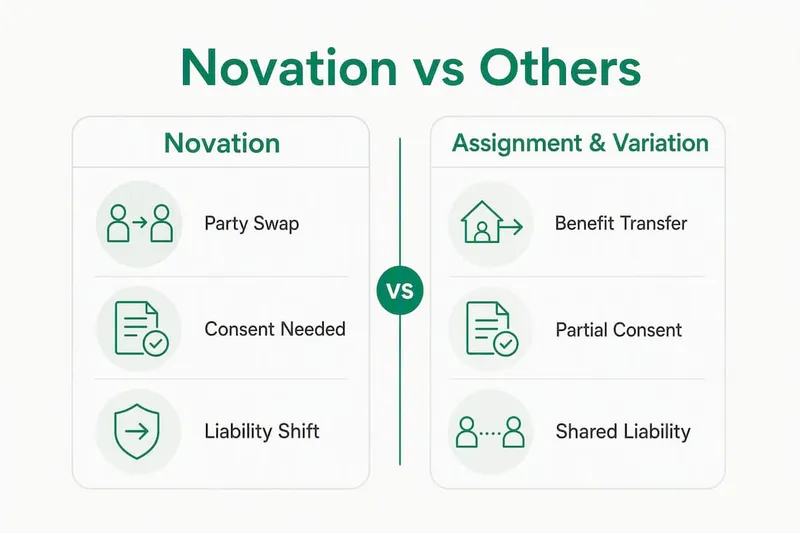
Assignment transfers benefits only; the original party stays on the hook for obligations. So if your contractor assigns the contract to a subcontractor, you could still pursue the original contractor if the work falls short. Novation removes that ambiguity entirely.
Variation is a different matter altogether. As Halsbury's Laws of England notes, variation keeps the same parties and changes the terms; novation replaces a party but typically keeps the core works unchanged. A price increase mid-project is a variation. Bringing in a new contractor is a novation.
Choose novation when you want complete legal separation. Choose assignment when you only need to transfer income rights. Use a variation when the parties stay the same but the scope or price changes.
How to novate a construction contract in the UK: step by step
The UK novation process follows a clear sequence. Skipping steps creates gaps in consent or enforceability.
Step 1: Check the original contract. Before anything else, review the contract for clauses that restrict assignment, require consent for a change of control, or set a defined novation procedure. These can limit your options or impose specific notice requirements.

Step 2: Clarify your goals. Decide whether you want a full party swap, a conditional handover, or a partial transfer. This is also the moment to consider whether any terms — pricing, insurance requirements, performance milestones — should be updated to reflect the new contractor's position. Practitioners often use novation to refresh these terms rather than carry over conditions that no longer fit.
Step 3: Secure written consent from all three parties. A novation requires consent of all parties — outgoing contractor, incoming contractor, and you. Verbal agreement is not sufficient. If any party refuses, the novation cannot legally proceed.
Step 4: Draft and execute the novation agreement. The agreement identifies all three parties, states the effective date, confirms the transfer of rights and obligations, and records the release of the outgoing party for future performance. In many UK novations, execution as a deed is required where there is no fresh consideration — a deed removes the need for consideration and strengthens enforceability. Always involve a solicitor at this stage.
Step 5: Update all operational paperwork. Once the deed is signed, update insurance policies, performance bonds, payment instructions, the project programme, subcontractor notices, and any warranties or guarantees.
Pro Tip: Review your project register before drafting the novation agreement. A complete record of consents, correspondence, and document versions makes the solicitor's job faster and reduces legal costs.
On timeline and cost: There is no fixed cost for novating a construction contract in the UK. Solicitor fees, the time needed to obtain consent from a reluctant party, and the administrative work of updating insurance and bonds all vary by project complexity. Budget for legal advice and allow several weeks if any party needs time to review the terms.
What should a novation agreement include?
A well-drafted novation agreement for a construction project covers the following:
- Identification of parties: full legal names of the outgoing contractor, incoming contractor, and client, plus the original contract reference.
- Effective date: the precise date from which the incoming party assumes responsibility.
- Transfer of rights and obligations: a clear statement that all future rights and obligations pass to the incoming party.
- Release of outgoing party: an express clause confirming the outgoing party is released from future performance (and, if negotiated, from specified pre-novation liabilities).
- Transitional arrangements: how outstanding payments, retentions, and interim valuations are handled at the handover date.
- Insurance and bonds continuity: confirmation that the incoming party holds equivalent cover and that existing bonds are novated or replaced.
- Warranties and guarantees: confirmation that product and workmanship warranties continue under the incoming party.
- Governing law and dispute resolution: state that English law governs and specify the dispute resolution mechanism.
A sample clause for the transfer and release might read:
Show this wording to your solicitor before using it. The clause above is illustrative; your solicitor will tailor it to your specific contract and circumstances.
Common pitfalls when novating a building contract
The most common mistake: failing to obtain written consent from all three parties before proceeding. If any party refuses, the novation has no legal effect — and work carried out in the meantime may fall into a contractual grey area.
Several other errors regularly cause problems for renovators:
- Assuming past liabilities are wiped out. The outgoing party commonly remains exposed to breaches that occurred before the novation date unless an express release is negotiated and recorded in the agreement.
- Not checking insurance and bonding continuity. If the incoming contractor's cover does not match the original requirements, the project may be exposed from day one of the handover.
- Relying on informal email agreements. An email exchange does not satisfy the execution formalities required for a deed. Missing deed formalities can make the novation unenforceable.
- Overlooking contract clauses. A prohibition on assignment or a change-of-control clause can block or complicate the novation if not identified early.
When is novation the right choice for your project?
Novation suits three situations particularly well. The first is replacing a main contractor or design-and-build contractor mid-project where you need the incoming firm to assume full contractual responsibility, not just carry out the remaining works informally. The second arises when a contractor's business is sold or restructured and you, as the client, require the new entity to step into the original firm's obligations. The third is where clean legal separation matters for a specific downstream reason — protecting a future mortgage advance, preserving a structural warranty, or satisfying a funder's requirements.
Where you only need to redirect payment or transfer a benefit, assignment may be simpler. Where the parties stay the same and only the scope or price changes, a variation suffices. Novation is the right tool when you want the outgoing party fully discharged and the incoming party fully responsible. Understanding hidden costs in renovations — including legal fees triggered by contractor changes — helps you plan for this eventuality before it arises.
Post-novation admin: what to update immediately
Once the novation agreement is executed, the administrative work begins. Delays here can leave the project exposed even when the legal paperwork is correct.
- Insurance: notify your insurer and confirm the incoming contractor holds equivalent cover; update the project's insurance schedule to reflect the new party.
- Performance bonds: arrange for existing bonds to be novated or replaced by equivalent bonds from the incoming contractor's surety.
- Payment instructions: update bank details and retention arrangements in your finance records; notify any funder or mortgage lender of the change.
- Subcontractors and suppliers: issue formal notices to all subcontractors and suppliers confirming the change of main contractor and any revised instructions.
- Project programme: issue a revised programme under the incoming contractor's name; update the risk register accordingly.
- Project file: retain the executed novation deed, all consent correspondence, and evidence of updated insurance and bonds in a single, accessible location.
Keeping a change order log alongside the novation file helps you track every instruction issued after the handover date, which matters if a dispute arises later.
Key takeaways
Novation replaces a contracting party entirely, transferring both rights and future obligations to the incoming party, and requires the written consent of all three parties to be legally effective in the UK.
| Point | Details |
|---|---|
| Consent is non-negotiable | All three parties must give written consent; if one refuses, the novation cannot proceed. |
| Past liabilities stay with the outgoing party | The outgoing contractor remains liable for breaches or liabilities incurred before the novation date, except where an express release is agreed. |
| Deed execution matters | UK novations often require execution as a deed where no fresh consideration exists, making solicitor involvement necessary. |
| Update admin immediately | Insurance, bonds, payment instructions, and the project programme must all be updated as soon as the deed is signed. |
| House A-Z supports the process | House A-Z's document storage, contractor notifications, and project register features help you track consents and keep novation records in one place. |
Why novation admin deserves more attention than it usually gets
Most first-time builders focus on getting the legal document right — and that matters. But the novation agreement is only half the job. The administrative gap that opens between signing the deed and updating insurance, payment records, and the project programme is where real problems occur. A contractor swap that is legally clean can still leave a project exposed if the insurer has not been notified or the funder still holds the outgoing contractor's bank details.
There is also a tendency to treat novation as a crisis response rather than a planned event. In reality, any project that involves a design-and-build contractor or a complex supply chain should have a clear protocol for what happens if a party needs to be replaced. Having your project documents centralised, your consents recorded, and your insurance schedule up to date before a novation is needed makes the process far less disruptive when it does arise.
One more point worth making: novation is a genuine opportunity to improve the contract, not just preserve it. If the original terms no longer reflect the project's current scope, cost, or programme, the novation moment is the right time to address that. Carrying forward a contract that no longer fits the incoming party's position stores up disputes for later.
Useful sources
The following UK legal and practical sources informed this article. They are worth consulting directly if you need to go deeper or seek professional guidance.
- Cambridge Dictionary: novation — a concise plain-English definition useful as a starting point.
- Halsbury's Laws of England (LexisNexis): meaning of novation — the authoritative UK legal commentary on how novation operates and how it differs from variation.
- Sprintlaw UK: contract novation — a practical UK-focused primer covering the process, consent requirements, and deed execution.
- Legistify: what is contract novation? — a clear explanation of the legal consequences and typical agreement structure.
When to get a solicitor involved: always, for deed execution and for any novation where pre-novation liabilities are disputed or where the incoming party's insurance or bonding position is unclear. A practical project-record check — reviewing your contract clauses and updating your project register — is something you can do yourself before the solicitor is engaged, and it will reduce the time (and cost) of that engagement considerably.