Bedroom orientation matters because where you place the bed and how you position the room's fixed elements — windows, doors, vents, and radiators — directly shapes sleep quality, thermal comfort, and energy use. Compass direction is far less important than most guides suggest. For UK builders and renovators, the practical priority is getting the layout right before a single wall goes up.
TL;DR
- Place the bed so the sleeper can see the door diagonally (the commanding position) to reduce vigilance anxiety and improve sleep onset.
- Avoid positioning the headboard against an exterior window or directly under a vent; an interior structural wall is the better choice.
- Lock bedroom orientation decisions at the concept or pre-planning stage, not after the frame is up.
House A-Z integrates these principles into early-stage planning templates. A ScienceDirect narrative review confirms that indoor environmental quality and layout have measurable effects on sleep, while direct evidence linking compass direction to sleep outcomes remains limited.
Table of Contents
- Why bedroom orientation matters: what the research actually says
- How orientation affects sleep, thermal comfort, and energy in practice
- Actionable bedroom-orientation checklist for first-time builders
- Common trade-offs builders face and how to mitigate them
- When does compass direction actually matter in UK bedrooms?
- What to ask your architect or builder — and what to include in the plans
- Key takeaways
- A practical perspective on bedroom orientation
- How House A-Z supports your bedroom orientation decisions
- Further reading and authoritative sources
Why bedroom orientation matters: what the research actually says
The strongest evidence centres on layout and indoor environmental quality, not magnetic compass direction. Environmental psychology research links the commanding position — placing the bed so the sleeper can see the bedroom door without being directly in line with it — to lower vigilance anxiety and faster sleep onset. This is not a feng shui abstraction; it reflects how the nervous system scans a space for safety signals even during sleep.
The ScienceDirect narrative review is equally clear on a second point: much sleep research omits physical bedroom factors entirely, which limits what can be said about orientation-specific effects. What the review does confirm is that overheating risk in temperate climates is a genuine concern, and that bedroom design and indoor environmental quality are meaningfully linked to sleep outcomes.
"The nervous system scans the entire room for safety signals; small, low-cost changes like repositioning the bed or removing visible work items can yield large sleep improvements." — Interior designer Catherine Shuman
On compass direction specifically, authoritative sleep-environment guidance is consistent: there is no reliable scientific evidence that magnetic orientation affects sleep quality for healthy adults. Layout factors — sightlines, window placement, vent location, noise sources — carry far greater measurable weight. Design experts and sleep professionals broadly agree that repositioning the bed and addressing lighting often improves sleep more than changing a mattress or bedtime routine alone.
How orientation affects sleep, thermal comfort, and energy in practice
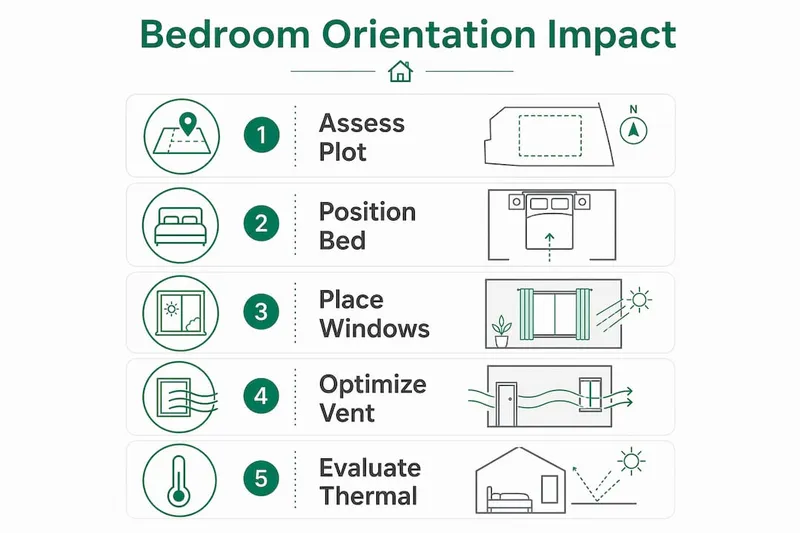
Sightlines and the commanding position are the single highest-impact layout decision. Placing the headboard against a solid interior wall, with the bed positioned diagonally from the door, gives the sleeper a clear view of the entry without being directly in its path. This arrangement satisfies a deep instinct to monitor surroundings, reducing the low-grade alertness that delays sleep onset. Sleeping with your back to the door, or with the door swinging directly toward the bed, can create unease the conscious mind never registers — but the body does.
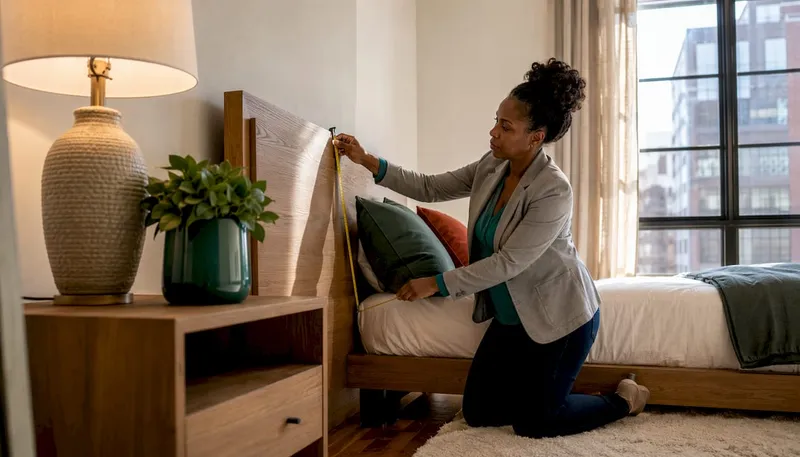
Light and circadian rhythm are shaped by window placement more than any other fixed element. East-facing windows deliver strong morning light, which supports natural waking but can be disruptive for late sleepers. West-facing rooms stay brighter into the evening, potentially delaying melatonin release. North-facing bedrooms offer the most stable, diffused light across the day — a practical advantage in UK conditions where overcast skies already moderate solar gain. Position the bed so that direct morning light does not strike the sleeper's face; even a shift of a metre can change when and how light reaches the pillow. Layered window treatments — a sheer for daytime privacy plus a blackout layer for night — give you precise control regardless of which direction the room faces.
Thermal performance is where compass orientation has its clearest practical effect in the UK. North-facing bedrooms tend to remain cooler, which can reduce the need for active cooling during warm spells — a point the Essex Design Guide notes for UK practitioners. Placing a headboard against an exterior wall in a poorly insulated home means the sleeper absorbs cold in winter and heat in summer; an interior or structural wall is the better choice. The recommended sleeping-room temperature to support sleep is roughly 16–19°C. Beds placed directly under HVAC vents or in the direct path between a window and a door — where cross-breezes travel — are exposed to drafts and uneven airflow that fragment sleep without the sleeper ever identifying the cause. Understanding home energy loss at the fabric level helps explain why wall choice for the headboard matters as much as it does.
| Factor | Effect on sleep | Priority at design stage |
|---|---|---|
| Commanding position (sightline to door) | Reduces vigilance anxiety, aids sleep onset | High — fix before services |
| Headboard wall (interior vs exterior) | Thermal comfort in winter and summer | High — fix before insulation spec |
| Window placement and orientation | Circadian rhythm, light intrusion, overheating | High — fix at concept stage |
| Vent and radiator location | Drafts, noise, uneven temperature | Medium — coordinate with M&E |
| Noise sources (street, party wall) | Sleep fragmentation | Medium — address at planning |
Actionable bedroom-orientation checklist for first-time builders
Build-stage checklist
- Site study (pre-planning): Map the solar path, prevailing wind direction, and external noise sources. Identify which elevations face north, south, east, and west before placing bedrooms on the plan.
- Room placement on plan (concept stage): Position bedrooms away from street frontage and living spaces where possible. North or east-facing rooms suit bedrooms in most UK schemes.
- Commanding position (concept/technical design): Mark the intended bed position on the floor plan. Confirm the sleeper can see the door diagonally from that position without being in line with it.
- Headboard wall (technical design): Specify an interior or structural wall for the headboard. Flag any exterior wall option for additional insulation before the spec is fixed.
- Window and vent locations (technical design/building regs): Confirm no vent outlet is directly above or at the head of the bed. Check that window cill height and position do not place the sleeper's head in direct light or draft.
- Blackout and daylight control (tender stage): Specify blackout lining or shutters for east-facing windows. Include a sheer layer for daytime privacy.
- Circulation paths: Maintain a minimum 600mm clear path on at least one side of the bed, preferably both. Keep the door swing clear of the bed frame.
- Lock-in point: Window, door, and vent positions must be fixed by the building regulations / tender stage. Structural changes after the frame is up carry significant cost.
Pro Tip: Treat the bed as the architectural anchor. Draw it on the floor plan at concept stage and position every fixed element — doors, windows, radiators, and socket outlets — around the intended sleeping layout. Changing a window or door opening after the frame is built typically costs several hundred to several thousand pounds depending on structural implications; getting it right on paper costs nothing.
Early orientation and fabric-first design choices also affect lifecycle running costs. Energy savings from early design decisions can offset build cost over time, which makes the concept-stage conversation with your architect worth having in full.
Common trade-offs builders face and how to mitigate them
UK bedrooms are frequently constrained by fixed elements decided before sleep hygiene enters the conversation. Here are the most common conflicts and practical responses:
- Small footprint with only one viable wall for the headboard: If that wall is exterior, upgrade insulation in that zone specifically and add a vapour-resistant layer. A well-insulated exterior wall is far better than a poorly placed interior one.
- Fixed window positions that create light intrusion: Specify blackout blinds with side channels to eliminate light bleed. Repositioning the bed even 600mm can move the sleeper out of the direct light path.
- Radiator or vent directly behind the intended headboard wall: Coordinate with the mechanical and electrical contractor early. Radiators can often be relocated within the same zone for a modest cost at first-fix stage; moving them after second fix is considerably more expensive.
- Party wall noise (terraced or semi-detached properties): Acoustic lining on the party wall adds resilience without structural change. Avoid placing the bed head against the party wall if an alternative exists.
- Stacked services (soil pipes, flues) limiting room layout: Map service runs on the floor plan before finalising the room layout. A bedroom above a kitchen or bathroom often has constrained ceiling zones; confirm ceiling height at the bed position before the slab or floor deck is poured.
Pro Tip: Coordinate radiator and socket-outlet layout with bed placement at first-fix stage. A double socket behind where the headboard will sit, and a radiator on the wall opposite the bed, costs nothing extra to specify early and avoids extension leads and cold spots later.
When does compass direction actually matter in UK bedrooms?
For most healthy adults in most UK homes, compass direction has no direct effect on sleep quality. Layout and indoor environmental quality carry larger, measurable impacts. That said, compass orientation does matter in three specific situations:
- Overheating risk in high-solar-exposure rooms: South and west-facing bedrooms with large glazed areas can overheat during warm spells. This is a growing concern in UK housing as summer temperatures rise. Specify solar-control glazing or external shading for these orientations.
- Passive-solar design priorities: If the scheme is targeting low-energy performance (e.g., Passivhaus or fabric-first standards), south-facing living spaces and north-facing bedrooms are a deliberate design strategy, not an afterthought.
- Site-specific shading or neighbouring massing: An urban plot hemmed in by taller buildings may receive little direct sun regardless of orientation. A rural detached house on an open site has full solar exposure on all elevations. The decision tree differs between these two cases.
| Scenario | Does compass direction matter? | Priority action |
|---|---|---|
| Small urban plot, surrounded by buildings | Low — shading dominates | Focus on layout and IEQ |
| Rural detached, open site | Medium — solar gains significant | Specify glazing and shading strategy |
| Passivhaus or low-energy scheme | High — orientation is a design driver | Engage energy consultant at concept stage |
| Standard UK spec house, any orientation | Low — layout factors dominate | Prioritise commanding position and IEQ |
What to ask your architect or builder — and what to include in the plans
Ask for these specifically before the technical design stage is complete:
- "Can the bed be placed so the sleeper can see the entry door without being directly in line with it?"
- "Where will vents and radiators be positioned relative to the intended bed location?"
- "Is the headboard wall an interior or exterior wall, and what is the insulation specification?"
- "Has acoustic performance been considered for the party wall or street-facing elevation?"
- "At what drawing stage will window and door positions be fixed, and can we review the bedroom layout before that point?"
Deliverables to request for the tender package:
- Annotated floor plans showing the intended bed position, door swing, window cill height, and vent outlet locations
- A brief indoor environmental quality note covering thermal and acoustic performance for each bedroom
- Section drawings showing ceiling slopes, beam positions, or any element that affects headboard placement
- Confirmation of socket-outlet and radiator positions relative to the bed
These items should appear no later than the technical design stage. Window and door positions must be fixed before building regulations submission; radiator and vent positions should be confirmed at first-fix coordination.
Key takeaways
Bedroom layout and indoor environmental quality have a far greater effect on sleep and comfort than compass direction alone — and the decisions that matter most must be made before the frame goes up.
| Point | Details |
|---|---|
| Layout beats compass direction | Sightlines, window placement, and vent location have larger, measurable effects on sleep than magnetic orientation. |
| Commanding position is the priority | Place the bed diagonally from the door so the sleeper can see the entry; use an interior wall for the headboard. |
| Temperature range matters | The recommended sleeping-room temperature is 16–19°C; avoid vents and exterior walls that create drafts or thermal instability. |
| Lock decisions early | Window, door, and vent positions must be fixed by the building regulations stage; structural changes after the frame is built are costly. |
| House A-Z helps you plan ahead | House A-Z's furniture-led templates and AI agents help first-time builders integrate these decisions before costly mistakes are made. |
A practical perspective on bedroom orientation
The most common mistake first-time builders make is treating the bedroom as a residual space — whatever footprint is left after the kitchen, living room, and bathrooms are planned. Bedroom orientation then becomes an afterthought, resolved by whichever wall happens to be available for the bed.
The evidence points in a different direction. Interior designer Catherine Shuman's observation that the nervous system scans the entire room for safety signals is not a soft lifestyle point; it reflects a real physiological process that affects sleep onset every night. Getting the commanding position right costs nothing at the drawing stage and potentially nothing at all on site. Getting it wrong after the frame is up can mean living with a suboptimal layout for decades.
The compass-direction debate is, in most UK cases, a distraction. North-facing bedrooms do tend to be cooler, which is a genuine thermal advantage in a warming climate. But a south-facing bedroom with good solar-control glazing, a well-placed headboard wall, and a clear sightline to the door will outperform a north-facing room with a bed jammed against an exterior window and a vent blowing directly onto the pillow. Fabric quality and layout decisions made at concept stage are what actually determine the outcome.
Further reading and authoritative sources
- ScienceDirect — Bedroom design and sleep quality in a warming climate: Peer-reviewed narrative review linking indoor environmental quality and bedroom design to sleep outcomes; flags overheating risk in temperate climates.
- Essex Design Guide: UK practitioner guidance on orientation, thermal performance, and passive design strategies relevant to residential schemes.
- Mattress Nut — Evidence-based bedroom layout principles: Practical layout guidance covering the commanding position, vent placement, window siting, and the 16–19°C temperature range.
- The Spruce — Bedroom layout and sleep quality: Design-expert consensus on bed repositioning, lighting, and clutter as high-impact sleep improvements.
- House A-Z blog: Practical guides for UK builders and renovators covering window placement, budget planning, and construction sequencing.
- Local building standards and site surveys: Always consult your local planning authority and commission a site-specific acoustic and thermal survey before finalising bedroom orientation on constrained or sensitive sites.