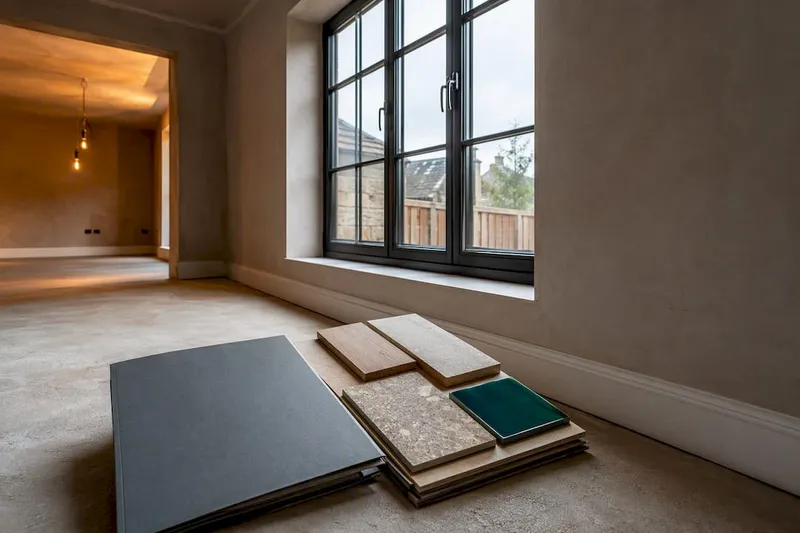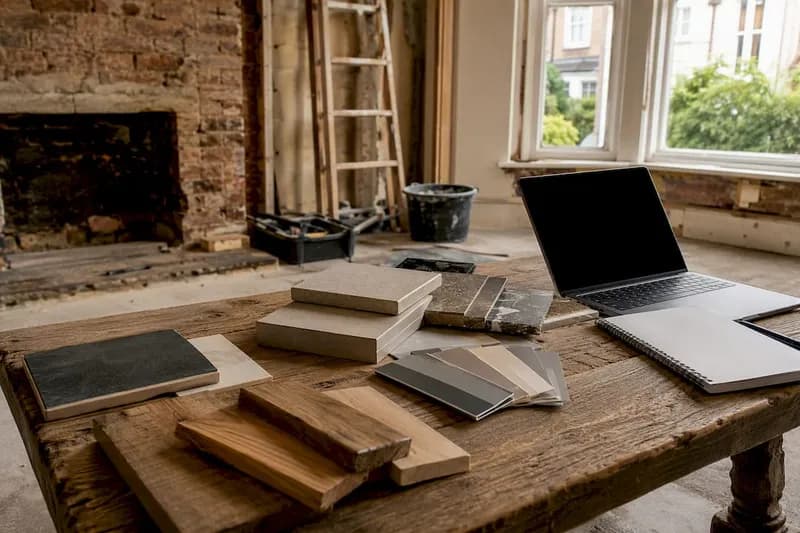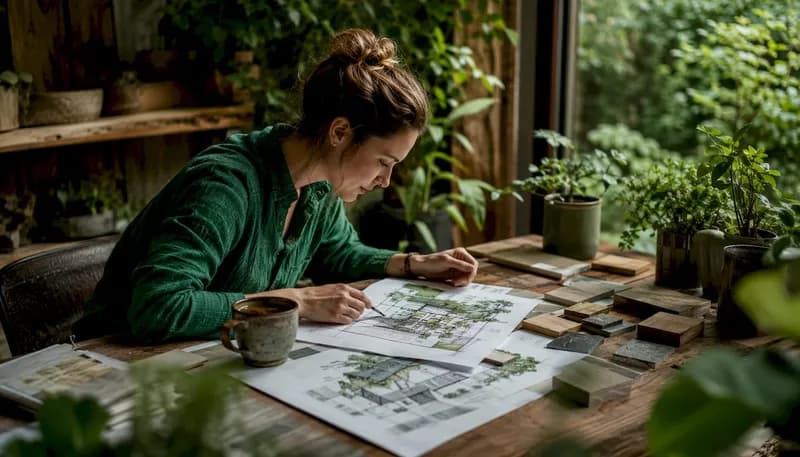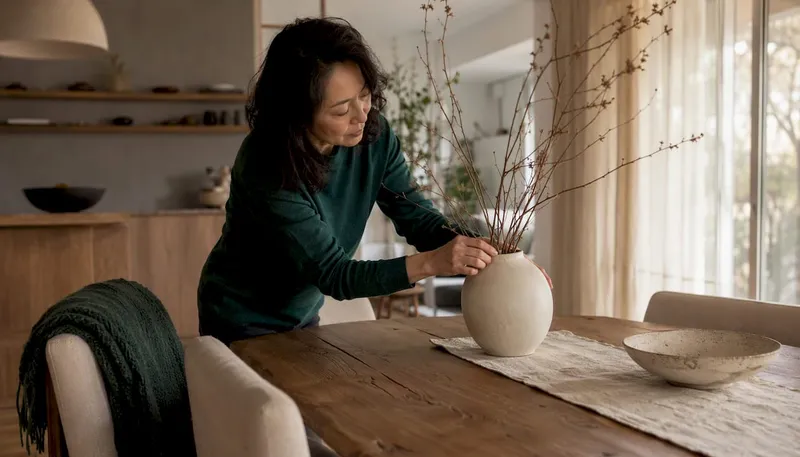
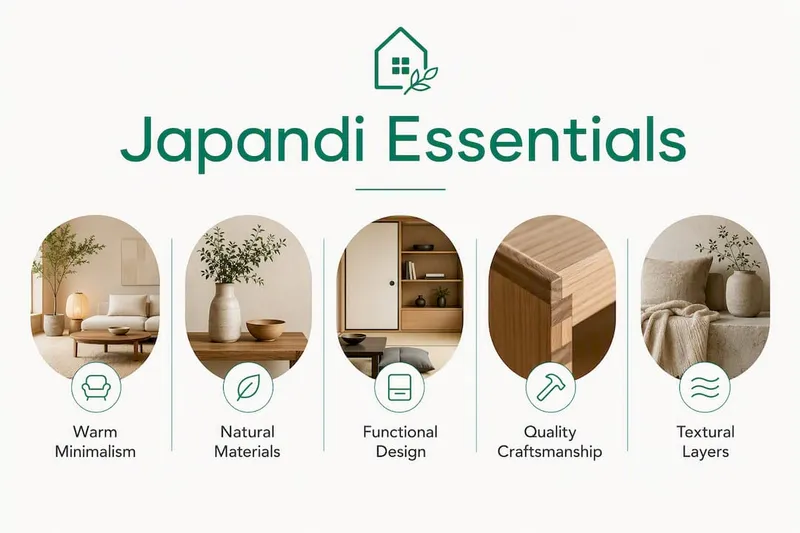
Japandi is a design fusion of Japanese wabi-sabi and Scandinavian hygge that prioritises warm minimalism, natural materials, and functional, uncluttered spaces. As Architectural Digest describes it, the style blends two distinct cultural traditions into a single cohesive aesthetic: one that feels calm, purposeful, and genuinely lived-in rather than staged. The name itself is a portmanteau of "Japan" and "Scandi," and the term entered mainstream design vocabulary around 2016, though the cross-cultural exchange between Japanese and Scandinavian designers dates back considerably further.
Three hallmarks let you recognise it immediately:
- Palette: Soft whites, warm beiges, muted taupes, and earthy charcoals, with deeper wood tones for contrast
- Materials: Timber with visible grain, stone, linen, bamboo, and hand-thrown ceramics
- Furniture silhouette: Low-profile, clean-lined pieces with no decorative excess
Table of Contents
- What are the core characteristics of Japandi interior design?
- Where does Japandi come from, and what are wabi-sabi and hygge?
- Which colours and materials make a Japandi room recognisable?
- How should you choose furniture and plan your layout?
- What textiles, accessories, and plants complete the look?
- How does lighting work in a Japandi interior?
- How do you bring Japandi into your home, step by step?
- What are the most common Japandi decor mistakes?
- How does Japandi differ from Scandinavian design and wabi-sabi?
- Room templates that show Japandi in practice
- Key takeaways
- Why Japandi rewards patience more than most styles
- Plan your Japandi renovation with House A-Z
- Useful sources and further reading
What are the core characteristics of Japandi interior design?
Japandi's defining quality is warm minimalism: spaces that are pared back but never cold. Every object earns its place through function, and the materials themselves provide the visual interest rather than pattern or ornament.
Furniture sits low to the ground, drawing the eye downward and creating a sense of groundedness. Timber is the dominant material, favoured for its natural grain and the way it ages. Stone surfaces, woven textiles, and hand-thrown pottery add tactile depth without introducing visual noise. The overall effect is one of curated restraint: a room that contains fewer things, but better ones.
Function comes first. Storage is built in or hidden. Surfaces are clear. Where Scandi design might allow a cheerful printed cushion or a brightly coloured throw, Japandi keeps the palette tightly controlled and lets texture carry the warmth. Good Housekeeping's professional designers describe the successful result as "warm minimalism" — minimal, but tactile and lived-in, achieved by balancing light Scandi bases with deeper Japanese woods and patinas.
Pro Tip: When selecting pieces, apply a simple rule: one high-quality item beats three average ones. A single hand-thrown ceramic bowl on a shelf reads as intentional; three mass-produced alternatives read as clutter.
Where does Japandi come from, and what are wabi-sabi and hygge?
The Wikipedia entry on Japandi traces the earliest examples of Japanese-Scandinavian fusion to ceramic crafts, architecture, and Danish furniture, well before the term itself appeared. Scandi designers encountered Japanese aesthetics through trade, travel, and mid-century craft exchanges, and found a natural affinity: both traditions valued simplicity, natural materials, and objects made to last.
The term "Japandi" crystallised around 2016 as interior design media began naming the trend explicitly. Two philosophical traditions underpin it.
Wabi-sabi is a Japanese aesthetic rooted in the acceptance of transience and imperfection. It finds beauty in things that are worn, weathered, or asymmetrical. A cracked glaze on a tea bowl, a timber beam with visible knots, a stone surface that has dulled with use: these are not flaws to be corrected but qualities to be appreciated. As L'Antic Colonial explains, wabi-sabi is a distinct philosophical root of Japandi but not identical to the contemporary movement. Japandi borrows its reverence for natural materials and imperfection without fully adopting wabi-sabi's more austere, melancholic register.
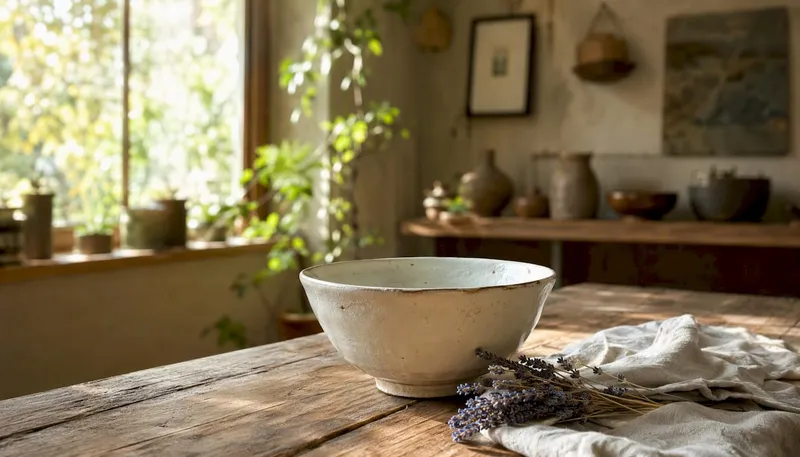
Hygge (pronounced roughly "hoo-gah") is a Danish and Norwegian concept that describes a quality of cosiness, warmth, and convivial comfort. It is less a visual style than a feeling: the pleasure of a warm room, soft light, and good company. Scandi interiors express hygge through layered textiles, candlelight, and materials that invite touch. Japandi absorbs this warmth but disciplines it with Japanese restraint, producing spaces that feel welcoming without becoming cluttered.
Together, the two philosophies explain why Japandi looks the way it does: the warmth comes from hygge, the discipline from wabi-sabi, and the result is a home that feels both calm and genuinely comfortable.
Which colours and materials make a Japandi room recognisable?
The Japandi colour palette typically runs from soft whites and warm beiges through muted taupes and earthy greys, with charcoal and deep wood tones providing contrast. The Spruce notes that natural light, high-quality sustainable materials, and an emphasis on organic forms are central to the look. Where Scandi palettes tend toward bright, cool neutrals, Japandi shifts warmer, adding depth through darker timber and stone without sacrificing the underlying calm.
Signature materials include:
- Timber: Oak, walnut, and ash with visible grain; charred wood (shou sugi ban) for dramatic contrast
- Stone: Slate, limestone, and honed marble in muted finishes
- Textiles: Undyed linen, chunky wool, hand-woven cotton
- Ceramics: Hand-thrown stoneware in earthy glazes
- Natural fibres: Bamboo, rattan, and paper (particularly for lighting)
| Do | Don't |
|---|---|
| Layer muted, warm neutrals | Use high-gloss synthetic surfaces |
| Choose materials that age gracefully | Buy uniform, mass-produced finishes |
| Let timber grain provide visual interest | Introduce busy patterns or bright accent colours |
| Mix textures within a tight palette | Combine too many wood tones in one room |
| Favour sustainable, natural sourcing | Rely on fast-fashion decor to fill space |
CNN Underscored highlights the importance of indoor/outdoor connection and living-finish metals alongside wood and stone. Aged brass, blackened steel, and unlacquered copper all fit the palette because they change with time rather than maintaining a factory-fresh uniformity.
How should you choose furniture and plan your layout?
Japandi furniture follows a clear logic: low, clean, purposeful. Pieces sit closer to the floor than typical Western furniture, a direct influence from Japanese interiors where floor-level living is traditional. Legs are slender and structural rather than decorative. Upholstery, where it appears, is plain and textural.
A practical checklist for selecting pieces:
- Low profile: sofas, beds, and storage units that sit below eye level when seated
- Clean lines with no carved or applied decoration
- Solid timber construction, preferably in oak, walnut, or ash
- Built-in or concealed storage to keep surfaces clear
- One or two statement pieces per room rather than a full suite
Negative space is not wasted space. Leaving a wall bare, a corner empty, or a surface clear is a deliberate choice that gives the eye somewhere to rest. Rooms feel calm precisely because they are not fully furnished.
For a living room, anchor the space with a low sofa in a neutral linen or boucle, a walnut coffee table, and a single floor lamp with a paper shade. Keep the shelving to one wall and edit its contents to functional objects and a few ceramics. For a bedroom, a platform bed in solid oak, linen bedding in warm white or oatmeal, and a single bedside table with one lamp is sufficient. Master bedroom planning benefits from thinking about sightlines and privacy before selecting furniture, which aligns well with Japandi's emphasis on considered spatial arrangement.
What textiles, accessories, and plants complete the look?
Texture is how Japandi avoids feeling sterile. The palette is narrow, so the tactile variety of materials carries the sensory interest. A hand-woven jute rug, a linen throw, a stoneware vase, and a wooden bowl can together create more visual warmth than a room full of decorative objects.
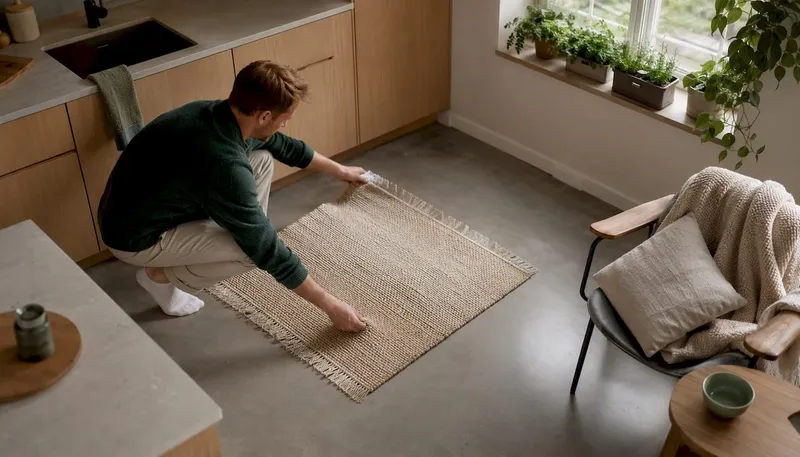
Textiles to favour: undyed or naturally dyed linen, chunky-knit wool, hand-woven cotton rugs in natural tones, and raw silk for occasional cushion covers. In the UK, makers such as those found at independent craft markets, Etsy studios, and regional pottery fairs offer genuinely handmade pieces that bring the right quality of imperfection.
Accessories: fewer is better. Each object should have a function or a clear reason for being there. A single sculptural ceramic, a wooden tray holding daily-use items, a stack of books with plain spines. Good Housekeeping designers caution specifically against cheap mass-produced accessories: the warmth of Japandi depends on the quality and authenticity of individual pieces, not their quantity.
Pro Tip: Before buying a new accessory, remove one existing object from the room. If the room improves, keep the edit. If it feels emptier, the new piece may genuinely add something.
Plants bring organic form and a connection to the natural world. Japandi favours structural, simple-leaved varieties: a fiddle-leaf fig, a snake plant, a single stem of pampas grass in a tall ceramic vase. The indoor/outdoor connection that Japandi values is expressed through greenery placed near windows and in corners where natural light falls.
How does lighting work in a Japandi interior?
Natural light is the starting point. Japandi interiors keep window treatments minimal: sheer linen panels or simple roller blinds in natural tones rather than heavy curtains that block daylight. Where possible, glazed interior doors allow light to travel through the plan, maintaining the sense of openness and connection between spaces.
Artificial lighting works in layers. Ambient light provides the base level; task lighting serves specific functions (reading, cooking, working); accent lighting picks out textures and materials. For Japandi, the key variable is colour temperature. Bulbs in the 2700K–3000K range produce a warm, slightly golden light that complements timber and stone without the clinical quality of cooler LEDs. Dimmable circuits are worth the investment: the ability to lower light levels in the evening is one of the simplest ways to shift a room from functional to restful.
A practical lighting checklist:
- Sheer or natural-fibre window treatments to maximise daylight
- Paper or washi pendant shades for ambient light (they diffuse warmth beautifully)
- Warm LED bulbs at 2700K–3000K throughout
- Dimmable circuits in living rooms and bedrooms
- A single floor lamp with a linen or paper shade for reading
- Avoid recessed spotlights as the sole light source — they flatten texture
How do you bring Japandi into your home, step by step?
The most common mistake is trying to achieve the look in a single shopping trip. Japandi rewards a phased approach: audit first, buy second.
- Audit the room. Remove everything that is not functional or genuinely valued. Work out what the room needs to do before deciding what it should contain.
- Edit the existing contents. Keep pieces that are natural, well-made, or have personal meaning. Set aside anything synthetic, heavily patterned, or purely decorative.
- Select one anchor piece. In a living room, this is usually the sofa or a large rug. In a bedroom, the bed frame. Choose this piece in a natural material and a neutral tone — it sets the palette for everything else.
- Add texture in layers. A rug, a throw, a cushion, a ceramic: each adds tactile depth without introducing new colours.
- Refine the accessories. Apply the one-in-one-out rule until the room contains only what it needs.
Budget route: UK charity shops, Facebook Marketplace, and car boot sales regularly yield solid timber furniture, plain ceramics, and linen textiles at low cost. The patina on second-hand pieces often suits Japandi better than new equivalents.
Premium route: Independent UK makers, specialist timber furniture studios, and Japandi-focused online retailers offer pieces built to last. Spending more on one well-made sofa or bed frame and less on accessories is the right trade-off.
For kitchen planning, thinking through layout options before selecting cabinetry and surfaces helps avoid costly changes later — particularly relevant when choosing the matte, handleless finishes that suit Japandi kitchens.
What are the most common Japandi decor mistakes?
Mistake 1: Treating minimalism as emptiness. A Japandi room is not an empty room. The Spruce describes the error as "clutter in the name of minimalism" — spaces that remove everything and then feel barren rather than calm. The fix is to replace removed objects with a smaller number of higher-quality pieces that add texture and function.
Mistake 2: Buying cheap imitations. Fast-fashion homeware brands produce Japandi-adjacent pieces at low prices, but the materials lack the quality that makes the style work. A synthetic rattan basket or a mass-produced "wabi-sabi" ceramic reads as a copy rather than the real thing. Invest in one genuine handmade piece rather than five approximations.
Mistake 3: Over-layering textures. Japandi uses texture for warmth, but there is a limit. A jute rug, a linen throw, a wool cushion, a woven basket, a macramé wall hanging, and a sheepskin in the same room becomes visually busy. Choose two or three textures and repeat them rather than introducing every natural material at once.
Mistake 4: Mixing too many wood tones. Oak, walnut, ash, and pine all appear in Japandi interiors, but not all in the same room. Pick one dominant timber tone and use it consistently across the main pieces.
Mistake 5: Ignoring the floor. The floor is a major surface in Japandi because furniture sits low. Bare boards in a warm timber tone, or a large plain rug, anchor the whole scheme. Flooring choices affect the flow and warmth of a room more than most people expect.
Pro Tip: Invest in one or two statement pieces — a solid timber dining table, a hand-thrown lamp base — rather than refreshing accessories seasonally. The longevity of well-made pieces is part of the Japandi ethos.
How does Japandi differ from Scandinavian design and wabi-sabi?
The three are related but distinct. Understanding the differences helps you borrow from each selectively.
| Dimension | Japandi | Scandinavian (Scandi) | Wabi-sabi |
|---|---|---|---|
| Palette | Warm neutrals, earthy charcoals, deep timber tones | Bright, cool neutrals; white-dominant | Muted, aged, often monochromatic |
| Texture | Layered but controlled: linen, timber, stone | Soft and cosy: wool, sheepskin, printed textiles | Rough, worn, asymmetrical surfaces |
| Furniture height | Low-profile, floor-oriented | Standard Western height | Often minimal or floor-level |
| Emotional tone | Calm, purposeful, warm | Cosy, cheerful, social | Contemplative, melancholic, accepting |
| Imperfection | Appreciated but not foregrounded | Less emphasis | Central to the philosophy |
Architectural Digest notes that Scandi and Japandi share minimalism but diverge in tone: Scandi favours brighter neutrals and hygge textures, while Japandi adds darker, earthier tones and lower-profile furniture reflecting wabi-sabi influence.
When to choose Scandi: if you want a brighter, more sociable space with room for colour and pattern, Scandi gives you that warmth without the restraint of Japandi.
When to choose Japandi: if you want a calmer, more contemplative home that ages well and rewards quality over quantity, Japandi is the stronger framework.
When to draw on wabi-sabi directly: if you are drawn to the philosophical dimension — the acceptance of imperfection and transience — rather than a specific interior style, wabi-sabi as a practice extends beyond decor into how you relate to your possessions.
Room templates that show Japandi in practice
These three templates give you a replicable starting point for each space.
Living room
- Low sofa in warm oatmeal linen or boucle
- Walnut or oak coffee table with a simple rectangular form
- Large jute or wool rug in a natural tone
- Single paper pendant or floor lamp with a linen shade
- One ceramic vase with a single branch or stem
- Open shelving with books, a bowl, and one plant (fiddle-leaf fig or snake plant)
- Bare walls or one framed piece of simple line art
Shot list / image search terms: low sofa, walnut coffee table, linen rug, paper pendant, single sculptural plant
Bedroom
- Platform bed in solid oak or walnut, low to the floor
- Linen bedding in warm white, oatmeal, or soft sage
- Single bedside table with one lamp (warm LED, paper shade)
- Concealed wardrobe or minimal open rail with a linen curtain
- One plant in a ceramic pot near the window
Weekend project: remove all decorative objects from the bedroom, replace the bedding with plain linen, and add one plant. The transformation is immediate and costs very little.
Small kitchen
- Handleless cabinetry in matte white, warm grey, or sage
- Timber worktop or stone in a honed, matte finish
- Open shelving for daily-use ceramics only
- One herb plant on the windowsill
- Concealed appliances where possible
Key takeaways
Japandi is a fusion of Japanese wabi-sabi and Scandinavian hygge that creates warm, functional, naturally material-led interiors through restraint, quality, and a tightly controlled palette.
| Point | Details |
|---|---|
| Definition | Japandi blends Japanese wabi-sabi and Scandinavian hygge into warm, functional minimalism. |
| Core palette | Soft whites, warm beiges, muted taupes, earthy charcoals, and deep timber tones. |
| Furniture approach | Choose low-profile, clean-lined pieces in solid timber; prioritise function and conceal storage. |
| Best starting action | Audit and edit one room first; add one quality anchor piece before buying accessories. |
| House A-Z | Use House A-Z to plan your Japandi renovation with budget tracking, mood boards, and room mapping. |
Why Japandi rewards patience more than most styles
Most interior design trends reward speed: buy the look, install it, photograph it. Japandi is different, and that difference is worth understanding before you start spending.
The style depends on materials that age. A walnut coffee table looks better after five years of use than it does on delivery day. A hand-thrown ceramic develops a quality of presence that a factory equivalent never achieves. This means that rushing the process — filling a room quickly with affordable approximations — actively works against the outcome you are trying to create. The patina, the wear, the slight irregularity: these are not things you can buy. They accumulate.
There is also a discipline to the editing process that most people underestimate. Removing things from a room is harder than adding them. The instinct is to keep options open, to hold onto the cushion that almost works or the print that might fit somewhere. Japandi asks you to be more decisive. A room with twenty objects that are all adequate will never feel as considered as a room with eight objects that are each exactly right.
The practical implication: start with less than you think you need, live with it for a few weeks, and add only what the room genuinely asks for. The spaces that read most authentically as Japandi are usually the ones where the designer stopped earlier than felt comfortable.
Useful sources and further reading
- Japandi Style: Everything You Need to Know | Architectural Digest — authoritative overview of the style's definition, philosophy, and key characteristics; a strong starting point.
- What Is Japandi Interior Design? A Complete Guide | The Spruce — practical how-tos, material lists, and room-level guidance for applying the style at home.
- Japandi style explained by professional designers | Good Housekeeping — designer perspectives on sourcing, common mistakes, and the warm-minimalism approach.
- Japandi interior design explained | CNN Underscored — covers materials, indoor/outdoor connection, and living-finish surfaces in detail.
- What is Wabi Sabi in Interior Design | L'Antic Colonial — clear explanation of wabi-sabi as a distinct philosophy and how it relates to (but differs from) Japandi.
- Japandi | Wikipedia — concise encyclopaedic entry covering the term's origins, history, and design lineage.
- House A-Z renovation planning platform — budget tracking, room mapping, and AI design suggestions for UK home renovators planning a Japandi-style project.