Use a staged decision plan, strict parameters, and periodic decision-free pauses to stop renovation decision fatigue in its tracks. The core prescription is simple: make structural and long-lead choices before work begins; batch the rest into scheduled sessions; set minimum acceptable standards for low-impact items; and protect at least one day per week from any project-related thinking.
Three quick wins you can apply in the next 48 hours:
- Write down every outstanding decision in one place. A single list turns an invisible mental burden into a finite, manageable plan.
- Designate one room as a construction-free zone. Experts recommend a 'sacrosanct' room free from dust and disruption to preserve a sense of normality.
- Block one two-hour 'decision window' this week and refuse any selection requests outside it.
| Do now (before work starts) | Do later (during construction) |
|---|---|
| Confirm layout and structural choices | Finalise socket and pipework positions |
| Select primary materials and fixtures | Approve tile alignment once cabinets are in |
| Set budget ceilings per category | Review snagging list at practical completion |
| Agree finish families (handles, taps, trims) | Confirm paint colours once natural light is visible |
Pro Tip: Set a personal rule on day one: no renovation decisions after 7 PM. Fatigue peaks in the evening, and late-night approvals are where costly mistakes creep in.
Table of Contents
- Why renovation decisions exhaust you
- When does decision fatigue typically hit during a project?
- Concrete tactics to prevent and manage decision fatigue
- Decision-structuring templates you can copy today
- When should you stop deciding and hire a professional?
- Wellbeing and communication measures that keep stress manageable
- How a single planning tool can reduce your decision volume
- Key takeaways
- The real cost of renovation overwhelm
- House A-Z helps you manage every decision in one place
- Useful sources
Why renovation decisions exhaust you
Decision fatigue is the measurable decline in judgement quality that follows a long sequence of choices. The more decisions you make, the less carefully you evaluate each subsequent one, and the more likely you are to default to whatever is easiest rather than what is best.
Renovations are a perfect storm for this effect. A kitchen project alone typically involves 150–300 individual choices, from cabinet style and hardware to countertops, fixtures, layouts, and fittings. That volume is not unusual; it is structural to how renovation projects work.
Several specific drivers make the problem worse:
- Option overload: Showrooms, websites, and catalogues present dozens of near-identical variants for every item, making comparison exhausting.
- Timing pressure: Contractors waiting on-site turn a considered choice into a rushed one.
- Mixed-emotion decisions: Choices about your home carry personal meaning, which raises the emotional stakes of every selection.
- Sunk-cost thinking: Once money is spent, homeowners often keep tweaking to justify the outlay, prolonging decisions that should be closed.
- Scattered records: When selections live across email threads, WhatsApp messages, and browser tabs, you repeat research you have already done.
"Overwhelm in a renovation is usually a process failure, not a taste failure. The solution is to distinguish critical decisions from minor ones and apply a different level of attention to each."
Interiors expert, via The Irish Times
When does decision fatigue typically hit during a project?
Knowing which stages carry the highest decision load lets you prepare protective tactics before the pressure arrives, rather than reacting once you are already exhausted.
- Research and budgeting phase: Comparing quotes, materials, and contractors simultaneously. Sign you are slipping: you keep reopening decisions you thought were closed.
- Pre-start selections: Finalising fixtures, finishes, and materials before work begins. This is the highest-value window; decisions made here are calm and reversible. Sign you are slipping: you are still browsing tiles the week before the builder arrives.
- Early on-site decisions: Structural and layout confirmations once walls are open. Pressure is high because contractors are waiting. Sign you are slipping: you are approving choices verbally without writing them down.
- Mid-project scope creep: "While we're at it" additions that generate a new wave of selections. Sign you are slipping: your budget contingency is being spent on upgrades, not surprises.
- Final selections and snagging: Paint colours, accessories, and final walkthrough checks when mental reserves are lowest. Sign you are slipping: you are choosing colours at random just to finish.
A practical note on lead times: some decisions feel optional until they suddenly become urgent. Bespoke joinery, imported tiles, and certain appliances can carry 8–14 week lead times in the UK. Leaving these until mid-project forces rushed choices under pressure. Identify long-lead items at the outset and treat them as critical-path decisions, not finishing touches.
Concrete tactics to prevent and manage decision fatigue
The following steps address the root causes of renovation overwhelm. Apply them in order; each one reduces the load the next step has to carry.
- Sequence decisions by impact and dependency. Structural choices (layout, load-bearing changes, drainage) must be confirmed before anything else. Finish choices follow. Never select a grout colour before the tile is confirmed.
- Set parameters before you shop. Define a budget ceiling, a finish family (warm metallics, matte black, brushed nickel), and two or three non-negotiables before visiting any showroom. Defining parameters before shopping can reduce the number of options you need to evaluate from approximately 80 to around 8, improving decision quality and lowering fatigue.
- Use decision windows. Reserve fixed, limited blocks of time for selections, such as Tuesday evenings and Saturday mornings, and refuse requests outside those windows. Reactive approvals made between sessions are where quality drops.
- Create defaults for low-impact items. Establish minimum acceptable standards and commit to the first option that meets them. White gloss for internal doors, brushed steel for socket covers, standard skirting profile. These choices do not need to be perfect; they need to be made.
- Maintain a single source of truth. Writing down every decision in one place, with a short note on why you chose it, turns an endless mental list into a finite plan and prevents redundant research.
- Stage your room order. Tackle rooms sequentially rather than simultaneously. Staging renovations by room concentrates your decision energy on one area at a time and prevents the paralysis of managing ten open questions at once.
- Set recovery rules. One decision-free day per week, a construction-free zone in the home, and a small celebration at each completed phase. These are not luxuries; they are maintenance for the judgement you need for the next round of choices.
Pro Tip: Focus only on the next task, not the whole project. A psychotherapist writing for House Beautiful recommends keeping a short 'what next' list of three items maximum to prevent future-focused anxiety from compounding present decisions.
Pro Tip: Avoid bold or highly specific finish choices unless you have lived with a sample in your home for at least a week. Common renovation regrets cluster around statement tiles and personalised colours that feel wrong in daily use.

Decision-structuring templates you can copy today
Decision hierarchy
| Priority | Category | Examples |
|---|---|---|
| Critical | Structural, layout, long-lead items | Load-bearing walls, drainage routes, bespoke joinery, appliances |
| Important | Primary finishes and fixtures | Flooring, tiles, kitchen units, bathroom suite, lighting positions |
| Minor | Decorative and interchangeable items | Paint colours, socket covers, door handles, towel rails |
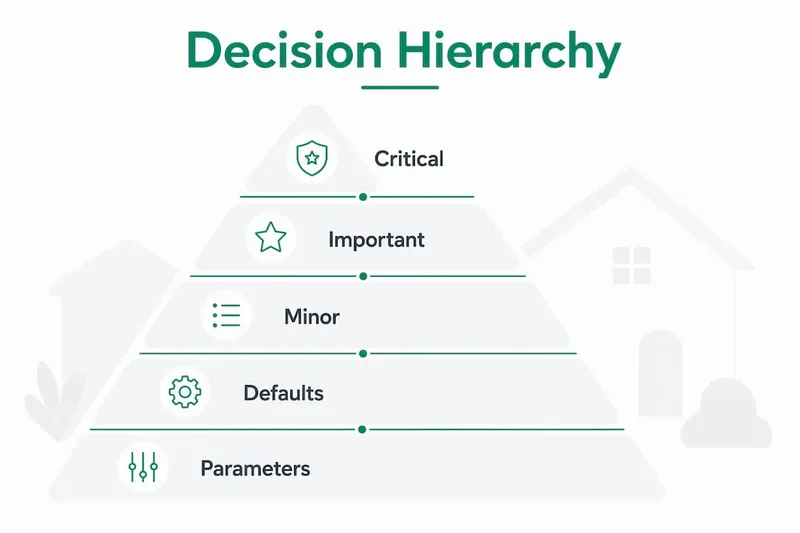
Apply your full attention to critical decisions. Use parameters and defaults for minor ones. Important decisions sit in the middle: worth a decision window, not worth a week of deliberation.
Decision log template
| Item | Choice made | Rationale | Date decided | Deadline | Supplier/source | Who decided |
|---|---|---|---|---|---|---|
| Kitchen floor tile | Porcelain, light grey | Neutral, easy to clean, within budget | — | Before groundworks | — | — |
| Worktop | Quartz, white with grey veining | Durable, matches units | — | 8 weeks before fit | — | — |
Copy this structure into a shared document or a planning tool and add a row for every open decision. The 'rationale' column is the most important field: a two-line note on why you chose something prevents second-guessing three months later.
Contractor request script
When a contractor asks for an on-the-spot decision, use this response: "I need to check that against my selections log. I will confirm by [specific date, within your next decision window]." If the decision is genuinely urgent and affects the order of work, escalate it to your designer or project manager rather than approving it under pressure.
Pro Tip: Photograph every sample, swatch, and product page you consider, and store them in a single folder labelled by room and category. When you return to a decision after a break, the photograph replaces the need to re-research from scratch.
When should you stop deciding and hire a professional?
Delegation is not a concession; it is a cost-benefit calculation. The question is whether your time and mental health are worth more than the fee.
Consider hiring a professional when any of the following apply:
- You have spent more than two hours on a single minor decision without resolution.
- A decision involves technical risk (structural, electrical, or plumbing implications) you cannot confidently assess.
- Delayed decisions are holding up contractors and generating additional day-rate costs.
- You are experiencing physical symptoms of stress: disrupted sleep, persistent irritability, or difficulty concentrating on work outside the project.
- The project is a heritage or listed property with additional regulatory constraints that multiply the decision load.
In the UK, an interior designer hired on an hourly basis typically charges £60–£150 per hour for a parameter-setting consultation. A single two-hour session that narrows your tile shortlist from 40 options to 4 is often more cost-effective than the hours you would spend researching independently, and hiring a designer even briefly reduces the options a homeowner must evaluate before visiting a showroom. For owner-builders managing the full project, the additional decision load is substantially higher than most people anticipate before they start.
A project manager or principal contractor who takes responsibility for day-to-day site decisions removes the reactive approval problem entirely. This is worth considering for projects above £50,000 or those running longer than three months.
Red flags that indicate it is time to hand over decisions:
- Your contingency budget is being spent on scope changes driven by indecision, not genuine surprises.
- You are avoiding contractor calls or emails because you do not want to face the questions.
- Relationships at home are under sustained strain from project-related disagreements.
Accepting sunk costs and bringing in a professional to resolve a stalled phase often protects both mental health and total project cost. Continuing to manage decisions you are no longer equipped to make clearly is rarely the cheaper option.
Wellbeing and communication measures that keep stress manageable
Practical household rules matter as much as decision frameworks. Without them, the project colonises every part of your life.
- Designate a construction-free zone. One room, kept clean and project-free, gives you a physical space to recover. This is one of the most consistently recommended tactics from renovation psychologists.
- Set contractor contact hours. Agree with your builder that calls and messages are handled between 8 AM and 5 PM on working days. Out-of-hours messages can wait for the morning decision window.
- Protect at least one decision-free day per week. Saturday or Sunday with no project discussion, no showroom visits, and no contractor messages.
- Schedule weekly project updates. A 30-minute check-in with your contractor, covering progress, upcoming decisions, and any issues, prevents the accumulation of unresolved questions. Regular check-ins and advance review of upcoming decisions are strong predictors of a lower-stress renovation experience.
- Agree an escalation path. Define in advance which decisions you make, which your contractor makes, and which require both parties. Ambiguity about who decides what generates repeated conversations.
- Celebrate milestones. Completing a phase, not just the whole project, deserves acknowledgement. A meal out after the structural work is signed off costs nothing significant and restores perspective.
Pro Tip: Keep a shared decision log with your partner or co-owner. Divergent preferences are much easier to resolve in a scheduled session than in a corridor conversation at 9 PM when you are both tired.
Pro Tip: If you are living at home during the renovation, establish a temporary kitchen or utility space from day one. Losing basic domestic routines amplifies stress and reduces the mental bandwidth available for project decisions.

How a single planning tool can reduce your decision volume
The practical problem with scattered decisions is that you repeat work. You research the same tile twice because the first search is buried in an email. You ask your contractor the same question because the answer is in a WhatsApp thread you cannot find. Centralising everything in one place removes that redundancy.
A planning tool that consolidates your budget, selections, and communications does several things that directly reduce decision fatigue:
- Prevents redundant research by storing every selection with its rationale, supplier, and cost in one searchable log.
- Surfaces budget ceilings automatically so you never evaluate options outside your range.
- Tracks outstanding decisions so you can see at a glance what needs to be resolved before the next contractor visit.
- Supports visual moodboards that let you confirm finish families before committing to individual products.
- Enables contractor collaboration so that approvals, queries, and confirmations live in one thread rather than across multiple channels.
House A-Z is built specifically for this workflow. Its AI agents narrow options to a manageable set based on your budget, preferences, and timeline, which addresses the option-overload problem directly. Users of the platform have reported saving significant sums by catching specification errors before they reached the build stage. The platform's shared home renovation vision tools also help couples and co-owners align on parameters before decisions become contentious.
For projects where hidden costs are a concern, having budget tracking integrated with your decision log means every selection is evaluated against your actual remaining budget, not a mental estimate.
Key takeaways
Renovation decision fatigue is a structural feature of projects, not a personal failing; the most effective solutions combine staged sequencing, strict parameters, and a single centralised record of every choice made.
| Point | Details |
|---|---|
| Sequence before you shop | Confirm structural and long-lead decisions before selecting any finishes or fixtures. |
| Parameters cut options dramatically | Defining budget ceilings and finish families before browsing can reduce options from approximately 80 to around 8. |
| Decision windows protect quality | Schedule fixed selection sessions and refuse ad-hoc approvals outside them to maintain judgement. |
| Defaults free up mental bandwidth | Set minimum acceptable standards for minor items and commit to the first option that meets them. |
| House A-Z centralises the process | The platform consolidates budget tracking, decision logs, and AI-suggested options to reduce repeated research. |
The real cost of renovation overwhelm
Most renovation guides treat decision fatigue as a side effect of a big project. The more useful framing is that it is a predictable, manageable risk, and one that has a direct financial cost.
When judgement degrades, homeowners approve changes they would not have accepted in a clearer state of mind. Scope creep accelerates. Finish choices get made to end the discomfort of choosing rather than because they are right. Contractors fill decision gaps with their own defaults, which may not match the brief. The result is a project that costs more and delivers less than it should.
The process-first approach described in this article, sequencing, parameters, decision windows, defaults, and a single source of truth, is not about making renovation easier in a vague sense. It is about protecting the quality of the decisions that actually determine whether the project succeeds. A renovation that finishes on budget and on brief is almost always one where the important decisions were made early, calmly, and with a clear record of why.
Useful sources
The following sources informed this article and provide further reading on renovation decision-making, project psychology, and practical planning.
| Source | What it covers | Relevant sections |
|---|---|---|
| Renoversity: avoiding decision fatigue in a kitchen renovation | Decision volume statistics, sequencing, and parameter-setting | Why it happens; concrete tactics |
| Archaus: avoiding decision fatigue during your renovation | Decision log methodology and single source of truth | Decision templates; concrete tactics |
| Weston Builders: stress-free remodelling | Minimum acceptable standards, defaults, and hiring professionals | Concrete tactics; when to delegate |
| Thomas Custom Builders: managing stress during a renovation | Communication routines and weekly check-ins | Wellbeing and communication |
| House Beautiful: the psychology of renovating | Psychotherapist advice on task focus and sunk-cost acceptance | Concrete tactics; when to delegate |
| The Irish Times: five decision-making strategies | Interiors expert view on critical vs minor decisions | Why it happens; decision hierarchy |
| KTVZ / Stacker: psychology of a stress-free renovation | Construction-free zones and contractor schedule management | Wellbeing and communication; BLUF |
| GetDwell: renovation mistakes homeowners regret most | Common finish regrets and minimum acceptable standards | Concrete tactics |
| House A-Z agents page | Platform for centralised decision logging and AI-guided planning | Promo; how software can help |