
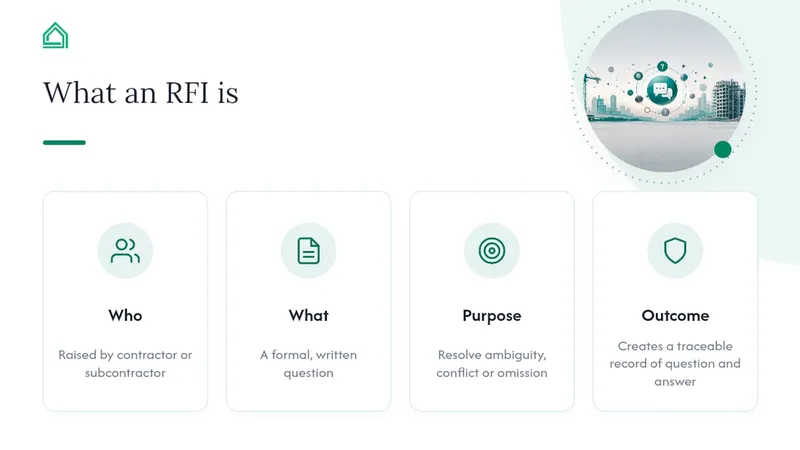
A request for information (RFI) is a formal, written question raised on a construction project to resolve ambiguity, conflict, or omission in the contract documents. If you are facing an unclear drawing, a missing dimension, or a scope split that nobody has defined, raise an RFI now rather than making an assumption. Use the template in the "Essential fields for an RFI" section below, and follow the six-step workflow in "Step-by-step RFI workflow" to process it correctly.
Key takeaways
A well-managed RFI process protects your programme, your cost, and your contractual position — raise every ambiguity in writing, log it centrally, and convert scope-changing responses into formal variations without delay.
| Point | Details |
|---|---|
| Raise RFIs early | Link every RFI to the affected programme activity and request a response before the critical path is threatened. |
| Use the standard template | Include drawing ref, precise question, proposed solution, and programme impact to get faster, cleaner responses. |
| Log centrally and distribute | Update the RFI log immediately on response and notify all affected trades, not just the originator. |
| Convert scope changes promptly | Any RFI response that changes scope must be followed by a formal variation or NEC4 compensation event notification. |
| House A-Z for RFI management | House A-Z consolidates templates, logs, and cost tracking so RFI responses are captured alongside budget and programme data. |
Table of Contents
- What is a request for information in construction?
- When should you raise an RFI?
- Who raises RFIs and who must respond?
- Essential fields for an RFI and a UK-ready template
- Step-by-step RFI workflow: raise, log, review, respond, distribute, close
- What types of RFIs will you encounter on site?
- How do RFIs differ from submittals, RFPs, and change orders?
- How RFIs interact with JCT and NEC contracts in the UK
- Best practices to reduce RFI volume and red flags to watch for
- The RFI pitfalls that actually cost projects money
- How House A-Z helps you manage the RFI lifecycle
- Sources
- FAQ
What is a request for information in construction?
An RFI is not a casual query. It is a formal, documented question that creates a traceable record of the problem, the question asked, and the answer given. The contract documents — drawings, specifications, schedules of work — are rarely perfect. Gaps, contradictions, and ambiguities appear on almost every project, and the RFI is the mechanism that resolves them without stopping work or creating undocumented verbal agreements.
Three things make an RFI worth raising:
- The contract documents cannot answer the question. If the answer is already in the specification or on another drawing, an RFI is unnecessary — check the documents first.
- The ambiguity affects cost, programme, or quality. A question that has no bearing on any of these can often be resolved informally; one that does must be documented.
- A written record is needed. RFIs protect all parties. The contractor has evidence that a question was raised; the design team has a record of the answer given; the employer can see the full picture if a dispute arises.
Typical scenarios where an RFI is appropriate include:
- A structural drawing shows a beam at 450 mm depth, but the architectural drawing shows 300 mm at the same location.
- A specification calls for a particular proprietary sealant that is no longer manufactured.
- The contract drawings show a wall but do not indicate which trade is responsible for the blockwork versus the plasterboard lining.
- A site condition (unexpected ground conditions, an existing service not shown on drawings) differs materially from what the documents described.
CMAA's analysis confirms that unmanaged RFIs increase both schedule and cost risk. Raising them promptly and logging them centrally is the single most effective control.
When should you raise an RFI?
Not every question warrants an RFI. The decision rule is straightforward: if the answer is in the documents, find it; if it is not, raise an RFI before proceeding.
Common triggers:
- Conflicting information between drawings, specifications, or schedules
- Missing dimensions, details, or finishes on construction drawings
- Ambiguous scope boundaries between trades or packages
- Unforeseen site conditions that differ from the contract description
- Regulatory or approval requirements that the documents do not address
- Material substitutions where the specified product is unavailable
When an RFI is not the right tool:
A verbal clarification is fine for minor, low-risk questions that have no cost or programme implication and where both parties agree the answer is obvious. A submittal is the correct route when you need approval of a product, shop drawing, or sample — not a question about the specification. A formal instruction or variation is needed when the employer or design team wants to change the scope; an RFI cannot authorise additional work.
Timing matters. Raise RFIs as early as possible, ideally during pre-construction or at the start of the relevant work package. An RFI raised two days before a schedule-critical pour is far more damaging than one raised three weeks out. Link every RFI to the programme activity it affects so the project manager can assess float and escalate if necessary.
Who raises RFIs and who must respond?
Ownership of the RFI process is clear in principle, though it often blurs in practice.
Originators:
- Subcontractors identify a conflict or gap and raise an RFI to the main contractor (GC).
- The main contractor reviews it, adds context or a proposed solution, and forwards it to the design team or employer.
- In design-and-build contracts, the contractor's own design team may raise internal clarification RFIs before issuing a formal response to a subcontractor.
Responders:
- The architect or engineer of record is typically the first point of contact for design and drawing queries.
- Specialist consultants (structural, mechanical, electrical) answer RFIs within their discipline.
- The employer or their representative responds to commercial or scope-boundary questions that fall outside the design team's remit.
NCARB's guidance on construction evaluation sets out the design professional's role in reviewing technical queries during construction — a useful reference for understanding what a thorough RFI response should contain.
Distribution and log management:
Once a response is received, the main contractor must:
- Update the RFI log with the response date, responder, and outcome.
- Distribute the response to all affected trades, not just the originator.
- Flag any cost or programme impact for the contract manager to assess.
- Notify the project manager if the response triggers a potential variation.
Pro Tip: Insert a contractual response window into your RFI template — for example, "Response required within 10 working days" — and state the consequences of non-response (e.g. the contractor will proceed on the basis of their proposed solution). This creates a clear follow-up trigger and supports any future entitlement claim.
Essential fields for an RFI and a UK-ready template
A well-structured RFI gets answered faster and generates fewer clarification cycles. Every field below serves a specific purpose; omitting any one of them typically adds a round of back-and-forth.
| Field | Purpose |
|---|---|
| RFI number | Unique sequential reference for the log and cross-referencing |
| Project name and reference | Identifies the contract; essential for multi-project offices |
| Date raised | Starts the response clock; used in claims evidence |
| Raised by | Name, company, and role of the originator |
| Drawing / spec reference | Pinpoints exactly where the ambiguity appears |
| Precise question | One clear question; avoid bundling multiple issues |
| Attachments | Marked-up drawing, photo, or extract that illustrates the issue |
| Proposed solution | Contractor's suggested resolution; speeds up the response |
| Cost impact | Estimated additional cost if the question is not resolved as proposed |
| Programme impact | Number of days' delay if the response is not received by the requested date |
| Requested response date | Tied to the programme; not arbitrary |
| Response | Completed by the responder; references any revised drawing or instruction |
| Closed date | Date the RFI is formally closed and the log updated |
Sample RFI text:
RFI-0042 | Elmwood Road Extension | 14 March 2026
Raised by: J. Patel, Site Manager, Redstone Contractors Ltd
Drawing ref: SK-S-104 Rev B / Spec Section 05 12 00
Question: Drawing SK-S-104 Rev B shows the primary steel beam at 450 mm overall depth. Specification Section 05 12 00, Clause 3.2, states 300 mm. Please confirm the correct depth and issue a revised drawing if required.
Proposed solution: Proceed with 450 mm depth as shown on the structural drawing, which aligns with the structural engineer's load calculations in the tender report.
Programme impact: Steel fabrication lead time is 4 weeks. Response required by 28 March 2026 to avoid delay to the frame erection start on 25 April 2026.
Cost impact: Nil if 450 mm confirmed. Additional cost to be assessed if 300 mm is required (revised fabrication).
Checklist — must-include items:
- One drawing or spec reference per RFI (not a vague "see drawings")
- A single, specific question
- At least one attachment (marked-up drawing or photograph)
- A proposed solution wherever possible
- A requested response date tied to the programme
ProjectManager's contractor guide confirms these fields as the standard minimum for a well-formed RFI. For guidance on reading the drawings you are referencing, the House A-Z guide to architectural plans is a practical starting point.
Step-by-step RFI workflow: raise, log, review, respond, distribute, close
A consistent process prevents RFIs from stalling in someone's inbox. The six steps below apply whether you are using a paper log, a spreadsheet, or dedicated project management software.
Identify and document the issue. The originator records the ambiguity with a drawing reference, a photograph, and a proposed solution. Do not proceed with the work until the RFI is raised if the issue affects structural, safety, or cost-critical elements.
Assign an RFI number and log it. Add the RFI to the central log immediately, with status "Open." The log is the single source of truth — every team member should have read access.
Review and forward. The main contractor's site manager or contract manager reviews the RFI for completeness before forwarding it to the design team or employer. Incomplete RFIs (missing references, vague questions) are returned to the originator at this stage, not after the design team has spent time on them.
Respond. The design professional or employer representative provides a written response, referencing any revised drawing, specification clause, or instruction issued. NCARB's construction evaluation guidance describes the design professional's responsibility here. Typical response windows range from 5 to 14 working days depending on complexity; set the window contractually rather than leaving it open.
Distribute and update the log. The main contractor distributes the response to all affected trades and updates the log with the response date, responder, and outcome. Status moves to "Responded" or "Closed" as appropriate. If the response triggers a potential variation, status is "Action Required" and the contract manager is notified.
Close or escalate. If the response is clear and accepted, the RFI is closed. If it raises further questions or confirms a scope change, the RFI remains open and a formal instruction or variation is initiated. CMAA's research recommends centralised logging and early prioritisation as the primary controls for reducing RFI-driven schedule risk.
Status labels to use in your log:
- Open — raised, not yet forwarded or under review
- Under review — with the design team or employer
- Responded — answer received, distribution pending
- Clarification needed — response received but insufficient; follow-up sent
- Closed — accepted, distributed, and logged
What types of RFIs will you encounter on site?
Classifying an RFI at the point of raising it helps you route it to the right responder and set the right level of urgency.
Design clarification RFI. The most common type. A drawing or specification is ambiguous, contradictory, or silent on a detail. Route to the architect or engineer of record. Example phrasing: "Drawing X shows Y; specification clause Z states W. Please confirm which takes precedence and issue a revised document if required."
Material or specification RFI. A specified product is unavailable, discontinued, or unsuitable for the site conditions. Route to the architect or specification writer, with the proposed substitute and its technical data sheet attached. Finish-selection queries — for example, where a trade supplier's product range has changed — often fall here; trade programme resources can help identify compliant alternatives to attach as supporting evidence.
Site condition RFI. Actual ground, structural, or service conditions differ from the contract documents. Route to the engineer of record and the employer's representative simultaneously. Include photographs, survey data, and a clear description of the discrepancy. These RFIs carry the highest cost and programme risk.
Scope or trade boundary RFI. The contract is silent on which trade or package is responsible for a specific element. Route to the contract manager or employer's representative. Example phrasing: "The contract drawings show [element] but do not allocate responsibility. Please confirm whether this falls within Package A or Package B."
Schedule or timing RFI. A sequence, access date, or handover condition is unclear or conflicts with the programme. Route to the project manager. Include the affected programme activity and the float available.
Regulatory or approval RFI. A detail may not comply with Building Regulations or a planning condition. Route to the design team and flag to the employer. The Gov is the primary reference for statutory requirements in England and Wales.
How do RFIs differ from submittals, RFPs, and change orders?
Using the wrong document type creates confusion, delays, and sometimes contractual exposure. The table below sets out the key distinctions.
| Document | Purpose | Typical content | Who initiates |
|---|---|---|---|
| RFI | Resolve ambiguity in contract documents | Question, drawing ref, proposed solution, impact | Contractor or subcontractor |
| Submittal | Confirm materials and methods meet the specification | Shop drawings, product data, samples | Contractor |
| RFP / RFQ | Invite pricing or proposals before contract award | Scope description, pricing schedule | Employer or procurement team |
| Instruction / AI | Direct the contractor to carry out specific work | Written instruction referencing the contract | Employer or design team |
| Variation / change order | Formally change the scope, cost, or programme | Revised scope, agreed cost, programme impact | Employer or contractor (by agreement) |
Construction submittals) — shop drawings, product data, and samples — confirm that materials and installation methods meet the specification. An RFI asks a question; a submittal provides evidence of compliance. The AIA's submittal guidance notes that the contractor carries responsibility for managing submittal timing and coordination, which is a separate obligation from the RFI process.
Common traps to avoid:
- Raising an RFI to request approval for a design change — that requires a formal instruction or variation.
- Using an RFI to substitute a product without providing a technical data sheet — that is a submittal.
- Treating an RFI response as authorisation to proceed with additional work — a response that creates scope change must be converted into a variation before work starts.
- Bundling multiple unrelated questions into one RFI — this delays the response and makes the log unmanageable.
How RFIs interact with JCT and NEC contracts in the UK
Neither the JCT suite nor NEC4 uses the term "RFI" as a defined contract mechanism, but both create the conditions that make RFIs necessary and both have provisions that govern how ambiguities and instructions are handled.
Under JCT contracts (Design and Build 2016, Standard Building Contract 2016), the architect or contract administrator has a duty to issue further drawings and information as reasonably necessary. If the contractor identifies an ambiguity or discrepancy, they are typically required to notify the contract administrator in writing. That written notification is, in practice, an RFI. The contract administrator's written response may constitute an instruction, which can give rise to a variation. Keeping the RFI and the instruction as linked documents in your log is therefore critical for preserving entitlement.
Under NEC4, the Early Warning Notice (EWN) and the Compensation Event mechanism are the formal routes for notifying matters that affect cost, time, or quality. An RFI sits alongside these mechanisms: it resolves technical ambiguity, but if the resolution changes the Scope, a Compensation Event notification should follow. NEC4's emphasis on early warning and collaborative problem-solving means that RFIs raised promptly and with a proposed solution are well-aligned with the contract's intent.
Pro Tip: In your project execution plan or pre-construction meeting minutes, agree and record the contractual response window for RFIs (typically 5–14 working days), the distribution list, and the escalation route if a response is not received on time. This single step prevents the most common RFI dispute: disagreement over whether a response was required and when.
Record-keeping is the practical priority. Every RFI, response, and associated instruction should be stored in a single, date-stamped log. If an RFI response creates a change, the RFI number should appear in the variation or compensation event record. For projects subject to Building Regulations, the gov.uk building regulation guidance remains the authoritative reference for statutory compliance obligations that may arise from an RFI response.
Best practices to reduce RFI volume and red flags to watch for
The most effective RFI management happens before the first RFI is raised.
Preconstruction checks that reduce RFI volume:
- Conduct a formal document review at tender stage: check for conflicts between drawings and specifications, missing details on schedule-critical elements, and undefined scope boundaries.
- Run a clash detection exercise on BIM models or overlay drawings before mobilisation.
- Clarify scope ownership during subcontract buyout — many RFIs arise from trades assuming another package covers an element.
- Issue a pre-construction RFI log to the design team with all identified gaps; resolve them before work starts rather than during construction.
Industry guides consistently show that catching scope gaps before construction reduces downstream RFIs and change orders significantly.
Writing RFIs that get answered quickly:
- One question per RFI, always.
- Reference the specific drawing revision and specification clause, not just the drawing number.
- Attach a marked-up PDF or photograph — practical templates and photo documentation reduce clarification cycles.
- State a proposed solution; responders are far more likely to confirm a solution than to generate one from scratch.
- Set a realistic requested response date tied to the programme, not an arbitrary deadline.
Red flags that predict disputes or delays:
- RFIs raised on the critical path with fewer than five working days before the affected activity starts.
- RFIs with no drawing reference or specification clause — these indicate the originator has not checked the documents.
- Repeated RFIs on the same topic, which suggests a systemic document quality problem or a failure to distribute previous responses.
- RFIs that remain "Under review" beyond the agreed response window without escalation.
- A sudden spike in RFI volume mid-project, which often signals a scope gap or a design change being managed informally.
Process controls:
- Maintain a single, shared RFI log — not one per trade or per discipline.
- Use a standard template so every RFI contains the minimum required fields.
- Review the RFI log weekly in site progress meetings and escalate overdue items.
- For projects with a construction draw schedule, align RFI response deadlines with draw approval milestones to avoid funding delays.
The RFI pitfalls that actually cost projects money
The most damaging RFI failures are not the ones that get raised late. They are the ones that never get raised at all.
On many projects, site teams absorb ambiguity rather than document it. A foreman makes a reasonable assumption, work proceeds, and the assumption turns out to be wrong. By the time the error surfaces, the cost of correction is ten times what a two-day RFI response would have cost. The reluctance to raise RFIs often comes from a misplaced concern about appearing difficult or slowing the job down. The opposite is true: a well-run RFI process is a sign of a well-run project.

The second pitfall is the bundled RFI. Grouping three unrelated questions into one document to save time is counterproductive. Each question goes to a different responder, the response is delayed by the slowest answer, and the log becomes unmanageable. One question, one RFI, every time.
The third pitfall is the RFI that substitutes for a variation. When a design team responds to an RFI by effectively changing the scope, some contractors accept the response and proceed without converting it into a formal variation. The cost and programme impact disappears from the record. Months later, when the final account is disputed, the evidence is gone. Every RFI response that changes scope must be followed immediately by a variation or compensation event notification. The change order management guide on the House A-Z blog covers this workflow in detail.
Pro Tip: At the start of every project, run a one-hour document review session with the site manager, contract manager, and lead subcontractors. Work through the drawings and specification together and raise all identified RFIs before mobilisation. This single session typically surfaces the issues that would otherwise become critical-path delays.
Sources
FAQ
What is a request for information in construction?
An RFI (request for information) is a formal, written question raised by a contractor or subcontractor to resolve an ambiguity, conflict, or omission in the contract documents. It creates a traceable record of the question and the answer, protecting all parties if a dispute arises.
Can you give a construction RFI example?
A typical example: a structural drawing shows a steel beam at 450 mm depth, but the specification states 300 mm at the same location. The contractor raises an RFI referencing both documents, proposes proceeding with 450 mm, and requests a response before the fabrication deadline.
Who submits RFIs in construction?
Subcontractors typically raise RFIs to the main contractor, who reviews them and forwards them to the design team or employer. In design-and-build contracts, the contractor's own design team may raise internal RFIs before responding to subcontractors.
How long does the RFI process take?
Response windows typically range from 5 to 14 working days depending on complexity. The window should be agreed contractually at the start of the project and tied to the programme so that critical-path activities are not delayed by an unanswered RFI.
How does an RFI differ from a change order?
An RFI asks a question to clarify the existing contract documents; it does not authorise additional work or cost. A change order (or variation under UK contracts) formally amends the scope, cost, or programme. If an RFI response confirms a scope change, a separate variation must be raised before work proceeds.