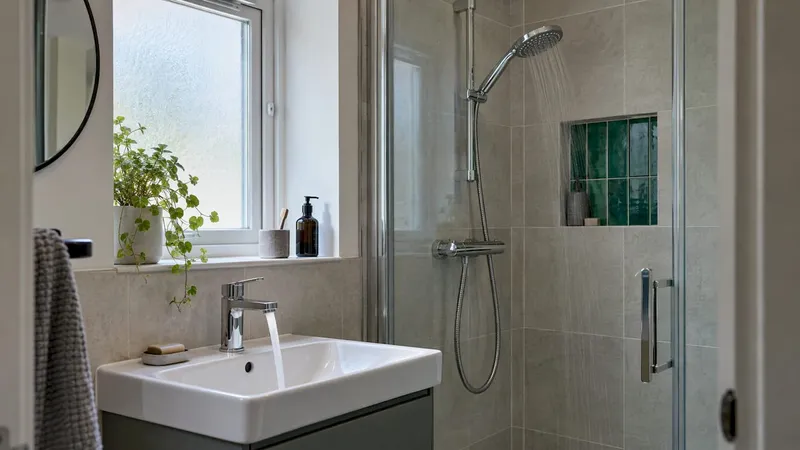
The water saving fixtures that matter most in a UK home are an efficient toilet, a low-flow shower and aerated taps, because the bathroom is where most indoor water goes. The best moment to choose them is while you are planning the build or renovation, when swapping a model costs a line in the budget rather than a second plumbing job. With House A-Z you can put each fixture, its price and its rough-in measurements on one project plan before you buy anything.
TL;DR
- Toilets, showers and taps are the big three. The University of Nebraska–Lincoln Extension ranks toilet, shower or bath and clothes washer as the top household water users, with taps and dishwashers next.
- Compare by litres per minute (showers, taps) and litres per flush (toilets), not by marketing words. Flow class 1 under the Unified Water Label means 6 L/min or less.
- New homes in England must be designed to a calculated 125 litres per person per day under Part G, and a tighter limit has been proposed.
- Check pressure, rough-in positions and a thermostatic valve before you fall in love with a showerhead.
- Put the fixtures in your budget and schedule early, so they are chosen once, not twice.
Table of Contents
- Where the water actually goes
- The fixtures that make the difference
- How to compare products like for like
- What the rules say for a new build
- Checks before you buy or install
- Does it pay back?
- Fitting fixtures into the budget and the schedule
- Our view: choose fixtures once, in the plan
- Plan your fixtures with House A-Z
- FAQ
- Sources
Where the water actually goes
Before picking products, it helps to know what you are aiming at. The US EPA reports that bathrooms account for more than half of household indoor water use, and that toilets are the largest single source at nearly 30% of average indoor use. Those are American averages, but the ranking of toilet, shower and taps is the same story the Nebraska guide tells, and it holds for most homes.
This is good news for anyone planning works. You do not need to rethink the whole house. Three or four decisions in one room deliver most of the saving, and they happen to be decisions you are making anyway when you renovate a bathroom.
There is a second reason to care. Hot water costs energy as well as water. The EPA notes that lower water-heating demand from efficient faucets can save energy equivalent to running a hairdryer for 17 minutes a day over a year, so a fixture that uses less water often trims the heating bill too.
The fixtures that make the difference
Toilets
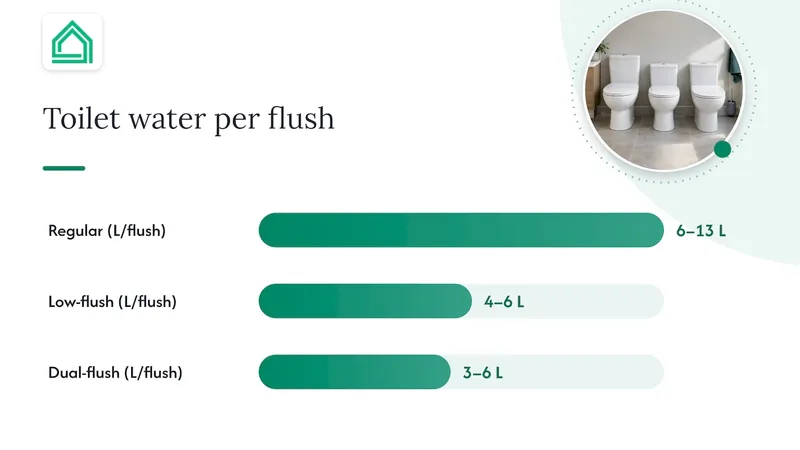
Older toilets are the biggest prize. The Eawag Circular Sanitation Toolbox (2025) puts regular toilets at roughly 6 to 13 litres per flush, low-flush at 4 to 6 litres and dual-flush at 3 to 6 litres. A dual-flush toilet gives you a small flush for liquid waste and a larger one for solid waste, which is why its average sits lower. The Arizona Department of Water Resources lists 0.8 to 1.2 gallons for the reduced flush and 1.6 gallons for the full flush in its examples.
In the US, the EPA estimates that replacing old toilets with certified efficient ones saves an average family 20 to 60% of toilet water, nearly 13,000 gallons a year. Those savings come from replacing very old, high-volume toilets, so they are the top of the range rather than the typical UK result. For a UK home with a 1990s cistern, the gap can still be large.
Showers
Showers are where flow rate varies most. Eawag reports low-flow showerheads at 6 to 9 L/min against 12 to 20 L/min for regular ones. There are two main designs. Aerating showerheads mix air into the water, and streamline models form separate jets; the US Department of Energy describes both as low-flow approaches.
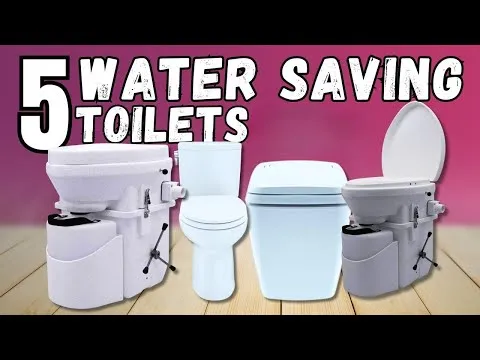
The EPA estimates that swapping to an efficient showerhead saves an average family more than 2,700 gallons of water and $70 in water and electricity costs per year. In Ireland, the 2025 An Fóram Uisce report estimates an efficient shower saves about 8.4 litres per person per day, worth up to €160 a year in homeowner savings, under its own stated assumptions about water prices.
Taps
Taps are the cheapest upgrade. Eawag lists low-flow taps at 5 to 8 L/min against 10 to 15 L/min for regular ones, and an aerator, a small fitting that mixes air bubbles into the stream, keeps the pressure feeling normal. The EPA says efficient bathroom faucets flow at no more than 1.5 gallons per minute against a standard 2.2, a cut of at least 30% without sacrificing performance. The same document trail, in its bathroom guide, sets a floor too: efficient faucets must still deliver a usable flow at low pressure, so you are not trading comfort for savings.
Baths
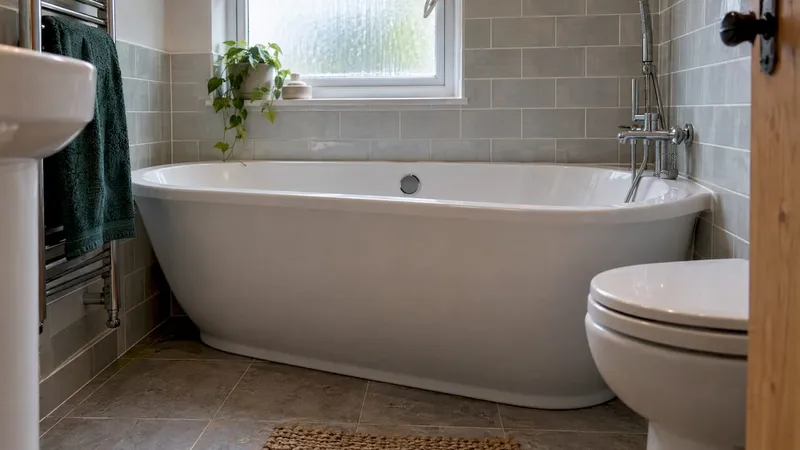
A bath is a fixture people forget. The Unified Water Label groups baths by measured capacity: band 1 is 155 litres or less, up to band 5 above 200 litres. The same criteria estimate that effective capacity is about 40% of the measured figure, because your body displaces water. So a bath that looks huge may hold less usable water than you think, and a shallow, well-shaped one can use noticeably less than a deep tub.
How to compare products like for like
Product pages are full of adjectives. Numbers are what let you compare.
| Fixture | What to look for | Reference figure |
|---|---|---|
| Shower | Maximum flow in L/min, spray coverage | Class 1 label: 6 L/min or less |
| Basin tap | Flow in L/min, aerator fitted | Low-flow range: 5 to 8 L/min |
| Toilet | Litres per flush, full and reduced | Dual-flush: 3 to 6 L |
| Bath | Measured capacity | Band 1: 155 L or less |
The Unified Water Label's taps and showers criteria use flow classes: class 1 at no more than 6 L/min, class 2 at 8, class 3 at 10, class 4 at 13 and class 5 above 13. Showers are also assessed for spray coverage, spray pattern and dripping, so a low number should come with a spray that still feels like a shower.
The UK is moving this way too. GOV.UK has announced that toilets, basin taps and showers will carry water efficiency labels alongside dishwashers and washing machines. Check the official page for the current rollout stage, because the timetable has moved before. Until labels are everywhere, the datasheet is your friend: look for the flow in litres per minute and the flush volumes.
What the rules say for a new build
If you are building, you are not choosing in a vacuum. Part G of the Building Regulations for England sets a calculated water use of 125 litres per person per day for new dwellings, with an optional tighter 110 litres where planning requires it. The calculation adds up the flow and flush figures of the fixtures you specify, which is why your tap, shower and toilet choices matter to your building control sign-off.
Proposals announced in September 2025 would lower those limits to 105 and 100 litres per person per day. Check the government's current Approved Document G for the version in force when you submit. Scotland, Wales and Northern Ireland have their own building regulations, so confirm yours with your local building control.
If you are thinking beyond fixtures, reusing bathwater is the next step up. This guide to greywater recycling in a detached house explains how it works in a new build, and it is easiest to plan before the pipework is laid.
Checks before you buy or install
This is where first-time renovators lose money. A fixture that saves water but does not fit, or does not work at your pressure, ends up costing more.
- Measure the existing fixture first. The EPA recommends starting by checking each fixture's flow rate or flush volume, and addressing leaks and wear, since age and deterioration magnify waste. Knowing your starting number tells you what a new fixture really saves.
- Fix leaks before anything else. A dripping cistern or tap undoes the benefit of an efficient model. This overview of hidden dangers of small leaks shows why a small drip is worth chasing.
- Confirm your water pressure. Low-pressure homes, such as those with a gravity-fed tank, need showers designed for them. Look for products that state a working range rather than a single flow figure.
- Plan the mixing. The EPA advises ensuring a replacement showerhead flows through a thermostatic mixing valve, which reduces the risk of scalding or thermal shock when the flow changes.
- Check the dimensions of the toilet. Rough-in distance, base size and cistern height decide whether a toilet fits your layout. Our guide to plumbing rough-in heights lists the standard measurements, and the bathroom layout rules cover clearances and the planning order.
- Buy the right size of shower system. Multi-head systems can use a lot of water and energy, so count the outlets before you count the savings.
Does it pay back?
Water-saving fixtures pay back differently depending on whether you are on a meter, what your supplier charges and how many people use the bathroom. The Irish An Fóram Uisce report estimates that an efficient tap saves about 5 litres per person per day in a four-person home and pays back in 1.1 years under its price assumptions. The US figures above are even larger for old toilets.
Your own result depends on your bill, so work from your own numbers: the litres your current fixtures use, your household size and your supplier's tariff. The fixture price difference is small when you are already buying a new bathroom, which is the strongest argument for choosing efficient models at the planning stage rather than retrofitting later.
Fitting fixtures into the budget and the schedule
A water-saving tap or showerhead rarely breaks a budget. The trouble is the surprise: a toilet that does not match the waste position, a shower that needs a new valve, a delivery that arrives after the tiler has gone. Those are planning problems, not product problems.
Treat the fixtures as line items from the start. Our bathroom remodel steps in the correct order shows where first fix plumbing sits relative to tiling and fitting, the project plan and Gantt guide helps you place deliveries, and the UK bathroom renovation cost guide gives you a price framework. If you want to catch measurement errors before they reach the plumber, room mapping from tape to LiDAR is a good place to begin, and the four-step workflow for tracking a renovation budget keeps the spend visible.
Our view: choose fixtures once, in the plan
Most people meet water-saving fixtures at the wrong moment: at the tile shop, with the plumber booked for Monday. That is when a flow rate becomes a stress rather than a choice.
We built House A-Z for first-time builders and renovators who would otherwise juggle spreadsheets and half a dozen apps. Our platform brings budget tracking, product tracking, room mapping and project management into one place, so the tap, the toilet and the shower sit next to their prices, their measurements and their delivery dates.
Our AI agents work in plain language from your budget, preferences and timeline, and they are designed to flag costly mistakes before they are built into a wall. Efficient fixtures are a perfect example: a small choice made early, which saves money for years and never needs to be redone.
Choose the numbers first, then the style. A bathroom can be beautiful and frugal at once.
Azai
FAQ
Which fixture saves the most water?
For most homes, the toilet is the first place to look, as the EPA puts it at nearly 30% of average indoor use in the US. Replacing a very old, high-volume toilet gives the largest single gain. Showers come next, and taps are the cheapest upgrade.
What is a good flow rate for a water-saving shower?
The Unified Water Label treats 6 L/min or less as its best flow class, and Eawag puts low-flow showerheads at 6 to 9 L/min. Choose a model that states its spray coverage and working pressure, so it still feels good to use.
Are water-saving taps just aerators?
Aerators are the most common method. They mix air into the stream so that pressure feels normal while less water leaves the tap. Some taps are built with them, and they can be fitted to many existing ones.
Do water-saving fixtures matter in a new build?
Yes. In England, new homes must meet a calculated limit of 125 litres per person per day under Part G, and your choice of fixtures feeds that calculation. A tighter limit has been proposed, so specifying efficient fixtures from the start gives you headroom.
Sources
- Your Better Bathroom, US EPA
- Residential Toilets, US EPA
- Bathroom Faucets, US EPA
- Statistics and Facts, US EPA
- Water Efficiency Management Guide Bathroom Suite, US EPA
- Water Wise Water Conservation In The Home, University of Nebraska–Lincoln Extension
- Guide to Home Water Efficiency, US Department of Energy
- Conservation Technologies, Arizona Department of Water Resources
- Circular Sanitation Toolbox, Eawag (2025)
- Taps and Showers technical criteria, Unified Water Label (2024)
- Sanitaryware, urinals and baths technical criteria, Unified Water Label (2024)
- The Value of Water Conservation, An Fóram Uisce (2025)
- Household goods to carry water efficiency labels, GOV.UK
- Approved Document G, GOV.UK
- Water efficiency and the Building Regulations, Designing Buildings
- Greywater recycling in a detached house
- Hidden dangers of small leaks