The best plot to buy is one that already sits within your council's Local Plan allocation, has confirmed legal access, and can connect to mains utilities at a cost you have actually verified. Everything else is potential, and potential is not a planning permission.
Before you view a single site, register with your local council's Right to Build register. Councils are legally obligated to monitor self-build demand and must have regard to it when bringing forward serviced plots. It is one of the most underused routes to finding credible land.
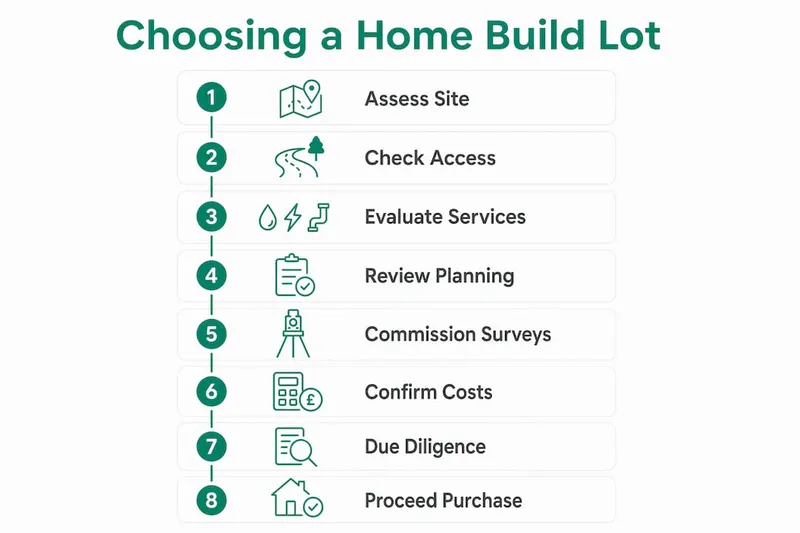
- Check the plot against the Local Plan before you negotiate a price.
- Confirm utility connection costs in writing, not from a listing description.
- Verify legal title and access through a conveyancer before exchange.
- Use the Planning Portal to review the site's planning history.
- House A-Z can help you track every constraint and cost in one place.
Pro Tip: An accepted offer on land is not legally binding. Only exchange of contracts, handled by a solicitor, creates a binding commitment. Never pay a deposit or commission surveys until your conveyancer has reviewed the title.
Table of Contents
- What makes a good home build lot?
- How UK planning rules determine whether you can actually build
- What surveys do you need, and what can they reveal?
- What does buying a plot actually cost, and how long does it take?
- Your due-diligence checklist before exchange
- Questions to ask sellers and agents before you commit
- Red flags that should make you pause or walk away
- What to do once you decide to proceed
- Key takeaways
- The mistake most first-time builders make
- How House A-Z helps you avoid the most costly mistakes
- Useful sources for UK plot research
What makes a good home build lot?
Size and orientation matter more than most buyers expect. A south-facing plot with a gentle gradient reduces both build cost and heating bills. A steeply sloping site can add tens of thousands of pounds in groundworks alone; typical groundworks budgets for a single self-build dwelling vary significantly depending on ground conditions and services connections.
Legal access is non-negotiable. Confirm that access to the public highway is adopted or that a formal right of way exists in the title deeds. A ransom strip, where a third party owns a narrow strip of land between the plot and the road, can block development entirely unless resolved before purchase.
Utility listings that say "available" commonly mean services are nearby, not connected – understanding when planning permission is needed for garden sheds can help clarify small-scale development rights. Water, electricity, and sewage connection costs can range from around £1,000 to over £20,000 depending on distance and whether reinforcement is needed. Get formal quotes from each utility provider before you make an offer.
Ground conditions and drainage deserve early attention. Contaminated land, high water tables, and poor load-bearing strata can each require specialist remediation. Check the site's history: former industrial or agricultural use raises contamination risk. Neighbourhood factors, including school catchments, transport links, and any nearby Local Plan allocations for new development, will affect both your build experience and eventual resale value.
How UK planning rules determine whether you can actually build
Local Plans set the policy tests that planners apply to every application: settlement boundaries, design expectations, and housing targets. A plot outside the settlement boundary in a restrictive Local Plan faces a very different approval probability than one allocated for residential development. Planners judge proposals on policy alignment, not on how much you want to build there.

Outline planning permission establishes whether the principle of development is acceptable. It is valid for three years, within which you must submit reserved matters covering access, appearance, landscaping, layout, and scale. Full planning permission requires detailed drawings and is also valid for three years from approval. Most mortgage lenders prefer full permission before they will release funds, so check your lender's criteria early.
Pre-commencement conditions are attached to many permissions and must be discharged before groundworks begin. Archaeology, ecology surveys, and drainage strategies are common triggers. These can delay a start by weeks or months and carry their own costs.
Pro Tip: Ask the local planning officer for pre-application advice before you exchange. Most councils charge £100–£500 for this service, and the feedback will tell you whether your proposal is likely to succeed before you commit.
What surveys do you need, and what can they reveal?
Commission surveys in priority order, starting with the cheapest desktop checks and escalating only where risk is confirmed.
| Survey | What it reveals | Red-flag result |
|---|---|---|
| Land Registry title review | Ownership, covenants, easements, ransom strips | Missing access rights; restrictive covenant preventing development |
| Local authority planning search | Planning history, refusals, conditions | Multiple refusals for similar proposals |
| Topographic survey | Levels, boundaries, gradients | Steep gradients requiring expensive groundworks |
| Phase 1 ground contamination | Historical land use, contamination risk | Former industrial use requiring Phase 2 investigation |
| Flood risk assessment | Flood zone classification | Flood Zone 3 without exception test evidence |
| Preliminary ecological appraisal | Protected species, habitats | Presence of bats, great crested newts, or TPO trees |
| Drainage assessment | Soakage rates, sewer proximity | No viable drainage solution within budget |
Standard legal searches cover planning, drainage and water, environmental risks, and sometimes mining or specialist utilities reports depending on site history. Lenders will usually require all of these before releasing funds.
- Treat a Flood Zone 3 designation as a near-certain showstopper unless a Sequential and Exception Test has already been passed.
- A Tree Preservation Order (TPO) does not prevent building, but it restricts what you can do near protected trees and may limit your footprint.
- Pre-commencement conditions on the Decision Notice must be costed and discharged before you rely on an immediate start date.
Pro Tip: Commission only the surveys that answer your specific planning questions at each stage. Over-engineering a full survey pack before you have confirmed the principle of development wastes budget.
What does buying a plot actually cost, and how long does it take?
Budget categories go well beyond the land price itself.
| Cost category | Typical range | Notes |
|---|---|---|
| Legal fees and searches | — | Conveyancer, Land Registry, local authority searches |
| Surveys (full set) | £1,000 to over £20,000 | Varies by site complexity and number required |
| Planning reports | — | Ecology, flood, highways, heritage as needed |
| Utility connections | £1,000–£20,000+ | Formal quotes essential before exchange |
| Groundworks (self-build) | — | Ground conditions and services are key drivers |
| — | Variable | Check with the council; self-build exemptions may apply |
| Contingency | a significant percentage of total build cost | Non-negotiable buffer |
Regional land prices vary significantly. Lower entry prices in northern England and rural areas can look attractive, but hidden connection and groundwork costs sometimes make a cheaper plot more expensive overall than a serviced plot in a higher-demand area.
On timeline: pre-application advice typically takes two to four weeks. A planning determination runs eight weeks for householder applications and thirteen weeks for major applications, though committee cycles and ecology seasons can extend this. Discharging pre-commencement conditions adds further weeks. Budget six to eighteen months from offer to start on site.
For a detailed breakdown of new build material costs, the House A-Z blog provides practical estimating guidance alongside this planning timeline.
Your due-diligence checklist before exchange
- Instruct a conveyancer to review title, covenants, easements, and access rights.
- Commission a Land Registry title search and check for restrictive covenants or ransom strips.
- Validate the planning decision: confirm permission type, expiry date, and all conditions listed on the Decision Notice.
- Commission priority surveys (Phase 1 contamination, flood risk, preliminary ecological appraisal) based on the site's history and location.
- Obtain formal utility connection quotes from each provider for water, electricity, gas, and sewage.
- Seek pre-application or planning officer feedback on your proposed scheme.
- Instruct a planning consultant if the site has a complex history or sits near a protected designation.
- Confirm mortgage lender criteria: most lenders require full planning permission and specific survey results before releasing self-build mortgage stages.
- Negotiate contract protections: conditional completion linked to planning, longstop dates, and option agreements where permissions are unresolved.
Understanding how building approvals work at each stage will help you sequence these steps correctly and avoid costly delays.
Questions to ask sellers and agents before you commit
Ask for the Decision Notice and check every condition listed on it, including any pre-commencement requirements. Then work through these:
- Is legal access to the public highway confirmed in the title deeds, and is the access road adopted by the highway authority?
- Are services connected to the boundary, or are they simply nearby? Can you provide written connection quotes?
- Is there an overage agreement that would require you to pay the seller a share of any uplift in value after planning is granted?
- Are there any restrictive covenants on the title, and have they been indemnified or released?
- Has any previous planning application been refused on this site, and if so, on what grounds?
- Is there a ransom strip between the plot and the highway?
Red flags that should make you pause or walk away
- No confirmed legal access. A plot without an adopted or legally secured route to the highway cannot be built on without resolving this first.
- Protected designations without a clear exception. Green Belt, AONB, SSSI, and Conservation Area designations do not prevent all development, but they raise the bar significantly. Walk away unless a specialist confirms a credible exception route.
- A history of planning refusals for similar proposals. Check the planning portal for the site address. Repeated refusals on the same grounds are a strong signal the council will refuse again.
- Restrictive covenants preventing development. Some covenants are old and unenforceable; others are actively maintained. Your conveyancer must advise before you proceed.
- Uninsurable contamination. Phase 1 findings that require Phase 2 investigation are not automatic deal-breakers, but contamination that cannot be remediated within budget is.
- Connection quotes that break the budget. Land without permission should be valued as agricultural or amenity land; any planning success is upside, not baseline. The same logic applies to connection costs.
Pro Tip: Do not dismiss a red flag without a specialist opinion. Many issues that look terminal at first glance, such as a TPO or a minor covenant, are resolvable with the right advice. The ones to walk away from are those where the cost of resolution exceeds the value it creates.
What to do once you decide to proceed
Secure the plot with heads of terms or an option agreement if planning permission is not yet in place. An option agreement lets you control the land for an agreed period while you pursue permission, without committing to purchase at full price. If permission is already granted and surveys are satisfactory, conditional contracts linked to the discharge of pre-commencement conditions offer a cleaner route to exchange.
Align your self-build mortgage draw schedule with the construction programme from the outset. Self-build mortgages release funds in stages, typically tied to completion of foundations, wall plate, roof, and fit-out. Understanding how a construction draw schedule works before you exchange prevents cash-flow gaps mid-build.
Instruct your architect to prepare a detailed planning application as soon as exchange completes. Simultaneously, begin discharging any pre-commencement conditions so that groundworks can start without delay once the building permit is in place.
Key takeaways
Choosing the right home build lot comes down to policy alignment, verified costs, and legal protection before exchange.
| Point | Details |
|---|---|
| Check the Local Plan first | Confirm the plot sits within an allocation or has a credible policy exception before negotiating. |
| Verify connection costs in writing | Utility "availability" in listings does not mean connection; costs can vary widely and should be verified with formal quotes. |
| Commission surveys early | Phase 1 contamination, flood risk, and ecological appraisal should precede exchange, not follow it. |
| Use conditional contracts | Option agreements or conditional completion protect you if planning or surveys reveal problems. |
| Use House A-Z to track it all | House A-Z centralises budget tracking, permit guidance, and AI-powered constraint checks in one place. |
The mistake most first-time builders make
The single most common error is treating a plot's "potential" as its value. A field on the edge of a village looks like a future home. Without a Local Plan allocation or a clear exception route, it is agricultural land priced as a dream. Buyers who pay residential land prices for unallocated plots regularly find themselves holding an asset they cannot develop and cannot resell at what they paid.
The reassuring truth is that most genuine obstacles, covenants, pre-commencement conditions, even moderate contamination, are manageable if identified early and handled by the right advisers. The problems that derail projects are almost always ones that were visible in the due-diligence phase but ignored in the excitement of finding a plot. Slow down before exchange. Speed up after it.
Useful sources for UK plot research
- Planning Portal: Submit planning applications, check permitted development rights, and review application histories for any address in England and Wales.
- Local authority planning portals: Search by site address to view Decision Notices, reserved matters, pre-commencement conditions, and neighbour objections.
- Land Registry Price Paid Data: Check what a seller paid for the land and when, which helps you assess whether the asking price reflects genuine market value.
- Council Right to Build registers: Register your interest with your local authority; councils must have regard to self-build demand when bringing forward plots.
- Environment Agency flood maps: Check flood zone classification for any plot before commissioning a full flood risk assessment.
When you find a promising plot, save or screenshot the Decision Notice, all listed conditions, and the title register entries. Hand these to your solicitor at the first meeting. The conditions on a Decision Notice, particularly any pre-commencement requirements, are the documents that most often contain the surprises that delay or derail a build.
This article provides general information for guidance purposes only and does not constitute legal, planning, or financial advice. Confirm current rules and requirements with a qualified solicitor, planning consultant, or the relevant local authority for your specific situation.