A price escalation clause is a term in a building contract that lets the contract price move when specified costs, usually materials, rise (or fall) after you sign. Walker Morris describes it as a way for contractors to pass on increased costs, and it can also let the client share in decreases. For a homeowner, the clause is neither good nor bad in itself. What matters is how tightly it is written: what triggers it, how the change is measured, and where it stops.
This guide walks you through the main types, a worked example, the terms worth insisting on, and the questions to put to your builder before you sign.
TL;DR
- An escalation clause adjusts the contract price when named costs change. A good one covers specific materials, a fixed baseline, a trigger, notice rules, evidence and a cap.
- The three common material forms are day-one, threshold and delay clauses. Threshold clauses leave ordinary price noise with the builder and share only the big jumps.
- As an owner, you want a defined method, a ceiling on your exposure, invoices as proof, and a right to walk away or rethink if the ceiling is hit.
- Without any clause, a prudent builder may price in a contingency instead, so a fair clause can lower the headline quote.
- Pair the clause with a clear selections schedule and a change-order routine so price moves never arrive as a surprise.
Table of Contents
- What a price escalation clause actually does
- Price escalation clause vs material price escalation clause
- Three common ways a clause is triggered
- How the price actually gets calculated
- What a clear clause should specify
- Protecting yourself as the owner
- Questions to ask your builder before signing
- Where escalation meets prime costs, selections and change orders
- Our perspective
- Keeping the numbers in one place
- When a clause is not worth the trouble
- FAQ
- Sources
What a price escalation clause actually does
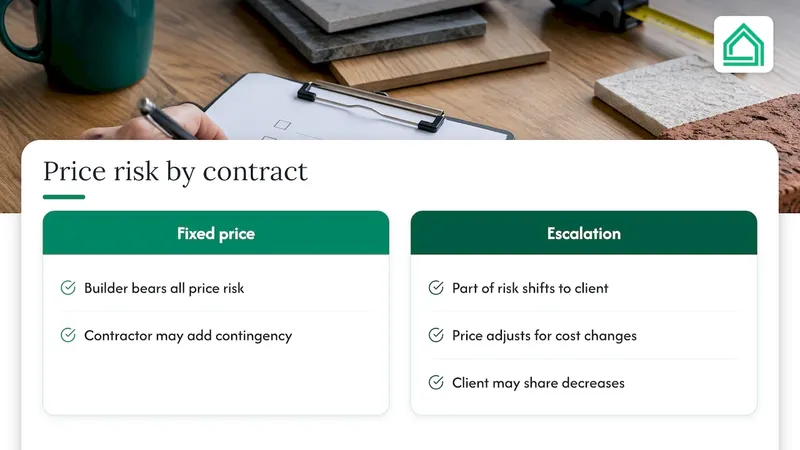
A fixed-price contract puts all the price risk on the builder. An escalation clause moves part of that risk to you, and sometimes the benefit too. The Freshfields guide defines these clauses as mechanisms that adjust the price for changes in materials, fuel, power, logistics or labour, and notes they can work both ways, often called "rise and fall".
In the UK you will often hear the word fluctuations instead. The JCT explains that a fluctuations clause allows the price to be adjusted for changes in law, materials or labour costs during the contract period, and that its 2016 contracts offer three fluctuation options for different kinds of increase. Same idea, different label. If your builder says "fluctuations", they mean this.
Why would anyone agree to one? Walker Morris lists several reasons: it can protect contractors from volatility, let clients share in decreases, reduce later disputes and support lower initial bids. That last point matters to you. FCIA's 2021 legal resource points out that without an escalation clause a prudent contractor may add a substantial contingency to a fixed price to cover a volatile market. You pay that contingency whether or not prices rise.
Price escalation clause vs material price escalation clause
The two phrases overlap, and most builders use them loosely. In practice:
- A general price escalation clause can cover several cost types: materials, labour, fuel, plant, energy.
- A material price escalation clause is narrower. As ConsensusDocs explains, it adjusts the price for changes in specified materials, usually by reference to an objective index chosen to track the project's materials.
For a home project, the narrow version is usually more sensible. You can name the three or four items that swing most (timber, steel, insulation, copper pipe, say) and leave everything else fixed. A broad clause that covers "all costs" is the one to be wary of.
Three common ways a clause is triggered
Hinckley Allen identifies three basic forms of material escalation clause, and a 2019 New England Real Estate Journal article lists the same three. These are US sources, but the structures are generic and show up in UK contracts under other names.
| Type | How it triggers | Who carries what | Best for |
|---|---|---|---|
| Day-one | Any increase after the contract is signed is reimbursed | Owner carries all increases from signing | Very volatile markets, short quotes |
| Threshold | Adjustment only when a named material rises by a set percentage (Hinckley Allen's example is 10%) | Builder absorbs small moves, owner shares the big ones | Most homeowner projects |
| Delay | Adjustment when completion slips past a stated date through no fault of the builder | Owner carries cost of delays outside the builder's control | Long programmes, supply chain problems |
Hinckley Allen also notes that a threshold clause shares risk by leaving ordinary increases with the contractor and shifting only significant increases. For a first-time builder that is often the sweet spot: you are not paying for every small wobble, and the builder is not ruined by a genuine spike.
How the price actually gets calculated
Two methods dominate, and Freshfields separates them clearly:
- Cost-based: compare the actual cost of the material with the cost assumed in the bid.
- Index-based: compare the input against a specified published price index. If you use more than one index, state the weighting.
Cost-based is easier to understand and works well for a small project, provided the builder shows invoices. Index-based is cleaner on large jobs because nobody argues about whose invoice is right, but you need to pick an index that matches the material. Freshfields advises checking whether an index tracks costs to the point of sale or beyond, and choosing indices specific to production inputs, since a general construction-cost index may move for reasons that have nothing to do with your timber.
A worked example (illustrative figures)
Say your builder's quote assumes structural timber at a baseline of £10,000 for the whole job, and you agree a threshold clause with a 10% trigger.
- Timber rises 6% before it is bought. Cost goes up £600, below the trigger. The builder absorbs it and your price does not change.
- Timber rises 14%. The cost goes up £1,400. Depending on the drafting, you pay the whole £1,400 or only the amount above the 10% line (£400). That detail is exactly why the clause has to say which.
- Timber falls 8% and the clause is rise-and-fall. You may get a £800 credit, if the drafting allows decreases.
These numbers are invented to show the mechanics. Your own baseline should come from your quote, as covered in our UK guide to new build material cost estimating.
What a clear clause should specify
Pulling together the checklists from Freshfields, Drewry Simmons Vornehm and the NAHB sample clause, a workable clause covers:
- Which materials. Named items, not "building materials" in general.
- The baseline. Price per unit or volume, the date or base period it applies to, and where the figure comes from.
- The measurement method. Actual cost or a named index.
- Up and down. Whether decreases flow back to you.
- A threshold. The percentage move that triggers any change.
- Frequency and maximum. How often adjustments can be made and a ceiling on the total.
- Notice. A deadline for the builder to tell you, in writing, before buying or soon after.
- Evidence. The NAHB sample asks for written notice identifying the increased cost, the material and the supplier, supported by invoices or bills of sale.
- Mark-ups. Whether overhead and profit are added to the increase.
- Time relief. What happens to the programme if a material is delayed or unavailable.
If a clause you are shown lacks the baseline and the cap, it is an open invitation to argue later.
Protecting yourself as the owner
Smith Currie's owner-side advice is blunt: an escalation clause is not a blank check. Owners should define the pricing method, cap their liability, require best efforts to obtain low prices from reputable or agreed suppliers, insist on written notice and invoices, and have a right to terminate if exposure passes their threshold. The NAHB sample reflects similar logic: it lets the owner terminate within a stated period if the rise exceeds a set percentage of the total contract price, with payment for costs incurred and prorated profit. Its authors also warn that the wording must be adapted to the law that applies and recommend consulting a lawyer.
That last point deserves emphasis. The NAHB sample is American. Before you rely on any clause wording, have a UK solicitor with construction experience check it against your own contract and the law that governs it.
Practical controls you can ask for
- A cap. A fixed amount or percentage of the contract sum above which you must approve any further increase.
- De-escalation. If a recent spike is likely to reverse, Drewry Simmons Vornehm notes that owners may ask for the price to come back down.
- Approved suppliers. Agree who the builder buys from, and ask for two quotes on big items.
- Buy early. Order the volatile items soon after signing, and agree who stores them and who insures them.
- An exit. A right to pause, re-scope or terminate if the cap is breached.
The benefit to you is real, not only a risk. Bernstein Shur says an agreed formula can discourage bid padding, make bids more comparable and cut disputes and interruptions. If you are comparing tenders, our eight-step bid levelling guide shows how to line up quotes so one builder's hidden contingency does not look like a bargain.
Questions to ask your builder before signing
Bring these to the meeting. They are friendly, direct, and a good builder will have answers.
- Which materials do you think are most at risk of price swings on my job?
- Is your quote based on current supplier prices, and can I see the baseline for those items?
- Are there contingencies in the price already? If I accept a clause, will they come out?
- What is the trigger, and is it measured on actual invoices or on an index?
- Does a price fall come back to me?
- What is the maximum I could be asked to pay, and what happens if we reach it?
- How quickly will you tell me about a rise, and what proof will I see?
Freshfields recommends that the parties collaboratively identify the input costs most at risk and be open about the price basis. That is a conversation, not a confrontation. If you want a meeting structure for it, here are eight contractor meeting agenda items you can copy, and a contractor selection checklist to run before you reach contract stage.
Where escalation meets prime costs, selections and change orders
Most homeowners meet price movement in three other places, and a clause only helps if these are tidy:
- Prime cost items. If your contract uses allowances for tiles, kitchens or sanitaryware, a price rise on those is a different mechanism from an escalation clause. Run the six checks on prime cost items so you do not pay twice.
- Selections. Late choices are a classic source of cost jumps. A materials selections schedule fixes decisions in time, so that escalation is about the market and not about your changing mind.
- Change orders. Any price movement the clause allows should still be written down. Read what a construction change order is and why it matters.
It also helps to align payments with progress. A fair construction payment schedule means you are never far ahead of the work if a dispute over a price adjustment arises.
Our perspective
We built House A-Z for people doing this for the first time, and the pattern we see is consistent: surprises hurt more than price rises. A 5% move on timber is manageable when you saw it coming, and a nightmare when it lands as an unexplained line on an invoice. So our view is that the clause itself matters less than three habits around it.
First, know your baseline. Keep the quoted unit prices, product choices and room measurements in one place, so a claimed increase can be checked against what was actually assumed. Second, decide your ceiling before you sign, not after the first request. Third, treat every adjustment as a written decision, with an invoice and a date, rather than a chat on site.
That is the kind of clarity we want the platform to give you: budget, product choices, rooms and contractor conversations together, with AI agents that work in plain language and suggest where a budget could be protected. We would rather you ask your builder the awkward question on day one than discover the answer on day ninety.
— Azai
Keeping the numbers in one place
A clause is only as good as the records behind it. House A-Z brings budget tracking, product tracking, room mapping and contractor collaboration into one workspace, so baseline prices and later changes sit side by side. There is a Free plan for basic use, Pro at €29 per month, and Enterprise from €99 per month for professional contractors and property teams. See the plans and pricing or meet the AI agents that help you spot costly mistakes before they are built in.
When a clause is not worth the trouble
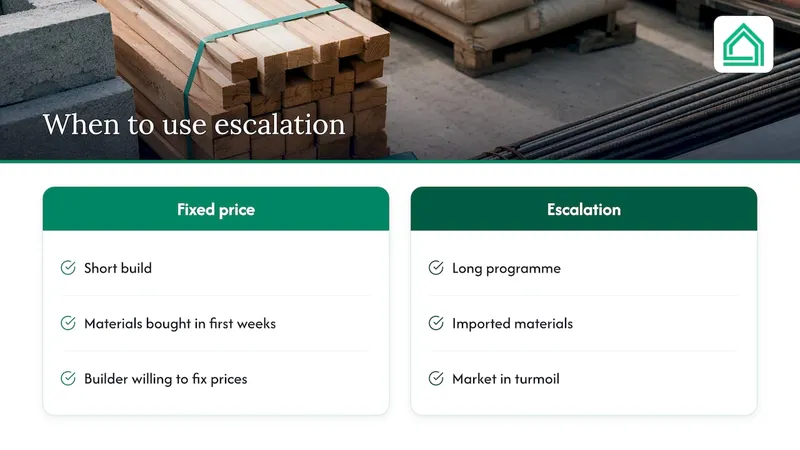
Sometimes a plain fixed price is the better deal. If the build is short, materials are bought in the first weeks, and the builder is willing to fix prices, an escalation clause adds paperwork for little benefit. The FHWA technical advisory is a US highway document, but its reasoning travels: when volatility makes firm quotes hard to get, bids get inflated, and sharing the risk can cut speculative contingencies. It also says fairness and effectiveness should be reviewed continually. Apply the same attitude to your own job: if the market calms, revisit the clause rather than treating it as sacred.
On the other hand, a long programme, imported materials or a market in turmoil are good reasons to talk about escalation openly. Whichever way you go, get it in writing and have a construction solicitor read it.
FAQ
What is a good contract clause for a price increase?
One that names the materials, states a baseline price and date, sets a trigger percentage and a cap, and requires written notice with invoices. It should say whether decreases come back to you and whether mark-ups apply. Have a solicitor check the final wording.
Does a seller have to accept an escalation clause?
No. It is a negotiated term, and a builder can insist on a fixed price or decline to take the job. If they price a fixed sum, ask whether it includes a contingency for price rises so you can compare it fairly with a quote that has a clause.
Can you give an example of an escalation clause?
The NAHB's sample residential clause says the owner pays increases in specified materials bought after signing, if the builder gives written notice naming the cost, material and supplier, backed by invoices. It is a US template, so adapt it to your law with a lawyer's help.
How do I calculate cost escalation?
Take the baseline price for each named material and compare it with the actual invoice price (or the movement in the agreed index). Apply the trigger and any cap in the clause. In the worked example above, a 14% rise on a £10,000 baseline is £1,400, and whether you pay all of it or only the part over the threshold depends on the drafting.
Sources
- Price escalation clauses in construction contracts, Walker Morris
- Dealing with supply cost volatility on major projects, Freshfields
- Managing Construction Price Inflation, JCT
- FCIA legal resource on material price increases (2021)
- Price Escalation Clauses in Construction, ConsensusDocs
- Protecting Yourself from Rising Material Costs, Hinckley Allen
- Using material price escalation clauses, New England Real Estate Journal
- Using Material Price Escalation Clauses to Offset Increasing Input Costs, Drewry Simmons Vornehm
- Escalation Clause for Specified Building Materials, NAHB
- Negotiating Material Escalation Clauses, Smith Currie
- Post-Contract Price Escalation in Construction, Bernstein Shur
- Development and Use of Price Adjustment Contract Provisions, FHWA