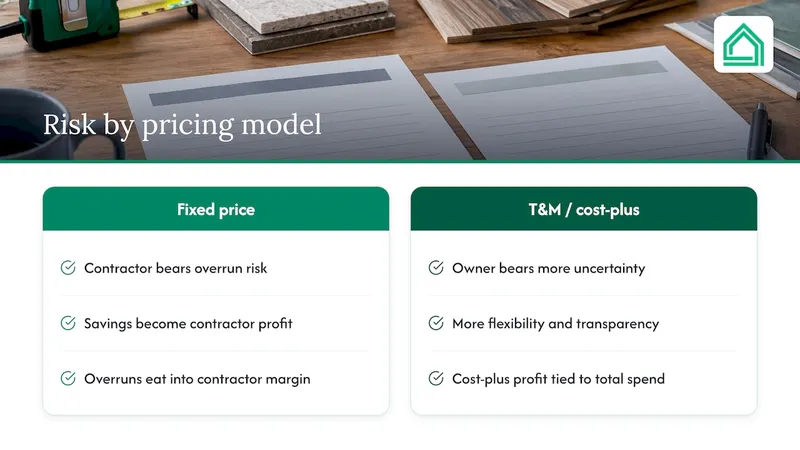
Choose a fixed price when your design and scope are settled, and time and materials (T&M) or cost-plus when the work is genuinely uncertain, such as an older house with unknowns behind the walls. The real question is who carries the risk of costs running over. With a fixed price the contractor carries most of it. With T&M or cost-plus you carry more, in return for flexibility and visibility of what is being spent.
This guide explains how each pricing model works on a home build or renovation, what each one does to your budget, and the contract checks that keep any of them under control.
TL;DR
- Fixed price sets one agreed sum for a defined scope. It gives the most certainty up front, but only if the scope is clear.
- Time and materials means you pay for hours worked and materials used, usually at agreed rates. It is flexible, but has no built-in price cap.
- Cost-plus reimburses actual costs plus a stated fee or percentage. It lets work start before the design is finished, but the contractor's profit rises with the spend.
- Whatever you choose, put the work, payment stages and every change in writing, and keep a contingency.
- A fixed price is only as firm as the scope behind it: variations, unforeseen conditions and provisional sums can still move it.
Table of Contents
- What each pricing model means
- How the risk is shared
- A fixed price is not always fixed
- Which model suits which project
- Hybrid options that work in practice
- What to check in the contract
- Keep a contingency, whichever you choose
- Our perspective
- Track whichever contract you choose
- FAQ
- Sources
What each pricing model means
Fixed price
A fixed-price contract sets an agreed price for a defined scope of work. The contractor generally takes responsibility for delivering that scope within the price, which is why it gives greater initial price certainty, according to Queensland's building regulator. The quote usually combines labour, materials and overheads into one total, with profit built in as a markup.
You may hear it called a lump sum or fixed bid. In everyday terms: you agree what is being built, the builder names a number, and you pay that number as the work reaches agreed stages.
Time and materials (T&M)
Under T&M you pay for the actual time spent and the actual materials bought. One finance-software publisher describes it as agreed labour rates multiplied by hours worked, plus materials and associated indirect costs, with the contractor typically marking up the rates or charges to make a profit. Its example puts such markups at 15% to 35%, but treat that as an illustration from business practice, not a rule. Your own quotes will tell you what is normal for your area and trade.
In a house, T&M often looks like a day rate for a carpenter or electrician, plus materials at cost or cost with a stated markup.
Cost-plus
Cost-plus reimburses the contractor's actual allowable costs, then adds a fee. The same source describes it as actual cost of labour and materials, plus overheads and administration, followed by a separately stated profit fee that may be a fixed amount or a percentage of total cost. A New Zealand quantity surveying firm notes that cost-plus can suit projects whose scope is not developed enough for a reliable fixed price.
How T&M and cost-plus differ
The two are close cousins, and people mix them up. The practical difference is where the contractor's profit sits.
| Fixed price | Time and materials | Cost-plus | |
|---|---|---|---|
| You pay | Agreed sum for defined scope | Hours at agreed rates plus materials | Actual costs plus a fee |
| Profit shown as | Built into the total | Marked up in rates and materials | Separate fee or percentage |
| Budget certainty | Highest, if scope is clear | Lower, no inherent cap | Lowest without a cap |
| Flexibility | Changes need a variation | High | Highest, can start before design is final |
| Visibility of spend | Low, you see the total | High, timesheets and receipts | High, full cost records |
| Main overrun risk sits with | Contractor | You | You |
How the risk is shared
A law firm's guide frames it as risk allocation: fixed price mainly puts cost-overrun risk on the contractor, while T&M and cost-plus place more uncertainty on the owner, in exchange for flexibility and transparency. Under a fixed price, the same guide explains, you pay the agreed sum whatever the actual cost. Savings become the contractor's profit and overruns eat into it.
That creates a tension worth understanding. A contractor on a tight fixed price has a reason to protect their margin, which can tempt cheaper materials or a stinting approach to anything not spelled out. Queensland's regulator makes the mirror-image point about the other model: cost-plus can reduce a contractor's incentive to keep costs down, because profit is tied to total spend. And a contractor quoted by Consumer Reports argues that where trust is high, cost-plus can save money and protect quality, since there is no reason to scrimp on materials.
Both views are fair. The model matters less than three things: how well defined the work is, how much you trust the contractor, and how closely you can follow the spend.
Plumbing shows how this plays out. What sits behind a wall or under a floor decides the final figure, and a guide to bathroom plumbing costs shows how far a price can move depending on drainage and access. That is exactly the kind of unknown that makes a fixed price either padded or fragile.
A fixed price is not always fixed
Many first-time builders hear "fixed" and stop reading. Do not. A fixed-price contract is not absolute: the price can still change through approved variations, unforeseen site conditions, and prime cost and provisional sum items.
Three places to look in your quote:
- Provisional sums: a placeholder for work that has not been priced yet. If the real cost is higher, you pay the difference.
- Prime cost items: an allowance for things you will choose later, such as tiles, taps or kitchen appliances. Pick above the allowance and the price rises. Our guide to six checks on prime cost items shows how to test them before signing.
- Variations: any change to the work. These are normal, and they are where budgets drift. Read what a construction change order is and why it matters before you agree to your first one.
The same New Zealand firm adds a blunt but useful point: a contract cannot give reliable cost certainty if the scope underneath it is unclear. A fixed price on a vague brief is a guess with a signature on it.
Which model suits which project
The architects' professional body says to use fixed price when scope, schedule and expectations are clearly defined, while cost-plus allows construction to begin before the full scope is set, at the price of less predictable costs. Here is how that translates to common home projects.
A new build with finished drawings
If you have full drawings, a specification and your finishes chosen, a fixed price makes sense. Contractors can price the same documents, and you can compare quotes like for like. Our renovation quotes comparison tips walk through how to line up quotes on a common basis.
A kitchen or bathroom refit
A well-defined refit with known dimensions and chosen fittings suits a fixed price, with prime cost allowances checked. If you are still deciding layout while work starts, you are heading for variations, and a fixed price will not feel fixed for long.
An older house with unknowns
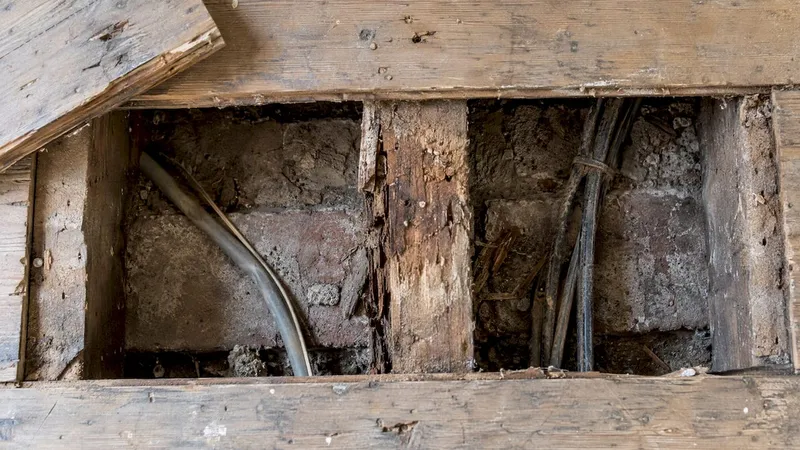
The law firm guide says cost-plus suits substantial unknowns, older-home renovations and evolving designs. Think hidden rot, old wiring, uneven structure. Pricing those blind forces a contractor to either add a large safety margin or hope for the best. If you are in this territory, it also helps to find contractors who specialise in old homes, and to read up on how hidden costs emerge in renovations. A structural question usually comes first, so see when to hire a structural engineer for a renovation.
Small, bounded jobs
The same guide says T&M suits smaller jobs where you can watch progress and approve purchases, but notes it carries no inherent price cap. Fixing a leak, replacing a few doors or a day of odd jobs are natural T&M work. Large, long projects are where uncapped T&M becomes uncomfortable.
A quick decision guide
- Is the design finished and specified? Yes: lean to fixed price. No: T&M or cost-plus, or finish the design first.
- Are there big unknowns behind surfaces? Yes: cost-plus or T&M for the uncertain phase, perhaps fixed price for the rest.
- Can you review invoices and receipts weekly? If not, avoid open-ended models.
- Do you know the contractor's track record? Verify it. Our contractor onboarding checklist covers checking three references.
Hybrid options that work in practice
You are not forced to pick one model for the whole job. Sensible mixes include:
- Fixed price for the defined work, T&M for the unknowns. Strip out and investigate first on T&M, then fix the price for the rebuild once you know what you have.
- T&M or cost-plus with a cap. An agreed ceiling, with the contractor needing your written approval to exceed it, gives you flexibility with a guardrail. Put the cap and the approval process in the contract.
- Staged contracts. Price phase one now, phase two once phase one reveals the facts.
The building regulator in Queensland recommends legal advice before agreeing to a cost-plus contract, and that applies to any structure you have not used before. Contract rules and consumer protections differ between countries and regions, so check what applies where your project is.
What to check in the contract
The California contractors' licensing board advises a written contract that sets out the work, the price and the payment schedule, with changes made in writing. That is a US example, but the principle travels well. Use this checklist with any pricing model:
- Scope of work in detail. Rooms, materials, finishes, standards. If it is not written, it is not priced.
- Payment stages linked to work done. Queensland's guidance recommends linking payments to clearly defined construction stages, with claims proportionate to the value of the work completed.
- Labour rates and markups (T&M, cost-plus). Day or hourly rates by trade, the markup on materials, and what counts as an allowable cost.
- Records and approvals. Timesheets, supplier receipts, and your written sign-off for purchases above a set amount.
- A cap or a review point. A figure at which work pauses and you both look at the numbers.
- A change process. Every variation priced and approved in writing before the work happens.
- Completion and defects. Agree how finishing is judged. In Tasmania, for instance, practical completion means the work is complete under the contract, plans and legal requirements, with agreed minor defects recorded in a document the contractor signs.
The Queensland regulator also names poorly documented variations and unclear progress payments as common causes of disputes, and recommends recording variations and tying payments to evidenced work. Most dispute prevention is simply paperwork done on the day, not three weeks later.
Before you sign anything unusual, ask a solicitor who knows construction contracts to read it, especially around warranty terms and what happens if something goes wrong. Choosing the right person in the first place also reduces change orders, as our contractor selection criteria explain.
Keep a contingency, whichever you choose
Even the firmest price needs a buffer for the things nobody can see. With T&M and cost-plus it matters more, because the overrun is yours from pound one. Our guide on how much construction contingency to set aside shows how to size it for your project, and when to hold it back for genuine surprises rather than upgrades.
Our perspective
We built House A-Z because the pricing model is rarely what sinks a first-time builder. The mess around it is: quotes in one email, receipts in a photo roll, variations agreed on a doorstep and a budget spreadsheet nobody has opened since March.
A fixed price feels safe, and a T&M invoice feels scary, but both are only as good as your view of the numbers. If you can see your budget, your quotes, your product choices and your changes in one place, a flexible contract becomes manageable and a fixed one stays honest.
That is why our AI agents work from your budget, preferences and timeline, in plain language, with real product pricing and room layouts behind them. They can suggest where to save, flag when a choice pushes you past an allowance, and help you and your contractor work from the same page. Our users have told us it helped them avoid errors worth thousands, in one case about €20K.
Pick the model that fits how finished your plans are, then give yourself the visibility to run it with confidence.
Azai
Track whichever contract you choose
A T&M or cost-plus job needs a running record: rates, receipts, approvals and a live total against budget. A fixed-price job needs the same for variations and prime cost choices. House A-Z brings budget tracking, product tracking, room mapping and contractor collaboration into one place, so you can see where you stand before approving the next change.
There is a free plan to start with, Pro at €29 per month, and Enterprise from €99 per month for professionals. See the options on the House A-Z pricing page.
FAQ
Is time and materials cheaper than fixed price?
Not automatically. A fixed price often includes a margin for the contractor's risk, while T&M can come in lower if the job goes smoothly, or higher if it does not. Because T&M has no inherent price cap, the final bill depends on how well the work is managed and monitored.
What is the difference between cost-plus and time and materials?
Cost-plus reimburses actual costs, including labour, materials and overheads, and adds a separately stated fee or percentage. T&M typically charges agreed labour rates for hours worked plus materials, with the profit marked up within those rates. In both cases you carry more of the cost risk than with a fixed price.
Can a fixed-price contract still go over budget?
Yes. Approved variations, unforeseen site conditions, and provisional sum or prime cost items can all raise the final amount. Check what each allowance covers, and get every change priced in writing before the work starts.
Which is best for a first-time renovator?
If your design and specification are complete, a fixed price with clearly checked allowances is usually the easier model to live with. If you are renovating an older home with unknowns, consider cost-plus or T&M with a cap and written approvals for the uncertain stage. Either way, keep a contingency and a clear record of every change.
Sources
- Domestic building contracts guide, Queensland Building and Construction Commission
- Types of construction contracts in New Zealand, QSA
- How to prepare a quote, Business.govt.nz
- Time and materials contract vs cost-plus contract, NetSuite
- Guide for understanding construction contracts, Hollington Law Firm
- Know what type of remodeling contract you are signing, Consumer Reports
- Residential construction contracts: types and best practices, AIA Contract Documents
- Home improvement contracts consumer guide, California CSLB
- Residential building consumer guide, Tasmania
- Basement bathroom plumbing cost
- Contractors that specialise in old homes