Owner builder project management means taking on the job a main contractor normally does: planning the scope, pricing the work, booking the trades, tracking every pound and signing off each stage. You do not need to lay a single brick. You do need one system that holds the budget, the programme, the decisions and the paperwork together, and that is exactly what we built House A-Z to be.
TL;DR
- An owner builder is the project's manager, not its labourer: you coordinate licensed trades and carry the financial and legal responsibility for the build.
- Plan before you spend: a written scope, a line-item budget and a contingency of 10% to 15% are the foundation most guides agree on.
- Fix your selections and decisions on a calendar, because late choices are a leading owner-driven cause of delay.
- Log every change in writing with its cost and time effect before the work happens.
- Keep budget, schedule, permits, products and contractor messages in one place rather than across spreadsheets and chat threads.
Table of Contents
- What an owner builder actually manages
- Step 1: Define the scope before you price anything
- Step 2: Build a line-item budget with a contingency
- Step 3: Build a programme and a decision calendar
- Step 4: Choose and coordinate contractors
- Step 5: Handle permits, inspections and safety
- Step 6: Track costs and control changes
- Step 7: Manage delays, quality and rework
- When a project manager or software makes sense
- Run your build in one place with House A-Z
- Our perspective
- FAQ
- Sources
What an owner builder actually manages
The phrase sounds like hard physical graft, but the Owner Builder Institute describes it as taking responsibility for the build, rather than building the house with your own hands. Many owner builders act mainly as the manager, coordinating the excavation, concrete, framing, roofing, electrical and plumbing stages. The same source lists the duties that come with the role: planning, permits, engaging contractors, scheduling, ordering materials, monitoring costs, supervising the site, arranging inspections and keeping records.
Managing a trade does not mean you are qualified to perform it. Government guidance in New South Wales, for example, makes clear that an owner-builder permit is not a building licence and does not cover specialist work such as electrical, plumbing or gasfitting unless you hold the separate licence. The rules differ by country and region, so treat the Australian examples in this guide as illustrations of the role, and check your own local authority for the rules that apply where you build.
The weight of the role is real. Owner Builder Club notes that the owner builder carries the financial and legal risk of the project even when qualified trades are hired. That is the reason a clear management routine matters more than enthusiasm.
Step 1: Define the scope before you price anything
Every overspend story starts with a vague brief. Write a short scope document that says what is being built, what is included for each trade, who supplies the materials, and who handles waste, equipment and temporary power. The Texas Owner-Builder Roadmap structures planning in just this way, with a budget reality check, a scope phase and a pre-construction phase that covers long-lead items, site access, staging and deliveries.
A homeowner's planning guide from Fire Engineering adds a useful habit: record the owner's requirements, budget and schedule expectations in one document, and submit permits before you buy materials. That order protects you from ordering products for a design that is later changed.
Where it goes wrong: the scope lives in your head and in three different email threads. When a trade asks "was that included?", nobody can prove it either way.
Step 2: Build a line-item budget with a contingency
A realistic budget starts from what you can afford to borrow or spend, then works down into costs. The Queensland regulator's Homeowner's Guide to Building and Renovating suggests basing the figure on borrowing capacity, then using a per-square-metre rate for new builds or contractor price ranges for alterations and extensions.
Break the number into line items and separate hard costs (materials and labour) from soft costs (design fees, permits, surveys). Then add a contingency. The Fire Engineering guide treats 10% as a practical starting point and 15% as sensible for complex sites or custom designs. Independent research points the same way: a 2025 study of 36 construction projects found change orders added an average of 13.32% to budgets, and recommended a contingency of 10% to 15% of the initial contract value.
Two more habits separate calm projects from stressful ones:
- Do a cash-flow projection. The Owner Builder Centre warns that many projects run out of money because the owner builder underestimates the funds needed at each point. When you pay matters as much as how much you pay. Our guide to setting up a construction draw schedule walks through the staged-payment side.
- Set a "do not go over" number. The Texas roadmap suggests an all-in figure plus a firm ceiling. Decide it before the first quote arrives, not after.
For the day-to-day tracking routine, see our four-step renovation budget workflow.
Step 3: Build a programme and a decision calendar
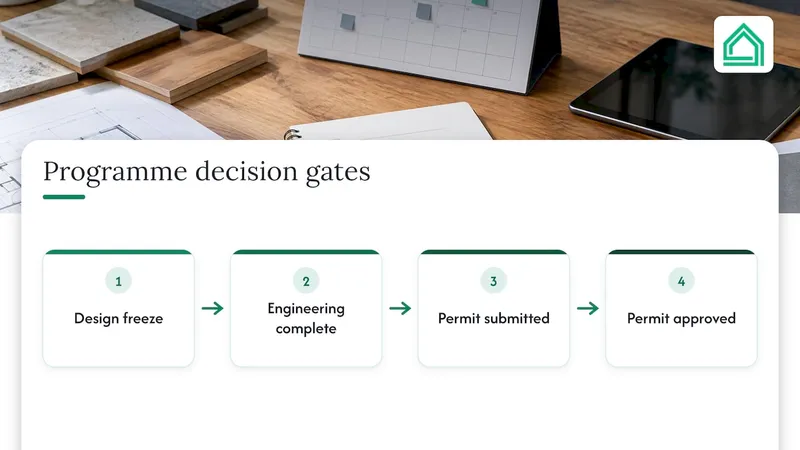
Timelines fail on decisions more often than on weather. GoBuildYourHouse reports that preconstruction typically takes 8 to 16 weeks in most markets and suggests four gates: design freeze, engineering complete, permit submitted and permit approved. It recommends a 10% to 15% time contingency on the whole schedule, with fixed buffers around weather-sensitive work and inspections.
The same guide calls missed selection dates the number-one owner-driven schedule killer. Its example is clear: if windows need six weeks' lead time, they must be chosen at least seven weeks before the framing inspections finish. Work backwards from each trade's start date to the last day you can decide on tiles, windows, kitchens and fixtures.
If you are renovating a single room, the same logic applies at smaller scale. Our bathroom remodel timeline shows how to copy a schedule and buffer for delays, and the materials selections schedule gives a simple rhythm for locking choices ahead of the trades.
A worked example: you plan a rear extension with a 20-week build. A 10% time contingency adds two weeks, so you plan for 22. If the kitchen has a six-week lead time and the fitters arrive in week 14, the order must be placed by week 7 at the very latest, and your calendar should say week 6.
Step 4: Choose and coordinate contractors
The cheapest quote is rarely the cheapest job. Owner Inspections advises asking every contractor for a written quote covering labour, materials, estimated completion time, payment terms and exclusions. It also recommends checking that all quotes price the same scope, because the lowest often leaves out rubbish removal, site clean-up or making good. Verify licence and insurance before anyone starts on site.
The i-build owner builder course guide suggests sending plans and requirements to contractors and suppliers for three quotes per item, and confirming each contractor's start date against the construction schedule. It also describes estimating as the most important element of financial success: prepare a take-off (a list of all materials, labour and associated costs), gather prices, then total them.
Once trades are on site, keep a weekly rhythm. Compare progress with the programme and each invoice with the original quote, because an undocumented variation is where disputes begin. Our contractor onboarding checklist covers what to verify, including three references, before you hand over a key.
Where it goes wrong: instructions given verbally on site. A plasterer is told to "just move the socket" and the electrician finds out a week later.
Step 5: Handle permits, inspections and safety
Permits are the part first-time builders most often leave too late. The rules differ by country, but the pattern is the same: someone must make sure the approvals are in place, inspections are booked at the right stage, and the finished work is certified. In Victoria, Australia, the Victorian Building Authority lists the owner-builder's duties as obtaining the permit, supervising the work, meeting regulations, arranging certification, ensuring site and worker safety and rectifying defective work.
Be clear about which steps belong to an authority. Building control or a certifier inspects and signs off, and you coordinate the timing. Booking inspections against your programme, not after the fact, avoids waiting weeks for a slot. If you are in the UK, our renovation permit checklist for UK homeowners is the best place to start, and the permit inspection checklist helps you avoid reinspection fees. For the legal groundwork, read owner builder permit requirements and, if the property is old, historic home renovation permits.
Specialist trades bring their own approvals. If your project involves new pipework or a boiler, a short read on plumbing permits explained for homeowners will tell you what to expect before the plumber arrives.
Safety is not optional. In the UK, a self-builder counts as a domestic client under the Construction (Design and Management) Regulations 2015, so confirm your duties with the Health and Safety Executive or your local building control team before work begins.
Step 6: Track costs and control changes
The total estimated cost becomes your budget once the project begins. The i-build guide notes that keeping figures current, whether in software or an exercise book, shows potential overspend early enough to act. A good working budget tracks the original figure, approved changes, commitments, actual costs, pending exposure and a projected final cost.
Changes are the main threat. In a study of 1,122 change orders on 22 Qatari projects, change orders accounted on average for 42.9% of cost overruns in civil projects, with owner changes to plans causing the largest single increase. A 2017 Philippine study recommends written approval from both parties, with the scope clear, before any changed work begins.
A simple change log is enough. Ridge Rock Builders suggests recording each request, the reason, the cost effect, related work, approval and status, then reviewing the cumulative effect, because several individually reasonable choices can move the whole budget when viewed together.
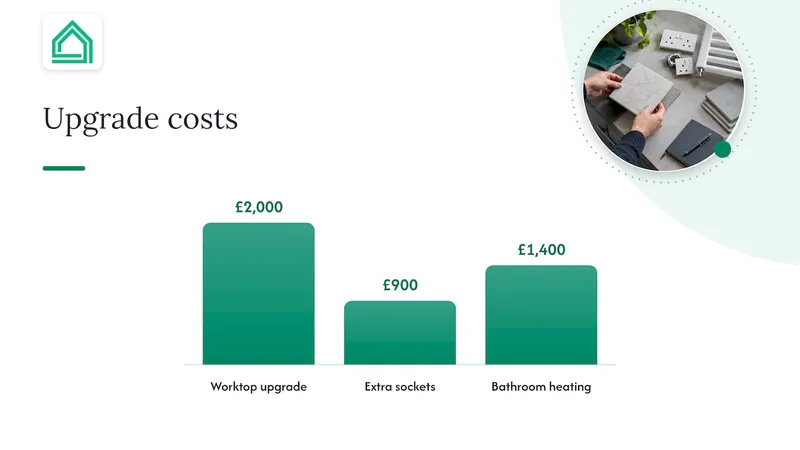
Worked example: a £2,000 upgrade to the worktop, £900 for extra sockets and £1,400 for underfloor heating in the bathroom each look sensible on their own. Together they use £4,300 of a contingency that, on a £100,000 budget at 10%, was £10,000. The log shows that at a glance, before the next "small" decision.
Step 7: Manage delays, quality and rework
Things will go wrong, so plan for it. Fire Engineering recommends a risk register listing each risk's probability, cost impact and mitigation, reviewed monthly, plus a log of permit submissions and responses, and regular quality and safety inspections. Rework is expensive: an analysis of 359 projects in the Construction Industry Institute database found direct rework averages 5% of total construction cost.
Photograph each stage before it is covered up, keep inspection results with the project record, and agree a snag list at completion. Build the habit early, and the end of the project feels like a handover, not an argument.
When a project manager or software makes sense
Some owners hire a professional to run the programme and trades, others do it themselves with a good system. Either way, the work is the same: someone has to hold the plan, the money, the decisions and the records. If your day job leaves little room for site visits, or the project involves several trades at once, a structured digital workspace takes the most repetitive coordination off your plate.
Our perspective
Most owner builders do not fail because they cannot manage people. They fail because the information is scattered: a budget in one spreadsheet, quotes in an inbox, product choices in screenshots, and a partner who never saw the latest change.
We designed House A-Z for people who are doing this for the first time. It keeps the budget, the room layouts, the real product pricing and the project plan together, speaks in plain language and offers budget-saving proposals you can act on. One customer told us it helped them avoid €20K of potential errors, and that is the kind of clarity we want every first-time builder to have.
When couples and contractors work from the same live picture, decisions get made earlier and arguments get shorter. That is project management at its best: calm, visible and shared.
Azai
FAQ
Do owner builders have to do the building work themselves?
No. Many owner builders act as the manager and hire licensed trades for the work. Managing a trade does not give you the right to perform specialist work such as electrical or plumbing, which needs its own licence.
How much contingency should I add to an owner build budget?
Guides commonly start at 10% and move to 15% for complex sites or custom designs. Research on change orders supports a range of 10% to 15% of the initial value. Add a similar time buffer to the programme.
What is the biggest cause of delay for owner builders?
Late decisions are a leading one. GoBuildYourHouse calls missed selection dates the number-one owner-driven schedule killer. Set a decision calendar that works back from each trade's start date and lead times.
What should I record in writing during the build?
Keep written quotes, change requests with their cost and time effect, inspection results, permit correspondence and weekly progress notes. An undocumented variation is the commonest source of disputes with trades.
Sources
- What Building Work Can an Owner Builder Actually Do?
- Working as an owner-builder, NSW Government
- What is an Owner Builder, Owner Builder Club
- Texas Owner-Builder Roadmap
- New Construction Planning Steps: A Homeowner's Guide
- Homeowner's Guide to Building and Renovating, QBCC
- Change order ratio analysis in construction projects
- Owner Builder Centre builder's guide
- How to Create a Realistic Timeline for Your Home Build
- Owner Builder Coordination Guide
- Owner Builder course study guide
- Being an owner-builder, Victorian Building Authority
- Analysis of change orders in Qatari construction projects
- Comparative Study on Change Orders in Building Projects
- How to Keep a Custom Home Build on Budget
- Impact of Rework in Construction
- Understanding plumbing permits: a homeowner's guide